

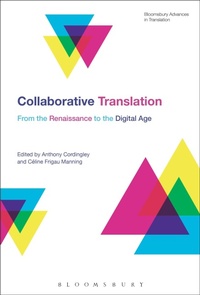
Collaborative Translation
From the Renaissance to the Digital Age
Published on 15. December 2016
Book
Hardback
272 pages
978-1-350-00602-7 (ISBN)
Description
For centuries, the art of translation has been misconstrued as a solitary affair. Yet, from Antiquity to the Middle Ages, groups of translators comprised of specialists of different languages formed in order to transport texts from one language and culture to another. Collaborative Translation uncovers the collaborative practices occluded in Renaissance theorizing of translation to which our individualist notions of translation are indebted. Leading translation scholars as well as professional translators have been invited here to detail their experiences of collaborative translation, as well as the fruits of their research into this neglected form of translation.
This volume offers in-depth analysis of rich, sometimes explosive, relationships between authors and their translators. Their negotiations of cooperation and control, assistance and interference, are shown here to shape the translation of prominent modern authors such as Guenter Grass, Vladimir Nabokov and Haruki Murakami.
The advent of printing, the cultural institutions and the legal and political environment that regulate the production of translated texts have each formalized many of the inherently social and communicative practices of translation. Yet this publishing regime has been profoundly disrupted by the technologies that are currently revolutionizing collaborative translation techniques. This volume details the impact that this technological and environmental evolution is having upon the translator, proliferating sites and communities of collaboration, transforming traditional relationships with authors and editors, revisers, stage directors, actors and readers.
This volume offers in-depth analysis of rich, sometimes explosive, relationships between authors and their translators. Their negotiations of cooperation and control, assistance and interference, are shown here to shape the translation of prominent modern authors such as Guenter Grass, Vladimir Nabokov and Haruki Murakami.
The advent of printing, the cultural institutions and the legal and political environment that regulate the production of translated texts have each formalized many of the inherently social and communicative practices of translation. Yet this publishing regime has been profoundly disrupted by the technologies that are currently revolutionizing collaborative translation techniques. This volume details the impact that this technological and environmental evolution is having upon the translator, proliferating sites and communities of collaboration, transforming traditional relationships with authors and editors, revisers, stage directors, actors and readers.
Reviews / Votes
Presents insightful case studies elaborating on various forms of collaborative translation, and includes detailed lists of references directing further reading. The scope of this book, ranging from the Renaissance to the digital age, provides the reader with an efficient exploration of the topic ... This book invites readers to think about the potential perspectives with which one can approach detailed case studies, and raises important questions. * Oxford Comparative Criticism & Translation * A ground-breaking collection by both rising and confirmed stars in the field. Questioning "the trope of the solitary translator" from a wide range of perspectives, several of these essays are destined to become classic references. Required reading for anyone wanting to know how cooperation and confrontation have shaped translations from the European Renaissance to our digital age. -- Rainier Grutman, Professor of French and Translation Studies, University of Ottawa, Canada Translators are constantly in conversation - with their authors, with each other, with other stakeholders. This scintillating collection engages in detail with some of the many facets of collaborative translation, from the ways authors debate with their translators to the dynamics of translator collectives, from crowd-sourcing and institutional agendas to an ecological vision of shared translation in the future. A very timely book. -- Theo Hermans, Director of the Centre for Translation Studies (CenTraS), University College London, UK. This thought-provoking volume makes the work of translators 'visible' in a somewhat unexpected way by decentering it and highlighting its intrinsically social and interactive dimensions. The book maps different degrees and modes of collaboration across a range of languages, periods, genres and technologies, drawing on various complementary theoretical approaches to enrich the discussion. It makes for fascinating reading for scholars and students of translation but - by the very nature of the project - also reaches out to anyone interested in the issue of authorship in the widest possible sense of the term. -- Dirk Delabastita, Professor of English literature and literary theory, University of Namur, BelgiumMore details
Series
Language
English
Place of publication
London
United Kingdom
Publishing group
Bloomsbury Publishing PLC
Target group
College/higher education
Dimensions
Height: 240 mm
Width: 161 mm
Thickness: 19 mm
Weight
575 gr
ISBN-13
978-1-350-00602-7 (9781350006027)
Copyright in bibliographic data and cover images is held by Nielsen Book Services Limited or by the publishers or by their respective licensors: all rights reserved.
Schweitzer Classification
Other editions
Additional editions
Anthony Cordingley | Celine Frigau Manning
Collaborative Translation
From the Renaissance to the Digital Age
E-Book
12/2016
1st Edition
Bloomsbury Academic
€39.99
Available for download
Persons
Anthony Cordingley is Associate Professor at the Universite Paris 8, France, on secondment to the University of Sydney, Australia as ARC Discovery Early Career Research Fellow.
Celine Frigau Manning is Associate Professor at the Universite Paris 8, member of the Institut Universitaire de France.
Celine Frigau Manning is Associate Professor at the Universite Paris 8, member of the Institut Universitaire de France.
Content
Notes on Contributors
1. What is collaborative translation?, Anthony Cordingley and Celine Frigau Manning
Part I: Reconceptualizing the translator : Renaissance and Enlightenment perspectives
2. On the incorrect way to translate: The absence of collaborative translation from Leonardo Bruni's De interpretatione recta, Belen Bistue
3. Towards a practice-theory of translation: on our translations of Savonarole, Machiavel, Guichardin and their effects, Jean-Louis Fournel and Jean-Claude Zancarini
4. "Shared" Translation: the Example of Forty Comedies by Goldoni in France (1993-1994), Francoise Decroisette
Part II: Collaborating with the author
5. Author-translator collaborations: a typological survey, Patrick Hersant
6. Vladimir Nabokov and his translators: collaboration or translating under duress, Olga Anokhina
7. Guenter Grass and his translators: from a collaborative dynamic to a controlling apparatus?, Celine Letawe
8. Contemporary poetry and transatlantic poetics at the Royaumont Translation Seminars (1983-2000): an experimental language laboratory, Abigail Lang
Part III: Environments of collaboration
9. Online multilingual collaboration: Haruki Murakami's European translators, Ika Kaminka and Anna Zielinska-Elliott
10. Translation crowdsourcing: research trends and perspectives, Miguel A. Jimenez-Crespo
11. The role of institutional collaborations in contexts of official bilingualism: The Canadian example, Gillian Lane-Mercier
12. A new ecology for translation? Collaboration and resilience, Michael Cronin
Index
1. What is collaborative translation?, Anthony Cordingley and Celine Frigau Manning
Part I: Reconceptualizing the translator : Renaissance and Enlightenment perspectives
2. On the incorrect way to translate: The absence of collaborative translation from Leonardo Bruni's De interpretatione recta, Belen Bistue
3. Towards a practice-theory of translation: on our translations of Savonarole, Machiavel, Guichardin and their effects, Jean-Louis Fournel and Jean-Claude Zancarini
4. "Shared" Translation: the Example of Forty Comedies by Goldoni in France (1993-1994), Francoise Decroisette
Part II: Collaborating with the author
5. Author-translator collaborations: a typological survey, Patrick Hersant
6. Vladimir Nabokov and his translators: collaboration or translating under duress, Olga Anokhina
7. Guenter Grass and his translators: from a collaborative dynamic to a controlling apparatus?, Celine Letawe
8. Contemporary poetry and transatlantic poetics at the Royaumont Translation Seminars (1983-2000): an experimental language laboratory, Abigail Lang
Part III: Environments of collaboration
9. Online multilingual collaboration: Haruki Murakami's European translators, Ika Kaminka and Anna Zielinska-Elliott
10. Translation crowdsourcing: research trends and perspectives, Miguel A. Jimenez-Crespo
11. The role of institutional collaborations in contexts of official bilingualism: The Canadian example, Gillian Lane-Mercier
12. A new ecology for translation? Collaboration and resilience, Michael Cronin
Index