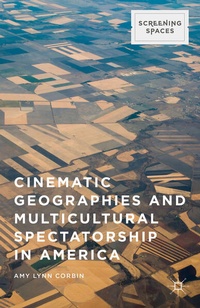
Exploration, intertwined with home-seeking, has always defined America. Corbin argues that films about significant cultural landscapes in America evoke a sense of travel for their viewers. These virtual travel experiences from the mid-1970s through the 1990s built a societal map of "popular multiculturalism" through a movie-going experience.
Reviews / Votes
"Taking revisionist Westerns of the seventies as its starting point and traveling through cinematic spaces as varied as the American South, cities, and suburbs, Cinematic Geographies and Multicultural Spectatorship in America explores the cinema's role in the creation of cultural landscapes. Its analysis of filmic space focuses not only on the role of travel and exploration within narratives, but it also maps the cinema's creation of spectatorial points of view based on the construction of certain settings in different genres. It is utterly original in its approach to understanding the functions and meanings of space in late twentieth-century film." - Paula Massood, Professor, Film Studies, Brooklyn College, City University of New York, USA
Series
Edition
Language
Place of publication
Target group
Professional and scholarly
Product notice
sewn/stitched
Cloth over boards
With dust jacket
Illustrations
Dimensions
Height: 216 mm
Width: 140 mm
Thickness: 19 mm
Weight
ISBN-13
978-1-137-48266-2 (9781137482662)
DOI
10.1007/978-1-137-47971-6
Schweitzer Classification
Amy Lynn Corbin is Assistant Professor of Media and Communication and Acting Director of Film Studies at Muhlenberg College, USA.
Introduction 1. The Story of a Land: The Spatial Politics of Early Multiculturalism in Indian Country 2. Primitive Cousins: Roots and Authenticity in the White South 3. The Urban Frontier: From Inner City Tourist to Resident 4. "Home" Turns Otherworldly in the Suburbs 5. Ghosts of Indian Country: Filling in the Map