

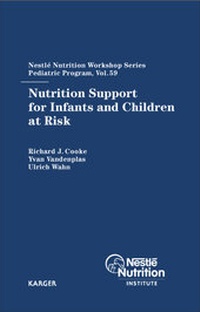
Nutrition Support for Infants and Children at Risk
59th Nestlé Nutrition Workshop, Pediatric Program, Berlin, April 2006
Published on 31. January 2007
Book
Hardback
236 pages
978-3-8055-8194-3 (ISBN)
Description
Adequate nutrition is especially important during infancy and childhood, where even short periods of malnutrition have long-lasting effects on growth, development and health in adult life. There are several high-risk scenarios for the development of malnutrition, which are the focus of the current publication: Atopic diseases, gastrointestinal disorders, and preterm delivery.
For the pediatric allergist it is important to understand the mechanisms regulating IgE responses to food proteins since they may also be the earliest markers for the atopic march. As breastfeeding seems to have only limited effects regarding the atopic march, other measures to modulate infantile immune responses have to be taken, including the use of hypoallergenic formulae or the addition of probiotics or prebiotics to infant formulae.
The second part of this book highlights the functional properties of nutrition with regard to diseases of the gastrointestinal tract and the ensuing chronic alterations of gastrointestinal function. Topics addressed include the molecular basis of some diseases, main causes of and nutritional measures in chronic enteropathy, including the role of parenteral and enteral nutrition, stressed mucosa and the role of nutrition in cholestatic liver disease.
Nowadays, smaller and more immature infants are surviving - but the smaller the infant, the greater the accrued deficit as nutritional needs change with advancing maturity, and one formulation may not meet all requirements. Furthermore, there are no sensitive, accurate and precise measures of nutritional outcome. The net effect of these uncertainties is that all very-low-birth-weight infants are growth retarded at hospital discharge. Strategies for improving growth in these high-risk infants are at the center of the last part of this publication.
More details
Content
Preface; Foreword; Contributors; Allergy; The Development of Atopic Phenotypes: Genetic and Environmental Determinants: Wahn, U.; von Mutius, E.; Lau, S.; Nickel, R.; Food Allergy to Proteins: Nowak-Wegrzyn, A.; Hypoallergenicity: A Principle for the Treatment of Food Allergy: Beyer, K.; The Concept of Hypoallergenicity for Atopy Prevention: von Berg, A.; The Concept of Oral Tolerance Induction to Foods: Lack, G.; Gastrointestinal Disorders; Chronic Enteropathy: Molecular Basis: Ruemmele, F.M.; Chronic Enteropathy: Clinical Aspects: Gibbons, T.; Fuchs, G.J.; Transition from Parenteral to Enteral Nutrition: Milla, P.J.; Chronic Enteropathy and Feeding: Salvatore, S.; Hauser, B.; Vandenplas, Y.; Stressed Mucosa: Davidson, G.; Kritas, S.; Butler, R.; Nutrition for Children with Cholestatic Liver Disease: Los, E.L.; Lukovac, S.; Werner, A.; Dijkstra, T.; Verkade, H.J.; Rings, E.H.H.M.; Nutrition for Preterm Infants; Nutrient Requirements of Premature Infants: Ziegler, E.E.; Nutritional Assessment in Preterm Infants: Griffin, I.J.; Early Aggressive Nutrition in Very Preterm Infants: Thureen, P.J.; Discussion on 'Human Milk Fortification': Putet, G.; Postdischarge Nutrition of Preterm Infants: More Questions than Answers: Cooke, R.J.; Concluding Remarks.