

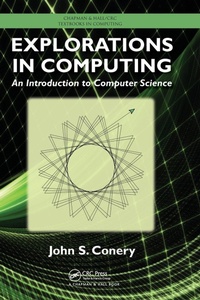
Explorations in Computing
An Introduction to Computer Science
1st Edition
Published on 29. October 2010
Book
Hardback
390 pages
978-1-4398-1262-4 (ISBN)
Description
Based on the author's introductory course at the University of Oregon, Explorations in Computing: An Introduction to Computer Science focuses on the fundamental idea of computation and offers insight into how computation is used to solve a variety of interesting and important real-world problems. Taking an active learning approach, the text encourages students to explore computing ideas by running programs and testing them on different inputs. It also features illustrations by Phil Foglio, winner of the 2009 and 2010 Hugo Award for Best Graphic Novel.
Classroom-Tested Material
The first four chapters introduce key concepts, such as algorithms and scalability, and hone practical lab skills for creating and using objects. In the remaining chapters, the author covers "divide and conquer" as a problem solving strategy, the role of data structures, issues related to encoding data, computer architecture, random numbers, challenges for natural language processing, computer simulation, and genetic algorithms. Through a series of interactive projects in each chapter, students can experiment with one or more algorithms that illustrate the main topic. Requiring no prior experience with programming, these projects show students how algorithms provide computational solutions to real-world problems.
Web ResourceThe book's website at www.cs.uoregon.edu/eic presents numerous ancillaries. The lab manual offers step-by-step instructions for installing Ruby and the RubyLabs gem with Windows XP, Mac OS X, and Linux. The manual includes tips for editing programs and running commands in a terminal emulator. The site also provides online documentation of all the modules in the RubyLabs gem. Once the gem is installed, the documentation can be read locally by a web browser.
After working through the in-depth examples in this textbook, students will gain a better overall understanding of what computer science is about and how computer scientists think about problems.
Classroom-Tested Material
The first four chapters introduce key concepts, such as algorithms and scalability, and hone practical lab skills for creating and using objects. In the remaining chapters, the author covers "divide and conquer" as a problem solving strategy, the role of data structures, issues related to encoding data, computer architecture, random numbers, challenges for natural language processing, computer simulation, and genetic algorithms. Through a series of interactive projects in each chapter, students can experiment with one or more algorithms that illustrate the main topic. Requiring no prior experience with programming, these projects show students how algorithms provide computational solutions to real-world problems.
Web ResourceThe book's website at www.cs.uoregon.edu/eic presents numerous ancillaries. The lab manual offers step-by-step instructions for installing Ruby and the RubyLabs gem with Windows XP, Mac OS X, and Linux. The manual includes tips for editing programs and running commands in a terminal emulator. The site also provides online documentation of all the modules in the RubyLabs gem. Once the gem is installed, the documentation can be read locally by a web browser.
After working through the in-depth examples in this textbook, students will gain a better overall understanding of what computer science is about and how computer scientists think about problems.
Reviews / Votes
This entry-level computer science textbook is intended for use in an introductory course for computer science majors or non-majors desiring an overview of the basic concepts and processes of computer programming. ... Each chapter contains illustrations and code examples as well as a tutorial project that walks the student step-by-step through a task-related programming activity. Access to online resources, including a lab manual and links to the latest version of the open source Ruby software, is provided.-SciTech Book News, February 2011
More details
Series
Language
English
Place of publication
Bosa Roca
United States
Publishing group
Taylor & Francis Inc
Target group
College/higher education
Undergraduate students in an introductory computer science course or elective (CS0); undergraduate students in an introductory computer science course on programming or objects (CS1).
Illustrations
115 s/w Abbildungen, 11 s/w Tabellen
11 Tables, black and white; 115 Illustrations, black and white
Dimensions
Height: 260 mm
Width: 183 mm
Thickness: 26 mm
Weight
930 gr
ISBN-13
978-1-4398-1262-4 (9781439812624)
Copyright in bibliographic data and cover images is held by Nielsen Book Services Limited or by the publishers or by their respective licensors: all rights reserved.
Schweitzer Classification
Other editions
Additional editions
E-Book
10/2010
1st Edition
CRC Press
€125.99
Available for download
Person
John S. Conery is a professor in the Department of Computer and Information Science at the University of Oregon. With over 30 years of teaching experience, he has taught courses on high performance computing and scientific computing in addition to introductory computer science courses. A member of the University's Center for Ecology and Evolutionary Biology, Dr. Conery has worked with biologists on a variety of problems related to gene and genome duplication, artificial neural networks, and population modeling. His current research interests are computational biology and bioinformatics.
Content
Introduction. The Ruby Workbench. The Sieve of Eratosthenes. A Journey of a Thousand Miles. Divide and Conquer. When Words Collide. Bit by Bit. The War of the Words. Now for Something Completely Different. Ask Dr. Ruby. The Music of the Spheres. The Traveling Salesman. Appendices.