

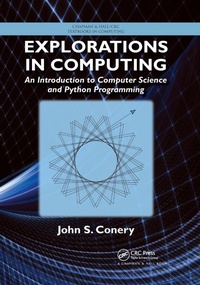
Explorations in Computing
An Introduction to Computer Science and Python Programming
1st Edition
Published on 30. September 2020
Book
Paperback/Softback
440 pages
978-0-367-65903-5 (ISBN)
Description
An Active Learning Approach to Teaching the Main Ideas in Computing Explorations in Computing: An Introduction to Computer Science and Python Programming teaches computer science students how to use programming skills to explore fundamental concepts and computational approaches to solving problems. Tbook gives beginning students an introduction to computer science concepts and computer programming. Designed for CS0 and CS1 courses, it is very well suited for alternative lecture styles, including flipped classrooms.
Prepares Students for Advanced Work in Computer ScienceA revised and updated version of the author's Explorations in Computing: An Introduction to Computer Science, this text incorporates two major differences. It now uses Python, instead of Ruby, as the lab software so that students can seamlessly transition from introductory projects to more advanced studies in later courses. The book also introduces Python programming, providing students with sufficient programming skills so they can implement their own programs.
Practical, Step-by-Step ProjectsThe interactive lab projects in each chapter allow students to examine important ideas in computer science, particularly how algorithms offer computational solutions to problems. Students can type expressions, view results, and run experiments that help them understand the concepts in a hands-on way.
Web ResourcesThe Python software modules for each lab project are available on the author's website. The modules include data files and sample Python code that students can copy and modify. In addition, the site provides a lab manual of installation instructions and tips for editing programs and running commands in a terminal emulator.
Prepares Students for Advanced Work in Computer ScienceA revised and updated version of the author's Explorations in Computing: An Introduction to Computer Science, this text incorporates two major differences. It now uses Python, instead of Ruby, as the lab software so that students can seamlessly transition from introductory projects to more advanced studies in later courses. The book also introduces Python programming, providing students with sufficient programming skills so they can implement their own programs.
Practical, Step-by-Step ProjectsThe interactive lab projects in each chapter allow students to examine important ideas in computer science, particularly how algorithms offer computational solutions to problems. Students can type expressions, view results, and run experiments that help them understand the concepts in a hands-on way.
Web ResourcesThe Python software modules for each lab project are available on the author's website. The modules include data files and sample Python code that students can copy and modify. In addition, the site provides a lab manual of installation instructions and tips for editing programs and running commands in a terminal emulator.
More details
Series
Language
English
Place of publication
Oxford
United Kingdom
Publishing group
Taylor & Francis Ltd
Target group
College/higher education
Dimensions
Height: 254 mm
Width: 178 mm
Thickness: 24 mm
Weight
822 gr
ISBN-13
978-0-367-65903-5 (9780367659035)
Copyright in bibliographic data and cover images is held by Nielsen Book Services Limited or by the publishers or by their respective licensors: all rights reserved.
Schweitzer Classification
Other editions
Additional editions
E-Book
09/2014
1st Edition
Chapman & Hall/CRC
€69.99
Available for download
Book
09/2014
1st Edition
CRC Press
€122.50
Shipment within 15-20 days
E-Book
09/2014
1st Edition
Chapman and Hall
€69.99
Available for download
Person
John S. Conery is a professor in the Department of Biology and the Institute of Ecology and Evolution at the University of Oregon, where he teaches computer science courses and is developing introductory programming courses for biology majors. As a professor of computer and information science, he taught introductory computer science courses as well as courses on high performance computing and computational science. His research in bioinformatics and computational biology spans a number of areas related to gene and genome duplication, artificial neural networks, population modeling, and systems biology. He received a Ph.D. in computer science.
Content
Introduction. The Python Workbench. The Sieve of Eratosthenes. A Journey of a Thousand Miles. Iteration as a Strategy for Solving Computational Problems. Breaking Large Problems into Smaller Subproblems. A Machine Learning Approach to Filtering Junk Mail. An Algorithm for Generating Random Numbers. Binary Codes and Algorithms for text Compression and Error Detection. Introduction to Computer Architecture and Assembly Language Programming. A Program that Understands English (or does it). Computer Simulation and the N-Body Problem. A Genetic Algorithm for a Computationally Demanding Problem.