

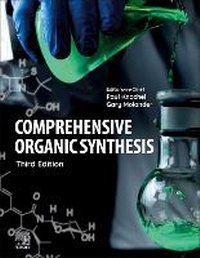
Comprehensive Organic Synthesis
Elsevier (Publisher)
3rd Edition
Published on 13. August 2025
Book
9500 pages
978-0-323-96025-0 (ISBN)
Description
Comprehensive Organic Synthesis, Third Edition, Eleven Volume Set builds upon the highly respected previous editions, including the 2nd edition which won the 2015 PROSE Award for Multivolume Reference/Science from the Association of American Publishers. This new edition continues to draw together the common themes that underlie the many disparate areas of organic chemistry, supporting effective and efficient synthetic strategies. With around 200 advanced chapters, it offers a comprehensive overview of this important discipline, making it essential for both experienced practitioners and those new to organic synthesis.
This fully revised and updated edition provides an authoritative overview of core concepts, serving as a valuable resource for synthetic chemists requiring essential facts in new areas and students completely new to the field. The work remains an invaluable source for anyone seeking information on solving synthetic problems, ensuring it continues to be an essential reference work for all in the field of organic chemistry.
This fully revised and updated edition provides an authoritative overview of core concepts, serving as a valuable resource for synthetic chemists requiring essential facts in new areas and students completely new to the field. The work remains an invaluable source for anyone seeking information on solving synthetic problems, ensuring it continues to be an essential reference work for all in the field of organic chemistry.
More details
Edition
3rd edition
Language
English
Place of publication
Philadelphia
United States
Target group
Professional and scholarly
Dimensions
Height: 276 mm
Width: 216 mm
Weight
1000 gr
ISBN-13
978-0-323-96025-0 (9780323960250)
Copyright in bibliographic data and cover images is held by Nielsen Book Services Limited or by the publishers or by their respective licensors: all rights reserved.
Schweitzer Classification
Other editions
Additional editions
Previous edition
Persons
Paul Knochel works at Ludwig-Maximilians-Universitat, Munich, Germany. Professor Gary A Molander works in the Department of Chemistry at University of Pennsylvania, USA.
Content
1. Additions to C-X ?-Bonds: comprehensive coverage of reactions involving carbon-bond formation with various substituents
2. Carbon-Carbon Bond Formation: fundamental methods for forming carbon-carbon bonds, essential for synthetic organic chemistry
3. Heteroatom Manipulation: techniques for introducing and modifying heteroatoms in organic molecules
4. Oxidation: various methodologies for oxidizing organic compounds, a cornerstone of synthetic transformations
5. Reduction: detailed approaches for reducing functional groups, providing essential strategies for chemists
6. Asymmetric Synthesis: methods for producing enantiomerically enriched compounds, increasingly important in pharmaceuticals
7. Photocatalysis: utilization of light to drive chemical reactions, highlighting innovative and sustainable synthetic strategies
8. Electrochemistry: emerging techniques for organic synthesis using electrochemical methods, signifying advancements in green chemistry
New Areas of Coverage in the 3rd Edition:
1. C-H Activation: new strategies for activating C-H bonds, enabling direct functionalization of hydrocarbons
2. Flow Chemistry: Innovative techniques for continuous flow synthesis, enhancing efficiency and scalability in organic synthesis
3. Dual Catalysis: recent developments in using two catalysts simultaneously for complex transformations
4. Biosynthesis: exploration of natural product synthesis through biological pathways, bridging organic chemistry and biochemistry
5. Catalytic Oxidation: Advanced methodologies for oxidation processes using modern catalytic systems
6. Photocatalysis: expanded focus on light-driven reactions, reflecting growing interest in sustainable and energy-efficient methods
7. Metal Catalysis: new approaches involving transition metals in catalysis, emphasizing their role in modern synthetic strategies
8. Asymmetric Synthesis: enhanced coverage of methods to achieve enantioselectivity in synthetic routes
2. Carbon-Carbon Bond Formation: fundamental methods for forming carbon-carbon bonds, essential for synthetic organic chemistry
3. Heteroatom Manipulation: techniques for introducing and modifying heteroatoms in organic molecules
4. Oxidation: various methodologies for oxidizing organic compounds, a cornerstone of synthetic transformations
5. Reduction: detailed approaches for reducing functional groups, providing essential strategies for chemists
6. Asymmetric Synthesis: methods for producing enantiomerically enriched compounds, increasingly important in pharmaceuticals
7. Photocatalysis: utilization of light to drive chemical reactions, highlighting innovative and sustainable synthetic strategies
8. Electrochemistry: emerging techniques for organic synthesis using electrochemical methods, signifying advancements in green chemistry
New Areas of Coverage in the 3rd Edition:
1. C-H Activation: new strategies for activating C-H bonds, enabling direct functionalization of hydrocarbons
2. Flow Chemistry: Innovative techniques for continuous flow synthesis, enhancing efficiency and scalability in organic synthesis
3. Dual Catalysis: recent developments in using two catalysts simultaneously for complex transformations
4. Biosynthesis: exploration of natural product synthesis through biological pathways, bridging organic chemistry and biochemistry
5. Catalytic Oxidation: Advanced methodologies for oxidation processes using modern catalytic systems
6. Photocatalysis: expanded focus on light-driven reactions, reflecting growing interest in sustainable and energy-efficient methods
7. Metal Catalysis: new approaches involving transition metals in catalysis, emphasizing their role in modern synthetic strategies
8. Asymmetric Synthesis: enhanced coverage of methods to achieve enantioselectivity in synthetic routes