

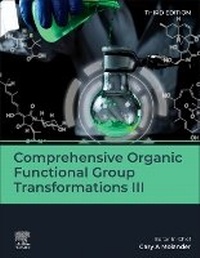
Comprehensive Organic Functional Group Transformations III
Elsevier (Publisher)
3rd Edition
Will be published approx. on 15. September 2026
Book
6800 pages
978-0-443-31482-7 (ISBN)
Description
Comprehensive Organic Functional Group Transformations III, Four Volume Set is the essential one-stop resource for researchers navigating the vast landscape of organic transformations. This new edition builds on the legacy of its predecessors by offering 130 expertly curated in-depth reviews, each focused on the efficient formation and interconversion of functional groups. This new edition covers breakthrough methodologies that are reshaping the field. Topics like C-H and C-F activation speak to the growing ability to functionalize previously inert bonds, opening new pathways in drug discovery and materials science. The coverage of alkene difunctionalization and dual catalysis highlights the push toward complexity-building in fewer steps, while continuous-flow methods and electrochemistry reflect the shift toward greener, scalable, and more automated synthesis. Organocatalysis, photoredox catalysis, and biocatalysis showcase the integration of biological and light-driven processes, aligning with the broader movement toward sustainable and selective transformations. Whether for teaching, research, or industrial application, Comprehensive Organic Functional Group Transformations III empowers users to quickly identify the best synthetic route for any functional group transformation, making it an indispensable tool for chemists at all levels.
Reviews / Votes
Review of the previous edition:"This new edition continues how the subject of organic synthesis was treated in the original in terms of functional group transformations, and it brings in all the new developments from the literature since the last version was published. It is truly a comprehensive, encyclopaedic overview of all known (and as yet unknown) functional groups. The material is easily accessible and provides essential references to methodologies for the interconversion of functional groups in organic synthesis. The references provide entry into the key literature and background necessary for anyone designing a new synthetic procedure. Organic and inorganic chemists who work in academia, industry, and government will find this series of books invaluable in their work. Teachers and students at all levels will appreciate all it offers and find that it will enhance their work. It is voluminous (6,400 pages, seven volumes, 144 chapters, written by 190 experts); it is expensive, and it may be affordable only by libraries." Summing Up: Recommended. Graduate students; faculty and researchers; professionals. --J. Landesberg, Adelphi University, CHOICE - Current Reviews for Academic Libraries, 2005
academic as well as industrial ones, since it gives comprehensive information and good references from general aspects to special applications. The seven volume set of COFGT-II provides well written, comprehensive and valuable documentation on all kinds of chemical transformations reactions and may be an indispensable tool for the daily work of chemists in different fields of research. In addition to the printer hardcover version it is also available as electronic on-line version through ScienceDirect which may enhance its utility." --Holgar Stark, Frankfurt/Germany, Archiv der Pharmazie, 2005
"It is truly a comprehensive encyclopedic overview of all known (and as yet unknown) functional groups. The material is easily accessible and provides essential references to methodologies for the interconversion of functional groups in organic synthesis." --J. Landesberg, Adelphi University, CHOICE, June, 2005
"When I reviewed this project in 1995, I wrote that it 'will be an indispensable tool in organic synthesis and will continue to contribute to the design of better synthetic routes'. I stand by this view in 2005, provided all 12 of the primary review volumes and the online index are available to the user. Then this Elsevier/Pergamon project will truly have transformed the practical utility of the science of functional group transformations" --G. Richard Stephenson, Wolfson Materials and Catalysis Centre at the School of Chemical Science and Pharmacy, University of East Anglia, Norwich, UK, CHEMISTRY AND INDUSTRY, Issue 16, August 2004
"In summary, this work is an important and valuable contribution to the literature on modern synthetic chemistry. Its usefulness is, of course, increased greatly by the fact that it is also available in electronic form through the Elsevier ScienceDirect service. The summaries of relevant reviews and monographs that are provided at the beginning of every chapter are very useful, and allow rapid access to further information that falls outside the scope of this work. The uniform design and style of the volumes, with regards to literature references, formula schemes, and tables, also deserves praise. It is very easy to work with these volumes using only one's intuition since the structure follows the systems based on patterns of substitution. That makes it very easy for the reader to recognize relationships between different classes of compounds and their behaviour in analogous functional group transformations, and to use the volumes for one's everyday work." --Edgar Haak, Braunschweig University, Germany, ANGEW. CHEM. INT. Ed, 2006
More details
Edition
3rd edition
Language
English
Place of publication
Philadelphia
United States
Target group
Professional and scholarly
Dimensions
Height: 276 mm
Width: 216 mm
ISBN-13
978-0-443-31482-7 (9780443314827)
Copyright in bibliographic data and cover images is held by Nielsen Book Services Limited or by the publishers or by their respective licensors: all rights reserved.
Schweitzer Classification
Other editions
Previous edition
Comprehensive Organic Functional Group Transformations II
A Comprehensive Review of the Synthetic Literature 1995 2003
Book
12/2004
2nd Edition
Elsevier
€7,700.25
Withdrawn from sale
Person
Professor Gary A Molander works in the Department of Chemistry at University of Pennsylvania, USA.
Content
1. Synthesis: Carbon with No Attached Heteroatoms
2. Synthesis: Carbon with One Heteroatom Attached by a Single Bond
3. Synthesis: Carbon with One Heteroatom Attached by a Multiple Bond
4. Synthesis: Carbon with Two Heteroatoms, Each Attached by a Single Bond
5. Synthesis: Carbon with Two Attached Heteroatoms with at Least One Carbon-to-Heteroatom Multiple Link
6. Synthesis: Carbon with Three or Four Attached Heteroatoms
2. Synthesis: Carbon with One Heteroatom Attached by a Single Bond
3. Synthesis: Carbon with One Heteroatom Attached by a Multiple Bond
4. Synthesis: Carbon with Two Heteroatoms, Each Attached by a Single Bond
5. Synthesis: Carbon with Two Attached Heteroatoms with at Least One Carbon-to-Heteroatom Multiple Link
6. Synthesis: Carbon with Three or Four Attached Heteroatoms