

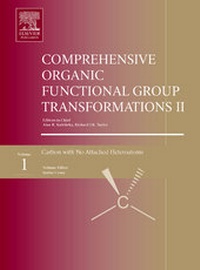
Comprehensive Organic Functional Group Transformations II
A Comprehensive Review of the Synthetic Literature 1995 2003
Elsevier (Publisher)
2nd Edition
Published on 16. December 2004
Book
Hardback
6805 pages
978-0-08-044256-3 (ISBN)
Description
Comprehensive Organic Functional Group Transformations II (COFGT-II) will provide the first point of entry to the literature for all scientists interested in chemical transformations. Presenting the vast subject of organic synthesis in terms of the introduction and interconversion of all known functional groups, COFGT-II provides a unique information source documenting all methods of efficiently performing a particular transformation. Organised by the functional group formed, COFGT-II consists of 144 specialist reviews, written by leading scientists who evaluate and summarise the methods available for each functional group transformation. Also available online via ScienceDirect - featuring extensive browsing, searching, and internal cross-referencing between articles in the work, plus dynamic linking to journal articles and abstract databases, making navigation flexible and easy. For more information, pricing options and availability visit www.info.sciencedirect.com.
Reviews / Votes
"This new edition continues how the subject of organic synthesis was treated in the original in terms of functional group transformations, and it brings in all the new developments from the literature since the last version was published. It is truly a comprehensive, encyclopaedic overview of all known (and as yet unknown) functional groups. The material is easily accessible and provides essential references to methodologies for the interconversion of functional groups in organic synthesis. The references provide entry into the key literature and background necessary for anyone designing a new synthetic procedure. Organic and inorganic chemists who work in academia, industry, and government will find this series of books invaluable in their work. Teachers and students at all levels will appreciate all it offers and find that it will enhance their work. It is voluminous (6,400 pages, seven volumes, 144 chapters, written by 190 experts); it is expensive, and it may be affordable only by libraries." Summing Up: Recommended. Graduate students; faculty and researchers; professionals. --J. Landesberg, Adelphi University, CHOICE - Current Reviews for Academic Libraries, 2005academic as well as industrial ones, since it gives comprehensive information and good references from general aspects to special applications. The seven volume set of COFGT-II provides well written, comprehensive and valuable documentation on all kinds of chemical transformations reactions and may be an indispensable tool for the daily work of chemists in different fields of research. In addition to the printer hardcover version it is also available as electronic on-line version through ScienceDirect which may enhance its utility." --Holgar Stark, Frankfurt/Germany, Archiv der Pharmazie, 2005
"It is truly a comprehensive encyclopedic overview of all known (and as yet unknown) functional groups. The material is easily accessible and provides essential references to methodologies for the interconversion of functional groups in organic synthesis." --J. Landesberg, Adelphi University, CHOICE, June, 2005
"When I reviewed this project in 1995, I wrote that it 'will be an indispensable tool in organic synthesis and will continue to contribute to the design of better synthetic routes'. I stand by this view in 2005, provided all 12 of the primary review volumes and the online index are available to the user. Then this Elsevier/Pergamon project will truly have transformed the practical utility of the science of functional group transformations" --G. Richard Stephenson, Wolfson Materials and Catalysis Centre at the School of Chemical Science and Pharmacy, University of East Anglia, Norwich, UK, CHEMISTRY AND INDUSTRY, Issue 16, August 2004
"In summary, this work is an important and valuable contribution to the literature on modern synthetic chemistry. Its usefulness is, of course, increased greatly by the fact that it is also available in electronic form through the Elsevier ScienceDirect service. The summaries of relevant reviews and monographs that are provided at the beginning of every chapter are very useful, and allow rapid access to further information that falls outside the scope of this work. The uniform design and style of the volumes, with regards to literature references, formula schemes, and tables, also deserves praise. It is very easy to work with these volumes using only one's intuition since the structure follows the systems based on patterns of substitution. That makes it very easy for the reader to recognize relationships between different classes of compounds and their behaviour in analogous functional group transformations, and to use the volumes for one's everyday work." --Edgar Haak, Braunschweig University, Germany, ANGEW. CHEM. INT. Ed, 2006
More details
Edition
2nd edition
Language
English
Place of publication
Oxford
United Kingdom
Publishing group
Elsevier Science & Technology
Target group
Professional and scholarly
For both specialist and non-specialist chemists in academic, industrial and government laboratories together with teachers at all levels.
Dimensions
Height: 270 mm
Width: 191 mm
Weight
17510 gr
ISBN-13
978-0-08-044256-3 (9780080442563)
Copyright in bibliographic data and cover images is held by Nielsen Book Services Limited or by the publishers or by their respective licensors: all rights reserved.
Schweitzer Classification
Other editions
New editions
Book
approx. 09/2026
3rd Edition
Elsevier
€6,817.57
Not yet published
Additional editions
Comprehensive Organic Functional Group Transformations II
A Comprehensive Review of the Synthetic Literature 1995 - 2003
E-Book
12/2004
2nd Edition
Elsevier
€7,575.00
Available for download
Persons
Alan Katritzky was educated at Oxford and has held faculty positions at Cambridge and East Anglia before he migrated in 1980 to the University of Florida, where he was Kenan Professor and Director for the Institute for Heterocyclic Compounds. During his career he has trained more than 1000 graduate students and post-docs, and lectured and consulted world-wide. He led the team, which produced "Comprehensive Heterocyclic Chemistry? and its sequels, "CHEC-II" and "CHEC-III?, has edited "Advances in Heterocyclic Chemistry, Vols. 1 through 111? and conceived the plan for "Comprehensive Organic Functional Group Transformations?. He founded Arkat-USA, a non-profit organization which publishes "Archive for Organic Chemistry? (ARKIVOC) an electronic journal completely free to authors and readers at (www.arkat-usa.org). Honors include 14 honorary doctorates from 11 countries and membership of foreign membership of the National Academies of Britain, Catalonia, India, Poland, Russia and Slovenia. Richard Taylor is currently Professor of Organic Chemistry at the University of York, where his research focuses on the development of novel synthetic methodology and the synthesis of natural products and related compounds of biological/medicinal interest. The methodology is concentrated primarily on organometallic, organosulfur and oxidation processes and the targets include, amino acids, carbohydrates, prostaglandins, and polyene and polyoxygenated natural products, particularly with activity as antibiotics and anti-cancer agents. Richard Taylor is a graduate and postgraduate of the University of Sheffield, and he then carried out postdoctoral research at Syntex, California (Dr. I. T. Harrison) and University College London (Professor F. Sondheimer). His first academic appointment was at the Open University in Milton Keynes. This post gave Professor Taylor the opportunity to contribute to Open University textbooks, radio programmes and television productions on various aspects of organic chemistry. Professor Taylor then moved to UEA, Norwich where he established his independent research programme,before taking up his present position in York in 1993. Richard Taylor is the current President of the Organic Division of the Royal Society of Chemistry and was awarded the 1999 RSC Tilden Lectureship and the 1999 RSC Heterocyclic Prize. He is currently the UK Regional Editor of the international journal Tetrahedron.
Content
Volume headings:
Carbon with no attached heteroatoms
Carbon with one heteroatom attached by a single bond
Carbon with one heteroatom attached by a multiple bond
Carbon with two heteroatoms, each attached by a single bond
Carbon with two attached heteroatoms with at least one carbon-to-heteroatom multiple link
Carbon with three or four attached heteroatoms
Indices
Carbon with no attached heteroatoms
Carbon with one heteroatom attached by a single bond
Carbon with one heteroatom attached by a multiple bond
Carbon with two heteroatoms, each attached by a single bond
Carbon with two attached heteroatoms with at least one carbon-to-heteroatom multiple link
Carbon with three or four attached heteroatoms
Indices