

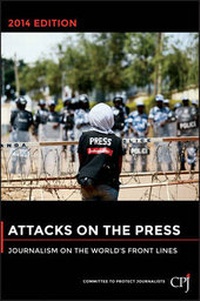
Attacks on the Press 2014
Journalism on the World's Front Lines
Published on 10. February 2014
Book
Paperback/Softback
240 pages
978-1-118-87311-3 (ISBN)
Description
The world's most comprehensive guide to international press freedom Every day, journalists around the world face incredible risks from imprisonment and assassination to simply just "disappearing" all for the ethical practice of their profession. Caught between wars and uprisings and corrupt police and drug cartels, as well as increasingly oppressive censorship laws, they find themselves in some of the most dangerous situations imaginable. This is why the Committee to Protect Journalists (CPJ) continues to create the annual edition of Attacks on the Press. Started as a simple typewritten list over 25 years ago, this reliable resource has grown to become the definitive annual assessment of press freedoms globally. It provides analyses of media conditions, press freedom violations, and emerging threats to journalists in every corner of the world.
* In this 2014 edition, you will find front-line reports and analytical essays by CPJ experts covering an array of topics of critical importance to journalists * Discusses how governments' capacity to store transactional data and the content of communications poses a unique threat to journalism in the digital age * Addresses the hope for more freedom in Iran and how the practical needs for communications technology may work in favor of a freer press * Examines the inability to solve journalist murders in areas such as Colombia and why eliminating witnesses has become an all too easy, and effective, method of stymying justice In addition to being an invaluable source of timely information and guidance for media professionals, Attacks on the Press gives voice to journalists globally, providing them with a platform for direct advocacy with governments and a tool for influence at the UN, OAS, EU, AU, and other official bodies.
* In this 2014 edition, you will find front-line reports and analytical essays by CPJ experts covering an array of topics of critical importance to journalists * Discusses how governments' capacity to store transactional data and the content of communications poses a unique threat to journalism in the digital age * Addresses the hope for more freedom in Iran and how the practical needs for communications technology may work in favor of a freer press * Examines the inability to solve journalist murders in areas such as Colombia and why eliminating witnesses has become an all too easy, and effective, method of stymying justice In addition to being an invaluable source of timely information and guidance for media professionals, Attacks on the Press gives voice to journalists globally, providing them with a platform for direct advocacy with governments and a tool for influence at the UN, OAS, EU, AU, and other official bodies.
More details
Series
Edition
2014 ed.
Language
English
Place of publication
New York
United States
Target group
Professional and scholarly
Dimensions
Height: 228 mm
Width: 154 mm
Thickness: 16 mm
Weight
330 gr
ISBN-13
978-1-118-87311-3 (9781118873113)
Copyright in bibliographic data and cover images is held by Nielsen Book Services Limited or by the publishers or by their respective licensors: all rights reserved.
Schweitzer Classification
Person
The Committee to Protect Journalists is an independent, nonprofit organization founded in 1981 by a group of U.S. correspondents in response to the often brutal treatment of their foreign colleagues by authoritarian regimes and other enemies of independent journalism. Operating with a full-time staff of 27 at its New York headquarters and correspondents around the world, its mission is to promote press freedom worldwide by defending the rights of journalists to report the news without fear of reprisal. A 37-member board of prominent journalists directs CPJ's activities. CPJ does not accept government funding and is financed solely by contributions from individuals, corporations, and foundations.
Content
Foreword ix by Jacob Weisberg 1. Under Surveillance How United States' Spying Strengthens China's Hand 3 The scope of the National Security Agency's digital surveillance raises doubts about the U.S. commitment to freedom of expression online. By Joel Simon The NSA Puts Journalists Under a Cloud of Suspicion 11 Governments' capacity to store transactional data and the content of communications poses a unique threat to journalism in the digital age. By Geoffrey King 2. The Information Imperative Putting Press Freedom at the Heart of Anti-Poverty Efforts 27 Economists and political scientists acknowledge that journalism is vital to development and democracy. By Robert Mahoney Without Stronger Transparency, More Financial Crises Loom 37 The recent financial meltdown should be treated as a lesson on the importance of information transparency and the crucial role of a free press. By Michael J. Casey 3. The Front Lines Syrian Journalists Strive to Report, Despite Shifting Dangers 51 They call themselves citizen journalists, media workers, or media activists. Amid the chaos of conflict, they are determined to gather and distribute the news. By Maria Salazar-Ferro Finding the Courage to Cover Sexual Violence 61 Coverage of rape can bring journalists swift and unpredictable repercussions, but it can also change attitudes. By Frank Smyth Afghan Journalists Steadfast as International Withdrawal Approaches 69 As they look toward the next era of uncertainty, reporters in Afghanistan express a sense of determination to build on what they have achieved. By Bob Dietz 4. Media and Money Journalists in Hong Kong and Taiwan Battle Beijing's Influence 77 Media owners' reluctance to draw China's disfavor imperils the ability of the Hong Kong and Taiwanese press to play a watchdog role. By a CPJ Contributor Advertising and Censorship in East Africa's Press 91 The printed word is thriving in parts of Africa, but advertisers' clout means they can often quietly control what is published. By Tom Rhodes 5. Controlling the Narrative Would-Be Repressors Brandish "Ethics" as Justification 103 Calls for journalists to exercise a sense of responsibility are very often code for censorship. Yet unethical journalism can also imperil the press. By Jean-Paul Marthoz Pressure on Journalists Rises Along With Africa's Prospects 113 After a decade of unprecedented growth and development, the insistence on positive news remains a significant threat to press freedom in sub-Saharan Africa. By Mohamed Keita Vietnam Tightens the Squeeze on Its Bloggers 123 A mushrooming blogosphere has challenged the state's media monopoly, drawing a heavy-handed bid to bring the Internet under government control. By Shawn W. Crispin 6. Legacies on the Line Mandela's Legacy of Media Freedom Stands Its Ground 133 How robust are the institutional safeguards that underpin Nelson Mandela's vision of a strong and independent South African media? By Sue Valentine Hassan Rouhani and the Hope for More Freedom in Iran 143 The new president may have limited power to enact change, but the practical needs for communications technology may work in favor of a freer press. By D. Parvaz Violence and Judicial Censorship Mar Brazil's Horizon 151 The Brazilian government's concern for the safety of an American journalist stands in contrast to a dismal performance protecting its own reporters. By Carlos Lauria 7. Getting Away With Murder When Journalists Are Killed, Witnesses May Be Next 163 Eliminating witnesses has become an all too easy and effective method of stymying justice when journalists are assassinated. By Elisabeth Witchel One Province Illustrates Colombia's Struggle With Impunity 173 The inability to solve journalist murders in Arauca feeds an atmosphere of hostility and intimidation for the media there. By John Otis 8. Censored Gunmen Rule Neza and the Press on Outskirts of Mexico City 183 Politicians say there are no organized crime cartels in the capital's metropolitan area. Journalists know better, but they are afraid to report it. By Mike O'Connor A Sliver of Hope Emerges for a More Independent Press in Turkey 193 The Gezi Park protests force some independent-minded journalists to confront the media's unwillingness to take on the government. By Nicole Pope 9. Trends in Press Freedom CPJ's Risk List: Where Press Freedom Suffered 203 Surveillance, restrictive Internet legislation, and cyberattacks compel CPJ to add cyberspace to the list of places trending in the wrong direction. By Maya Taal Index 217