

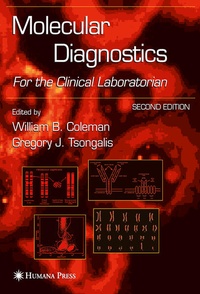
Molecular Diagnostics
For the Clinical Laboratorian
2nd Edition
Published on 15. August 2005
Book
Hardback
XVIII, 567 pages
978-1-58829-356-5 (ISBN)
Description
In 1994 I coedited a book, Molecular Pathology: Ap- efforts. It should be evident that molecular pathology and proaches to Diagnosing Human Disease in the Clinical diagnostics impact almost every conceivable subspecialty Laboratory, that coined the phrase "molecular pathology" in laboratory medicine and, particularly in the case of to refer to applications of molecular biology in the tradi- pharmacogenomics, have led to the development of new tional areas of laboratory medicine. That compilation of areas of investigation. clinical molecular techniques included 11 chapters and an What is less evident is the burden placed upon the epilogue on "New Directions for the Clinical Laboratory. " laboratorians directing these efforts. Issues regarding Chapter headings included: automation, neoplasia, heri- training, certification, continuing education, and re- table diseases, and infectious diseases. bursement (just to name a few) have demanded enormous Three years later, in 1997, Bill Coleman and Greg Tson- time and effort from professional organizations and g- galis edited Molecular Diagnostics: For the Clinical ernmental agencies.
In addition, because conventional Laboratorian, which contained 18 chapters and introduced approaches cannot always be applied to molecular di- the new areas of RT-PCR and In Situ PCR, and included nostics, unique solutions for quality assurance and quality a section on gene therapy. Now, ten years after the intro- control must be developed. These challenges have eng- duction of molecular pathology, we are looking at the dered committees, subcommittees, taskforces, and second edition of Bill Coleman and Greg Tsongalis' text.
In addition, because conventional Laboratorian, which contained 18 chapters and introduced approaches cannot always be applied to molecular di- the new areas of RT-PCR and In Situ PCR, and included nostics, unique solutions for quality assurance and quality a section on gene therapy. Now, ten years after the intro- control must be developed. These challenges have eng- duction of molecular pathology, we are looking at the dered committees, subcommittees, taskforces, and second edition of Bill Coleman and Greg Tsongalis' text.
Reviews / Votes
"This is a great book to have handy for ready reference in this rapidly evolving field. While the reader may not use this reference daily, there is no question that it will be needed for those occasions when such testing is ordered and a clinical consultation between the clinical laboratory and the healthcare provider is necessary." - Doody's Health Sciences Book Review Journal"...the textbook of choice for anyone working in molecular diagnostics who wants to remain current with this rapidly changing field. -Clinical Laboratory International
From Reviews of the First Edition...
"...a very good introduction to the basic elements of molecular pathology...a clear, enjoyable read...an excellent discussion of methods." -Clinical Chemistry
"...highly recommended...for those interested in clinical molecular diagnosis...will satisfy those who are more expert in certain areas of molecular diagnosis, but who have been unable to keep up with the wide range of recent advances in molecular diagnosis." -American Journal of Clinical Pathology
"...gives a good theoretical background for those with little experience in this field. It is readable, comprehensive, and...up-to-date." -Journal of Clinical Pathology
"...well written, comprehensive...should bring even the reader with limited background knowledge up to speed on what is a rapidly progressing field." -Trends in Molecular Medicine
"...a timely and highly relevant book that will serve as a valuable resource to those practicing molecular diagnostics from the bench, as well as to basic and clinical scientists..." -Endocrine News
More details
Edition
Second Edition 2005
Language
English
Place of publication
Totowa
United States
Target group
Professional and scholarly
Professional/practitioner
Edition type
Revised edition
Illustrations
XVIII, 567 p.
Dimensions
Height: 260 mm
Width: 183 mm
Thickness: 38 mm
Weight
1303 gr
ISBN-13
978-1-58829-356-5 (9781588293565)
DOI
10.1385/1592599281
Schweitzer Classification
Other editions
Additional editions
E-Book
10/2007
2nd Edition
Humana
€266.43
Available for download
Previous edition

Book
12/2009
Humana Press Inc.
€92.88
Article exhausted; check for reprint
Content
An Historical Perspective on the Clinical Diagnostic Laboratory.- Basic Molecular Biology.- An Overview of Nucleic Acid Chemistry, Structure, and Function.- Extraction of Nucleic Acids.- Nucleic Acid Blotting Techniques.- The Polymerase Chain Reaction.- Bioinformatics.- Molecular Diagnostic Technologies.- PCR-Based Methods for Mutation Detection.- Alternative Methods for Amplified Nucleic Acid Testing.- Electrophoretic Methods for Mutation Detection and DNA Sequencing.- Single-Nucleotide Polymorphisms.- Microarray Approaches to Gene Expression Analysis.- Methods for Analysis of DNA Methylation.- Other Clinical Diagnostic Technologies.- Flow Cytometry.- Medical Cytogenetics.- Fluorescence In Situ Hybridization.- Immunohistochemistry.- Laser Capture Microdissection.- Quality Assurance in the Molecular Diagnostics Laboratory.- Framework for Quality Assurance in Molecular Diagnostics.- Verification of Molecular Assays.- Standards and Standardization of Molecular Diagnostics.- Laboratory-Developed Tests in Molecular Diagnostics.- Applications of Molecular Diagnostics for Genetic Diseases.- An Overview of Molecular Genetics.- Genetic Basis of Neurologic and Neuromuscular Diseases.- Molecular Mechanisms of Endocrine Disorders.- Molecular Pathogenesis of Cardiovascular Disease.- Molecular Diagnostics in Coagulation.- Cystic Fibrosis.- Prenatal Genotyping for Identification of Fetuses at Risk for Immune Cytopenic Disorders.- Personalized Medicine.- Applications of Molecular Diagnostics for Human Cancers.- Molecular Pathogenesis of Human Cancer.- Application of Molecular Diagnostics to Hereditary Nonpolyposis Colorectal Cancer.- Molecular Genetic Applications to the Diagnosis of Lymphoma.- Molecular Genetic Abnormalities in Acute and Chronic Leukemias.- Applications of MolecularDiagnostics for Infectious Diseases.- Molecular Testing for Chlamydia trachomatis and Neisseria gonorrhoeae.- Human Papillomavirus.- Molecular Diagnostics for HIV-1.- Hepatitis C.- Cytomegalovirus.- Applications of Molecular Diagnostics for Identity-Based Testing.- HLA Typing Using Molecular Methods.- Molecular Analysis for Forensic Casework and Parentage Testing.- Molecular Assessment of Bone Marrow Transplant Engraftment.- Use of DNA-Based Identity Testing for Specimen Identification.- Issues for the Clinical Molecular Pathology Laboratory.- Genetic Counseling Considerations in Molecular Diagnosis.- Ethical, Social, and Legal Issues Related to Molecular Genetic Testing.