

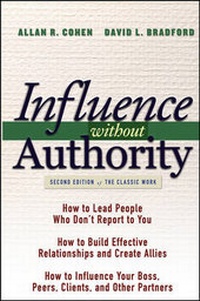
Influence Without Authority
2nd Edition
Published on 15. April 2005
Book
Hardback
320 pages
978-0-471-46330-6 (ISBN)
Description
In organizations today, getting work done requires political and collaborative skills. That's why the first edition of this book has been widely adopted as a guide for consultants, project leaders, staff experts, and anyone else who does not have direct authority but who is nevertheless accountable for results. In this revised edition, leadership gurus Allan Cohen and David Bradford explain how to get cooperation from those over whom you have no official authority by offering them help in the form of the "currencies" they value. This classic work, now revised and updated, gives you powerful techniques for cutting through interpersonal and interdepartmental barriers, and motivating people to lend you their support, time, and resources.
More details
Edition
2nd edition
Language
English
Place of publication
New York
United States
Target group
Professional and scholarly
Dimensions
Height: 236 mm
Width: 160 mm
Thickness: 31 mm
Weight
513 gr
ISBN-13
978-0-471-46330-6 (9780471463306)
Copyright in bibliographic data and cover images is held by Nielsen Book Services Limited or by the publishers or by their respective licensors: all rights reserved.
Schweitzer Classification
Other editions
New editions
Allan R. Cohen | David L. Bradford
Influence Without Authority
Book
11/2017
3rd Edition
Wiley
€30.90
Shipment within 15-20 days
Additional editions
Allan R. Cohen | David L. Bradford
Influence Without Authority
E-Book
01/2011
2nd Edition
Wiley
€23.99
Available for download
Allan R. Cohen | David L. Bradford
Influence Without Authority
E-Book
03/2005
2nd Edition
Wiley
€23.99
Available for download
Previous edition

Allan R. Cohen | David L. Bradford
Influence without Authority
Book
09/1991
Wiley
€20.99
Article exhausted; check for reprint
Persons
ALLAN R. COHEN is Edward A. Madden Distinguished Professor of Global Leadership and Director of Corporate Entrepreneurship at Babson College, where he specializes in leadership and transforming organizations. He holds MBA and DBA degrees from Harvard Business School and has consulted for such organizations as GE, Polaroid, IBM, and Toshiba. DAVID L. BRADFORD is Senior Lecturer on Organizational Behavior at Stanford Graduate School of Business and Director of Stanford's Executive Program in Leadership. He has consulted for such organizations as Frito-Lay, Levi Strauss & Co., and the Whitney Museum of American Art.
Cohen and Bradford are also the authors of Managing for Excellence and Power Up, both from Wiley.
Cohen and Bradford are also the authors of Managing for Excellence and Power Up, both from Wiley.
Content
Part I: Introduction. Chapter 1: Why Influence: What You Will Get from This Book.
Part II: The Influence Model.
Chapter 2: The Influence Model: Trading What They Want for What You've Got (Using Reciprocity and Exchange).
Chapter 3: Goods and Services: The Currencies of Exchange.
Chapter 4: How to Know What They Want: Understanding Their Worlds (and the Forces Acting on Them).
Chapter 5: You Have More to Offer Than You Think if You Know Your Goals, Priorities, and Resources (The Dirty Little Secret about Power).
Chapter 6: Building Effective Relationships: The Art of Finding and Developing Your Allies.
Chapter 7: Strategies for Making Mutually Profitable Trades.
Part III: Practical Applications of Influence.
Chapter 8: Influencing Your Boss.
Chapter 9: Influencing Difficult Subordinates.
Chapter 10: Working Cross Functionally: Leading and Influencing a Team, Task Force, or Committee.
Chapter 11: Influencing Organizational Groups, Departments, and Divisions.
Chapter 12: Influencing Colleagues.
Chapter 13: Initiating or Leading Major Change.
Chapter 14: Indirect Influence.
Chapter 15: Understanding and Overcoming Organizational Politics.
Chapter 16: Hardball: Escalating to Tougher Strategies When You Can No Longer Catch Flies with Honey.
Appendix A: Extended Case Examples Available on the Web.
Appendix B: Additional Resources.
Notes.
Index.
Part II: The Influence Model.
Chapter 2: The Influence Model: Trading What They Want for What You've Got (Using Reciprocity and Exchange).
Chapter 3: Goods and Services: The Currencies of Exchange.
Chapter 4: How to Know What They Want: Understanding Their Worlds (and the Forces Acting on Them).
Chapter 5: You Have More to Offer Than You Think if You Know Your Goals, Priorities, and Resources (The Dirty Little Secret about Power).
Chapter 6: Building Effective Relationships: The Art of Finding and Developing Your Allies.
Chapter 7: Strategies for Making Mutually Profitable Trades.
Part III: Practical Applications of Influence.
Chapter 8: Influencing Your Boss.
Chapter 9: Influencing Difficult Subordinates.
Chapter 10: Working Cross Functionally: Leading and Influencing a Team, Task Force, or Committee.
Chapter 11: Influencing Organizational Groups, Departments, and Divisions.
Chapter 12: Influencing Colleagues.
Chapter 13: Initiating or Leading Major Change.
Chapter 14: Indirect Influence.
Chapter 15: Understanding and Overcoming Organizational Politics.
Chapter 16: Hardball: Escalating to Tougher Strategies When You Can No Longer Catch Flies with Honey.
Appendix A: Extended Case Examples Available on the Web.
Appendix B: Additional Resources.
Notes.
Index.