

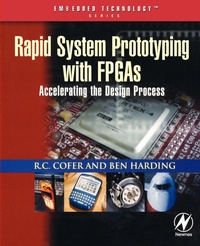
Rapid System Prototyping with FPGAs
Accelerating the Design Process
Published on 27. October 2005
Book
Paperback/Softback
320 pages
978-0-7506-7866-7 (ISBN)
Description
The push to move products to market as quickly and cheaply as possible is fiercer than ever, and accordingly, engineers are always looking for new ways to provide their companies with the edge over the competition. Field-Programmable Gate Arrays (FPGAs), which are faster, denser, and more cost-effective than traditional programmable logic devices (PLDs), are quickly becoming one of the most widespread tools that embedded engineers can utilize in order to gain that needed edge. FPGAs are especially popular for prototyping designs, due to their superior speed and efficiency.
This book hones in on that rapid prototyping aspect of FPGA use, showing designers exactly how they can cut time off production cycles and save their companies money drained by costly mistakes, via prototyping designs with FPGAs first. Reading it will take a designer with a basic knowledge of implementing FPGAs to the "next-level? of FPGA use because unlike broad beginner books on FPGAs, this book presents the required design skills in a focused, practical, example-oriented manner.
This book hones in on that rapid prototyping aspect of FPGA use, showing designers exactly how they can cut time off production cycles and save their companies money drained by costly mistakes, via prototyping designs with FPGAs first. Reading it will take a designer with a basic knowledge of implementing FPGAs to the "next-level? of FPGA use because unlike broad beginner books on FPGAs, this book presents the required design skills in a focused, practical, example-oriented manner.
More details
Series
Language
English
Place of publication
Oxford
United Kingdom
Publishing group
Elsevier Science & Technology
Target group
Professional and scholarly
PRIMARY MARKET: Embedded Design Engineers, Electrical Engineers, Computer Engineers, Software Engineers , System Engineers, Project Managers
SECONDARY MARKET: Seniors and post-graduate level electrical and computer engineering students
Product notice
Paperback (trade)
Illustrations
Approx. 150 illustrations; Illustrations
Dimensions
Height: 235 mm
Width: 191 mm
Thickness: 17 mm
Weight
550 gr
ISBN-13
978-0-7506-7866-7 (9780750678667)
Copyright in bibliographic data and cover images is held by Nielsen Book Services Limited or by the publishers or by their respective licensors: all rights reserved.
Schweitzer Classification
Other editions
New editions

R. C. Cofer | Benjamin F. Harding
The FPGA Users Guide
Book
2nd Edition
Newnes
€61.84
The article will not be published
Persons
RC Cofer has 30 years of embedded design experience including real-time DSP algorithm development high-speed hardware, ASIC and FPGA design, systems engineering and project management. His technical focus is on system-level design, FPGA-based systems, high-performance hardware and signal processing. He has been educating engineers on FPGA related topics for the 17 years. RC holds an MSEE from the University of Florida and a BSEE from Florida Tech. Ben Harding has a BSEE from the University of Alabama with post graduate studies in digital signal processing, control theory, parallel processing and robotics. Ben has held leadership and design roles in a wide range of design and research projects. He has over 20 years of extensive embedded system design experience. His hardware design experience includes high-speed design with DSPs, network processors and programmable logic. Ben also has embedded software development experience in a broad range of areas including voice and signal processing algorithm development and board-support package development for numerous real-time operating systems.
Content
Chapter 1: Introduction
Chapter 2: FPGA Fundamentals
Chapter 3: Optimizing the Development Cycle;
Chapter 4: System Engineering
Chapter 5:FPGA Device Level Design Decisions
Chapter 6: Board-Level Design Decisions and Allocation
Chapter 7: Design Implementation
Chapter 8: Design Simulation
Chapter 9: Design Constraints and Optimization
Chapter 10: Configuration
Chapter 11: Board-Level Testing
Chapter 12: Advanced Topics Introduction
Chapter 13:Cores and Intellectual Property
Chapter 14: Embedded Processing Cores
Chapter 15: Digital Signal Processing
Chapter 16: Advanced Interconnects
Chapter 17: Bringing it All Together
Chapter 2: FPGA Fundamentals
Chapter 3: Optimizing the Development Cycle;
Chapter 4: System Engineering
Chapter 5:FPGA Device Level Design Decisions
Chapter 6: Board-Level Design Decisions and Allocation
Chapter 7: Design Implementation
Chapter 8: Design Simulation
Chapter 9: Design Constraints and Optimization
Chapter 10: Configuration
Chapter 11: Board-Level Testing
Chapter 12: Advanced Topics Introduction
Chapter 13:Cores and Intellectual Property
Chapter 14: Embedded Processing Cores
Chapter 15: Digital Signal Processing
Chapter 16: Advanced Interconnects
Chapter 17: Bringing it All Together