

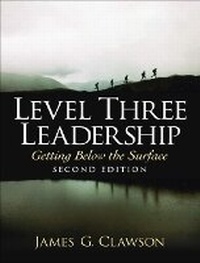
Level Three Leadership
2nd Edition
Published on 14. October 2002
Book
Paperback/Softback
356 pages
978-0-13-032943-1 (ISBN)
Description
For MBA and upper-level undergraduate courses in Leadership, Organizational Behavior, and Change.
This brief paperback outlines a practical, contemporary model for making a difference as a leader in the Information Age-one which goes well beyond the single, behavior-focused leadership style (Level One) typically associated with Industrial-Age organizations to encompass opportunities to influence people and their thinking (Level Two Leadership), and their values and basicassumptions about how the world operates (Level Three Leadership). Drawing on the work of a wide range of scholars and authors in the field of leadership and managing change, it integrates theory and practice to create the model and a set of related perspectives and concepts about how students can become better leaders not only in their own lives, but in their work group, and in their organizations. Questions for Reflection throughout and an innovative Workbook section help students explore their own values, assumptions, beliefs, and expectations about what it means to be an effective leader-and suggest ways to grow and develop their leadership skills.
This brief paperback outlines a practical, contemporary model for making a difference as a leader in the Information Age-one which goes well beyond the single, behavior-focused leadership style (Level One) typically associated with Industrial-Age organizations to encompass opportunities to influence people and their thinking (Level Two Leadership), and their values and basicassumptions about how the world operates (Level Three Leadership). Drawing on the work of a wide range of scholars and authors in the field of leadership and managing change, it integrates theory and practice to create the model and a set of related perspectives and concepts about how students can become better leaders not only in their own lives, but in their work group, and in their organizations. Questions for Reflection throughout and an innovative Workbook section help students explore their own values, assumptions, beliefs, and expectations about what it means to be an effective leader-and suggest ways to grow and develop their leadership skills.
More details
Edition
2nd edition
Language
English
Place of publication
United States
Publishing group
Pearson Education (US)
Target group
Professional and scholarly
Dimensions
Height: 235 mm
Width: 178 mm
Thickness: 15 mm
Weight
547 gr
ISBN-13
978-0-13-032943-1 (9780130329431)
Copyright in bibliographic data and cover images is held by Nielsen Book Services Limited or by the publishers or by their respective licensors: all rights reserved.
Schweitzer Classification
Other editions
New editions
James G. Clawson
Level Three Leadership
Book
11/2005
3rd Edition
Pearson
€51.98
Article exhausted; check for reprint
Previous edition

Book
12/1998
Pearson
€43.32
Article exhausted; check for reprint
Person
James G. Clawson is an Associate Professor at the Darden Graduate School of Business, University of Virginia, where he teaches in the MBA, Executive Education, and Doctoral programs. He has also taught at the Harvard Business School, Northeastern University, the International University of Japan, and in various countries throughout Europe, Africa, Australia, Asia, and North America. Dr. Clawson earned a DBA from the Harvard University Graduate School of Business Administration, an MBA from Brigham Young University, and a BA from Stanford University. His areas of research include leadership, managing change, mentoring, management development, and career management, and he is an active consultant in these areas to a variety of public- and private-sector organizations.
Content
I. INTRODUCTION.
1. The Leadership Point of View.
2. The Changing Context of Leadership.
3. General Model of Leadership in Organizations: A Diamond in the Rough.
4. Levels of Leadership.
5. The Moral Foundation of Extraordinary Leadership.
6. A Leader's Guide to Why People Behave the Way They Do.
II. SELF.
7. Six Steps to Effective Leadership.
8. Leadership and Intelligence.
9. Resonance, Leadership and the Purpose of Life.
III. STRATEGIC THINKING.
10. Strategic Thinking.
11. Personal and Organizational Charters.
IV. LEADING OTHERS.
12. Leading Others.
13. Leading Teams.
V. LEADERS AS DESIGNERS.
14. Leading Organizational Design.
15. Leading Change.
VI. CONCLUSION.
16. Summary.
VII. SUPPLEMENTARY MATERIALS.
Level Three Leadership Workbook.
Survey of Managerial Style.
Life's Dream Exercise.
Leadership Steps Assessment.
Team Self Assessment.
Assessing the Moral Foundation of Your Leadership.
Balancing Your Life.
Energy Management Exercise.
Life's Story Assignment.
Leadership Theories.
Appendix: Cases That Apply.
Select Bibliography.
Index.
1. The Leadership Point of View.
2. The Changing Context of Leadership.
3. General Model of Leadership in Organizations: A Diamond in the Rough.
4. Levels of Leadership.
5. The Moral Foundation of Extraordinary Leadership.
6. A Leader's Guide to Why People Behave the Way They Do.
II. SELF.
7. Six Steps to Effective Leadership.
8. Leadership and Intelligence.
9. Resonance, Leadership and the Purpose of Life.
III. STRATEGIC THINKING.
10. Strategic Thinking.
11. Personal and Organizational Charters.
IV. LEADING OTHERS.
12. Leading Others.
13. Leading Teams.
V. LEADERS AS DESIGNERS.
14. Leading Organizational Design.
15. Leading Change.
VI. CONCLUSION.
16. Summary.
VII. SUPPLEMENTARY MATERIALS.
Level Three Leadership Workbook.
Survey of Managerial Style.
Life's Dream Exercise.
Leadership Steps Assessment.
Team Self Assessment.
Assessing the Moral Foundation of Your Leadership.
Balancing Your Life.
Energy Management Exercise.
Life's Story Assignment.
Leadership Theories.
Appendix: Cases That Apply.
Select Bibliography.
Index.