

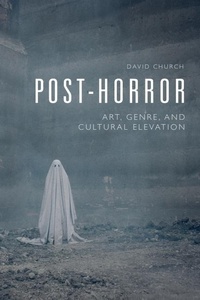
Post-Horror
Art, Genre and Cultural Elevation
Published on 16. January 2023
Book
Paperback/Softback
280 pages
978-1-4744-7589-1 (ISBN)
Description
Horror's longstanding reputation as a popular but culturally denigrated genre has been challenged by a new wave of films mixing arthouse minimalism with established genre conventions. Variously dubbed 'elevated horror' and 'post-horror,' films such as The Babadook, It Follows, The Witch, It Comes at Night, Get Out, The Invitation, Hereditary, Midsommar, A Ghost Story, and mother! represent an emerging nexus of taste, politics, and style that has often earned outsized acclaim from critics and populist rejection by wider audiences. Post-Horror is the first full-length study of one of the most important and divisive movements in twenty-first-century horror cinema.
Reviews / Votes
Church's investment in reception cultures renders Post-Horror even more valuable as a pedagogical resource. [...] Post-Horror further affirms that the past decade-an epoch of horrors-has provided a fertile opportunity for filmmakers of various marginalized backgrounds to rethink what it means to be horrified. -- Caetlin Benson-Allott, Georgetown University * Film Quarterly * This book is indispensable for both academic researchers and film critics - as well as genre fans - who strive to understand the finer workings of this new cycle in horror cinema. -- Sandra Aline Wagner, University of Limerick * Gothic Studies * Post-Horror: Art, Genre and Cultural Elevation is a thoughtful yet ambitious study of 2010s horror cinema. The book is well-researched and scholarly, yet it remains accessible in its tone and coherent in its argumentative structure. A useful entry point for readers unfamiliar with contemporary horror, Post-Horror will also engage scholars already acquainted with 2010s horror cinema through the rich detail of its analysis. Church's monograph is unique in its capacity to engage with contemporary critical paradigms while simultaneously questioning their most basic assumptions. Indeed, Post-Horror is impressive precisely because of how it employs a divisive critical term as springboard from which to launch an incisive exploration of genre, form, narrative and, most crucially, the way viewers respond to and talk about horror. -- Miranda Corcoran, University College Cork * Supernatural Studies * With this book, David Church confirms his status as one of the most interesting contemporary scholars working on horror and on taste politics. Church expands the notion of art-horror and shows the links between contemporary post-horror and 1940s woman's films, melodrama, science fiction and European art cinema, with great chapters devoted to the post-horror connection between family, intimate relationships, and epistemic violence. Meticulously researched and theorized, this is a book that, like the films it analyzes, rewards multiple readings. A thumping good read. -- Joan C. Hawkins, Indiana University The horror film is often read as a low-budget and disreputable genre that is disparaged by critics and loved by only a small core of committed fans. However, there has always been a high end to horror, a high end that is made up of both art films and prestigious productions from the major studios. In this book, then, Church offers a crucial contribution to an understanding of this trend through his analysis of recent developments in its history. Grounded in an analysis of the reception contexts within which these films are produced, mediated and consumed, this book is a must for those interested in contemporary film culture in general and the horror film in particular. -- Mark Jancovich, University of East AngliaMore details
Language
English
Place of publication
Edinburgh
United Kingdom
Target group
Professional and scholarly
Illustrations
20 black and white illustrations, 1 black and white table
Dimensions
Height: 232 mm
Width: 155 mm
Thickness: 19 mm
Weight
444 gr
ISBN-13
978-1-4744-7589-1 (9781474475891)
Copyright in bibliographic data and cover images is held by Nielsen Book Services Limited or by the publishers or by their respective licensors: all rights reserved.
Schweitzer Classification
Other editions
Additional editions
E-Book
12/2020
1st Edition
Edinburgh University Press
€21.49
Available for download
E-Book
12/2020
1st Edition
Edinburgh University Press
€21.49
Available for download
Person
David Church is a film and media scholar specializing in genre studies, taste cultures, and histories of film circulation. He is the author of Grindhouse Nostalgia: Memory, Home Video, and Exploitation Film Fandom (EUP, 2015), Disposable Passions: Vintage Pornography and the Material Legacies of Adult Cinema (Bloomsbury, 2016), and Mortal Kombat: Games of Death (University of Michigan Press, 2022).
Content
FiguresAcknowledgments
1. Apprehension Engines: Defining a New Wave of Art-Horror Cinema
2. "Slow," "Smart," "Indie," "Prestige," "Elevated": Discursive Struggle for Cultural Distinction
3. Grief, Mourning, and the Horrors of Familial Inheritance
4. Horror by Gaslight: Epistemic Violence and Ambivalent Belonging
5. Beautiful, Horrible Desolation: Landscape in Post-Horror Cinema
6. Queer Ethics and the Urban Ruin-Porn Landscape: The Horrors of Monogamy in It Follows
7. Existential Dread and the Trouble with Transcendence
Selected BibliographyIndex
1. Apprehension Engines: Defining a New Wave of Art-Horror Cinema
2. "Slow," "Smart," "Indie," "Prestige," "Elevated": Discursive Struggle for Cultural Distinction
3. Grief, Mourning, and the Horrors of Familial Inheritance
4. Horror by Gaslight: Epistemic Violence and Ambivalent Belonging
5. Beautiful, Horrible Desolation: Landscape in Post-Horror Cinema
6. Queer Ethics and the Urban Ruin-Porn Landscape: The Horrors of Monogamy in It Follows
7. Existential Dread and the Trouble with Transcendence
Selected BibliographyIndex