

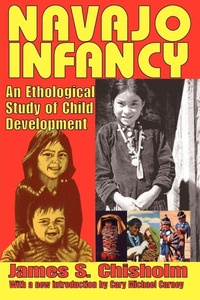
Navajo Infancy
An Ethological Study of Child Development
1st Edition
Published on 15. July 2009
Book
Paperback/Softback
286 pages
978-0-202-36251-9 (ISBN)
Description
Navajo Infancy describes the major sources of change and continuity in Navajo infant development. It does so by combining concepts and methods of classical ethology with those of social-cultural anthropology. The goal is to establish the relationships between human nature and culture. Buy considering the nature of adaptation, and the evolution of human developmental patterns, and through analyses of the determinants of change and continuity in Navajo infant development, Navajo Infancy outlines how the process of development itself may bridge nature and culture.
With its special focus on the effect of the cradleboard on Navajo mother-infant interaction, Navajo Infancy raises important developmental issues in its analyses of why the eff ects of the cradleboard do not last. Incorporating the Brazelton Neonatal Behavioral Assessment Scale into its ethological-anthropological methods, Navajo Infancy demonstrates signifi cant Navajo-Anglo-American differences in newborn temperament. It fi nds a strong correlation between newborn behavior and prenatal environmental factors, arguing that racial and ethnic differences in behavior at birth go well beyond simple gene pool differences.
Navajo Infancy also describes the individual and group differences in the development of Navajo and Anglo- American children's fear of strangers and patterns of mother-infant interaction. Aspects of attachment theory, transactional theories of development, and anthropological theories of socialization are related to this broad new evolutionary approach to the process of development and nature-culture interaction.
With its special focus on the effect of the cradleboard on Navajo mother-infant interaction, Navajo Infancy raises important developmental issues in its analyses of why the eff ects of the cradleboard do not last. Incorporating the Brazelton Neonatal Behavioral Assessment Scale into its ethological-anthropological methods, Navajo Infancy demonstrates signifi cant Navajo-Anglo-American differences in newborn temperament. It fi nds a strong correlation between newborn behavior and prenatal environmental factors, arguing that racial and ethnic differences in behavior at birth go well beyond simple gene pool differences.
Navajo Infancy also describes the individual and group differences in the development of Navajo and Anglo- American children's fear of strangers and patterns of mother-infant interaction. Aspects of attachment theory, transactional theories of development, and anthropological theories of socialization are related to this broad new evolutionary approach to the process of development and nature-culture interaction.
More details
Language
English
Place of publication
Somerset
United States
Publishing group
Taylor & Francis Inc
Target group
College/higher education
Professional and scholarly
Product notice
Paperback (trade)
Unsewn / adhesive bound
Dimensions
Height: 227 mm
Width: 153 mm
Thickness: 20 mm
Weight
386 gr
ISBN-13
978-0-202-36251-9 (9780202362519)
Copyright in bibliographic data and cover images is held by Nielsen Book Services Limited or by the publishers or by their respective licensors: all rights reserved.
Schweitzer Classification
Other editions
Additional editions
E-Book
07/2017
Routledge
€67.49
Available for download
E-Book
07/2017
1st Edition
Routledge
€67.49
Available for download
Book
12/1983
1st Edition
AldineTransaction
€166.20
Shipment within 10-15 days
Person
James S. Chisholm is professor at the school of Anatomy and Human Biology at the University of Western Australia. His research interests include Biological and Biosocial Anthropology. He is the author of Death, Hope, and Sex and Cultural Persistence: Continuity in Meaning and Moral Responsibility Among the Bear Lake Athapaskans (with S. Rushforth). Cary Michael Carney is the program director of the ASVAB (Armed Services Vocational Aptitude Battery) student testing program, covering Missouri and Kansas for the Department of Defense.
Content
1: Development in an Evolutionary Context; 2: The Environment of Navajo Infancy; 3: The Cradleboard; 4: The Research; 5: The Behavior of Navajo and Anglo Newborn Infants; 6: Navajo and Anglo Children's Fear of Strangers; 7: Mother-Infant Interaction and the Cradleboard; 8: The Determinants of Mother-Infant Interaction; 9: Summary and Conclusions: Development as Adaptation