

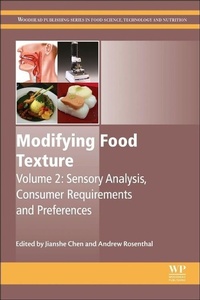
Modifying Food Texture
Volume 2: Sensory Analysis, Consumer Requirements and Preferences
Published on 10. June 2015
Book
Hardback
300 pages
978-1-78242-334-8 (ISBN)
Description
Modifying Food Texture, Volume 2: Sensory Analysis, Consumer Requirements and Preferences explores texture as an important aspect of consumer food acceptance and preference, specifically addressing the food textural needs of infants, the elderly, and dysphagia patients.
This volume covers the sensory analysis of texture-modified foods, taking an in-depth look at the product development needs of consumers and exploring the sensory analysis of food texture and the development of texture-modified foods.
This volume covers the sensory analysis of texture-modified foods, taking an in-depth look at the product development needs of consumers and exploring the sensory analysis of food texture and the development of texture-modified foods.
More details
Language
English
Place of publication
Cambridge
United Kingdom
Publishing group
Elsevier Science & Technology
Target group
Professional and scholarly
R&D managers in the food industry, particularly those concentrating on niche consumer products and food formulation; hospital dietitians; postgraduate students and academics with a research interest in the area
Product notice
sewn/stitched
Cloth over boards
Dimensions
Height: 236 mm
Width: 154 mm
Thickness: 22 mm
Weight
611 gr
ISBN-13
978-1-78242-334-8 (9781782423348)
Copyright in bibliographic data and cover images is held by Nielsen Book Services Limited or by the publishers or by their respective licensors: all rights reserved.
Schweitzer Classification
Other editions
Additional editions
E-Book
01/2015
Elsevier
€170.00
Available for download
Jianshe Chen | Andrew Rosenthal
Modifying Food Texture
Volume 2: Sensory Analysis, Consumer Requirements and Preferences
E-Book
01/2015
Elsevier
€155.00
Available for download
Persons
Dr. Jianshe Chen is a senior lecturer and associate professor in Food Science at the University of Leeds, UK. He is fellow of the Institute of Food Science & Technology (IFST), serving the committee of IFST North England Branch, and the Royal Society of Chemistry Food Group committee. He is editor of the Journal of Texture Studies and a member of editorial board of Food Digestion. He is also a visiting professor to Tianjin University of Science and Technology (China) and China Jiliang University. Prior to his job in Leeds, he had worked as a research scientist in National Starch and Chemical, post-doctoral research fellow in the University of Leeds and the University of Hull (UK), and a lecturer in Zhejiang Gongshang University (China). Andrew Rosenthal started at Coventry University in August 2013 after nearly 25 years at Oxford Brookes University. He is a Food Scientist with research interests in the functional properties of food components and how they contribute to food texture. To this end he has worked on rheological, surface and thermal properties of food materials along with an interest in their sensory properties. As an educationalist he has undertaken pedagogic research arising from a passion for e-learning and the teaching of transferable skills to science undergraduates. Following a HEFCE teaching assessment, Andrew gained FDTL funding to develop what was recognised as good practice in the creation of a Food Video Library - the footage (now on DVD) is available on request for the teaching of food processing operations.
Content
Preface
1 Vocabularies and terminologies of food texture appreciation
Fumiyo Hayakawa, National Food Research Institute, Japan
Part One Sensory analysis and consumer preference of food texture
2 Sensory changes with ageing
Lisa Duizer, University of Guelph, Canada
3 Statistical methods and tools for analysing sensory food texture
Peter Ho, The University of Leeds, UK
4 Instrumental characterisation of texture properties of solid and semi-solid food
Andrew Rosenthal, Coventry University, UK
5 Instrumental characterisation of textural properties of fluid food
Guido Sala, WUR, Netherlands
Part Two Modifying texture for specific consumer groups
6 Texture-modified meals for hospital patients (e.g. dysphagia)
Julie Cichero, University of Queensland, Australia
7 Texture modification for elderly people
Karin Wendin, SIK, Sweden
8 Modifying the texture of foods for infants and young children
Sophie Nicklaus, INRA, France
9 Texture design of institutional food (e.g. schools, hospitals)
Derek Johnson, National Association of Care Catering, UK
10 Texture design of 'free from' foods (e.g. GF bread)
Maria Papageorgiou, ATEI of Thessaloniki, Greece
1 Vocabularies and terminologies of food texture appreciation
Fumiyo Hayakawa, National Food Research Institute, Japan
Part One Sensory analysis and consumer preference of food texture
2 Sensory changes with ageing
Lisa Duizer, University of Guelph, Canada
3 Statistical methods and tools for analysing sensory food texture
Peter Ho, The University of Leeds, UK
4 Instrumental characterisation of texture properties of solid and semi-solid food
Andrew Rosenthal, Coventry University, UK
5 Instrumental characterisation of textural properties of fluid food
Guido Sala, WUR, Netherlands
Part Two Modifying texture for specific consumer groups
6 Texture-modified meals for hospital patients (e.g. dysphagia)
Julie Cichero, University of Queensland, Australia
7 Texture modification for elderly people
Karin Wendin, SIK, Sweden
8 Modifying the texture of foods for infants and young children
Sophie Nicklaus, INRA, France
9 Texture design of institutional food (e.g. schools, hospitals)
Derek Johnson, National Association of Care Catering, UK
10 Texture design of 'free from' foods (e.g. GF bread)
Maria Papageorgiou, ATEI of Thessaloniki, Greece