

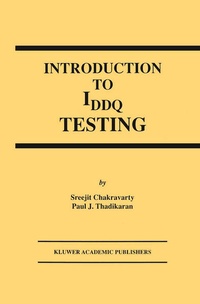
Introduction to IDDQ Testing
Published on 30. June 1997
Book
Hardback
XIX, 323 pages
978-0-7923-9945-2 (ISBN)
Description
Testing techniques for VLSI circuits are undergoing many exciting changes. The predominant method for testing digital circuits consists of applying a set of input stimuli to the IC and monitoring the logic levels at primary outputs. If, for one or more inputs, there is a discrepancy between the observed output and the expected output then the IC is declared to be defective.
A new approach to testing digital circuits, which has come to be known as I DDQ testing, has been actively researched for the last fifteen years. In I DDQ testing, the steady state supply current, rather than the logic levels at the primary outputs, is monitored. Years of research suggests that I DDQ testing can significantly improve the quality and reliability of fabricated circuits. This has prompted many semiconductor manufacturers to adopt this testing technique, among them Philips Semiconductors, Ford Microelectronics, Intel, Texas Instruments, LSI Logic, Hewlett-Packard, SUN microsystems, Alcatel, and SGS Thomson.
This increase in the use of I DDQ testing should be of interest to three groups of individuals associated with the IC business: Product Managers and Test Engineers, CAD Tool Vendors and Circuit Designers.
Introduction to I DDQ Testing is designed to educate this community. The authors have summarized in one volume the main findings of more than fifteen years of research in this area.
A new approach to testing digital circuits, which has come to be known as I DDQ testing, has been actively researched for the last fifteen years. In I DDQ testing, the steady state supply current, rather than the logic levels at the primary outputs, is monitored. Years of research suggests that I DDQ testing can significantly improve the quality and reliability of fabricated circuits. This has prompted many semiconductor manufacturers to adopt this testing technique, among them Philips Semiconductors, Ford Microelectronics, Intel, Texas Instruments, LSI Logic, Hewlett-Packard, SUN microsystems, Alcatel, and SGS Thomson.
This increase in the use of I DDQ testing should be of interest to three groups of individuals associated with the IC business: Product Managers and Test Engineers, CAD Tool Vendors and Circuit Designers.
Introduction to I DDQ Testing is designed to educate this community. The authors have summarized in one volume the main findings of more than fifteen years of research in this area.
More details
Series
Edition
1997 ed.
Language
English
Place of publication
New York
United States
Target group
Professional and scholarly
Research
Illustrations
XIX, 323 p.
Dimensions
Height: 241 mm
Width: 160 mm
Thickness: 24 mm
Weight
688 gr
ISBN-13
978-0-7923-9945-2 (9780792399452)
DOI
10.1007/978-1-4615-6137-8
Schweitzer Classification
Other editions
Additional editions
S. Chakravarty | Paul J. Thadikaran
Introduction to IDDQ Testing
E-Book
12/2012
Springer
€96.29
Available for download
S. Chakravarty | Paul J. Thadikaran
Introduction to IDDQ Testing
Book
10/2012
Springer
€106.99
Shipment within 7-9 days
Content
1 Introduction.- 2 Why IDDQ Testing?.- 3 Putting IDDQ Testing to Work.- 4 Physical Defects.- 5 Test Suites, Fault Models, Test Sets and Defects.- 6 Evaluating IDDQ Tests.- 7 Selecting IDDQ Tests.- 8 Computing IDDQ Tests.- 9 Fault Diagnosis.- 10 Instrumentation for IDDQ Measurement.- References.