

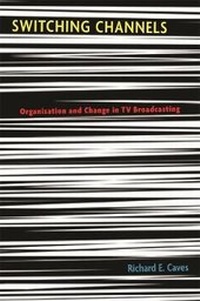
Switching Channels
Organization and Change in TV Broadcasting
Published on 15. September 2005
Book
Hardback
376 pages
978-0-674-01878-5 (ISBN)
Description
Media critics invariably disparage the quality of programming produced by the U.S. television industry. But why the industry produces what it does is a question largely unasked. It is this question, at the crux of American popular culture, that Switching Channels explores.
In the past twenty-five years, the expansion of cable and satellite systems has transformed television. Richard Caves examines the economics of this phenomenon--and the nature and logic of the broadcast networks' response to the incursion of cable TV, especially the shift to inexpensive unscripted game and "reality" shows and "news" magazines. An explanation of these changes, Caves argues, requires an understanding of two very different sectors: the "creative industry," which produces programs; and the commercial channels, which bring them to viewers. His book shows how distributors' judgment of profitability determines the quality and character of the programs the creative industry produces. This determination, writes Caves, depends on the number and types of viewers that various programs can attract and advertisers' willingness to pay for their attention, as well as the organization of the networks that package programs, the distributors that transmit them, and the deals these parties strike with one another.
In the past twenty-five years, the expansion of cable and satellite systems has transformed television. Richard Caves examines the economics of this phenomenon--and the nature and logic of the broadcast networks' response to the incursion of cable TV, especially the shift to inexpensive unscripted game and "reality" shows and "news" magazines. An explanation of these changes, Caves argues, requires an understanding of two very different sectors: the "creative industry," which produces programs; and the commercial channels, which bring them to viewers. His book shows how distributors' judgment of profitability determines the quality and character of the programs the creative industry produces. This determination, writes Caves, depends on the number and types of viewers that various programs can attract and advertisers' willingness to pay for their attention, as well as the organization of the networks that package programs, the distributors that transmit them, and the deals these parties strike with one another.
Reviews / Votes
This book is a successful effort to subject to economic analysis an industry that has undergone substantial organizational changes within a short time and that is marked by quite peculiar structural properties and production practices. Caves ingeniously sorts out the industry's peculiarities and reads the economic meaning and implications of its "tribal customs." -- Dick Netzer, Robert F. Wagner Graduate School of Public Service, New York University In Switching Channels, Richard Caves has done a great job bringing together a vast amount of disparate information to provide a comprehensive framework for the study of television broadcasting. The book covers everything from syndication through the rise of cable networks. -- S. Mark Young, Marshall School of Business, University of Southern California Richard E. Caves [is] the don of entertainment economics. -- Austan Goolsbee * New York Times *More details
Language
English
Place of publication
Cambridge, Mass
United States
Target group
Professional and scholarly
Illustrations
13 tables
Dimensions
Height: 210 mm
Width: 140 mm
ISBN-13
978-0-674-01878-5 (9780674018785)
Copyright in bibliographic data and cover images is held by Nielsen Book Services Limited or by the publishers or by their respective licensors: all rights reserved.
Schweitzer Classification
Other editions
Additional editions
E-Book
07/2009
Harvard University Press
€57.19
Available for download
Person
Richard E. Caves is Nathaniel Ropes Research Professor of Political Economy at Harvard University.
Content
Contents Preface Introduction I. TV PROGRAMS AS CREATIVE GOODS 1. The Market for Broadcast Network Programming 2. Syndication 3. The Public Broadcasting System II. SWITCHING CHANNELS AND PROGRAM QUALITY 4. The Squeeze on Broadcasters' Rents 5. Cable Networks and Upgraded Cable Programming 6. Broadcast Networks, Stations, and Rents III. BARGAINING TABLES AND MEDIA CONGLOMERATES 7. Program Supply, Integration, and the Fin-Syn Rules 8. Broadcast Stations: Lengthening the Chains 9. Cable Networks and Cable Operators: Ownership Links and Carriage Decisions Epilogue Appendix A. Determinants of Affiliates' Compensation Appendix B. Gains for Chains in Radio Notes Selected References Index