

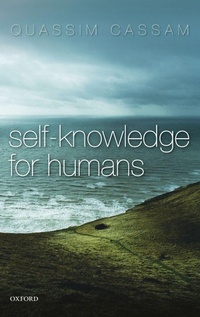
Self-Knowledge for Humans
Published on 27. November 2014
Book
Hardback
254 pages
978-0-19-965757-5 (ISBN)
Description
Human beings are not model epistemic citizens. Our reasoning can be careless and uncritical, and our beliefs, desires, and other attitudes aren't always as they ought rationally to be. Our beliefs can be eccentric, our desires irrational and our hopes hopelessly unrealistic. Our attitudes are influenced by a wide range of non-epistemic or non-rational factors, including our character, our emotions and powerful unconscious biases. Yet we are rarely conscious of such influences. Self-ignorance is not something to which human beings are immune.
In this book Quassim Cassam develops an account of self-knowledge which tries to do justice to these and other respects in which humans aren't model epistemic citizens. He rejects rationalist and other mainstream philosophical accounts of self-knowledge on the grounds that, in more than one sense, they aren't accounts of self-knowledge for humans. Instead he defends the view that inferences from behavioural and psychological evidence are a basic source of human self-knowledge. On this account, self-knowledge is a genuine cognitive achievement and self-ignorance is almost always on the cards.
As well as explaining knowledge of our own states of mind, Cassam also accounts for what he calls 'substantial' self-knowledge, including knowledge of our values, emotions, and character. He criticizes philosophical accounts of self-knowledge for neglecting substantial self-knowledge, and concludes with a discussion of the value of self-knowledge.
This book tries to do for philosophy what behavioural economics tries to do for economics. Just as behavioural economics is the economics of homo sapiens, as distinct from the economics of an ideally rational homo economicus, so Cassam argues that philosophy should focus on the human predicament rather on the reasoning and self-knowledge of an idealized homo philosophicus.
In this book Quassim Cassam develops an account of self-knowledge which tries to do justice to these and other respects in which humans aren't model epistemic citizens. He rejects rationalist and other mainstream philosophical accounts of self-knowledge on the grounds that, in more than one sense, they aren't accounts of self-knowledge for humans. Instead he defends the view that inferences from behavioural and psychological evidence are a basic source of human self-knowledge. On this account, self-knowledge is a genuine cognitive achievement and self-ignorance is almost always on the cards.
As well as explaining knowledge of our own states of mind, Cassam also accounts for what he calls 'substantial' self-knowledge, including knowledge of our values, emotions, and character. He criticizes philosophical accounts of self-knowledge for neglecting substantial self-knowledge, and concludes with a discussion of the value of self-knowledge.
This book tries to do for philosophy what behavioural economics tries to do for economics. Just as behavioural economics is the economics of homo sapiens, as distinct from the economics of an ideally rational homo economicus, so Cassam argues that philosophy should focus on the human predicament rather on the reasoning and self-knowledge of an idealized homo philosophicus.
Reviews / Votes
I highly recommend Cassam's book. It provides a deep, yet admirably accessible study of self-knowledge and surrounding issues, and is full of helpful and often surprising insights. * Michael Roche, Mississippi State University, The Philosophical Quarterly * A particular virtue of the book is its unwavering insistence that philosophical views about self-knowledge must be judged by their fidelity to what self-knowledge actually is, namely, an untidy phenomenon in the lives of cognitively limited creatures...Cassam's realist outlook is sensible and refreshing, and his effort to bring philosophical attention to neglected issues about self-knowledge is commendable. * Brie Gertler, Mind * Valuable for those interested in epistemology, philosophy of mind, and philosophical psychology ... Highly recommended. * Choice * is a truly fine book. It is clearly and elegantly written, and metes out criticism fairly while developing a number of lines of powerful argument. It demonstrates where most philosophical discussions of self-knowledge have gone astray, puts forward a plausible positive theory of insubstantial self-knowledge, and makes an important start on the project of examining the nature and importance of substantial self-knowledge. It deserves to be widely read. * Notre Dame Philosophical Reviews Online *More details
Language
English
Place of publication
Oxford
United Kingdom
Target group
College/higher education
Professional and scholarly
Dimensions
Height: 240 mm
Width: 161 mm
Thickness: 20 mm
Weight
596 gr
ISBN-13
978-0-19-965757-5 (9780199657575)
Copyright in bibliographic data and cover images is held by Nielsen Book Services Limited or by the publishers or by their respective licensors: all rights reserved.
Schweitzer Classification
Other editions
Additional editions
Quassim Cassam
Self-Knowledge for Humans
Book
11/2016
Oxford University Press
€46.80
Shipment within 15-20 days
Quassim Cassam
Self-Knowledge for Humans
E-Book
11/2014
1st Edition
OUP eBook
€20.99
Available for download
Quassim Cassam
Self-Knowledge for Humans
E-Book
11/2014
1st Edition
OUP Oxford
€69.49
Available for download
Person
Quassim Cassam is Professor of Philosophy at the University of Warwick. He was previously Knightbridge Professor of Philosophy at Cambridge, and has also taught at Oxford and UCL. He is the author of Self and World (OUP, 1997), The Possibility of Knowledge (OUP, 2007) and, with John Campbell, Berkeley's Puzzle: What Does Experience Teach Us? (OUP, 2014).
Content
Preface ; 1. Homo Philosophicus ; 2. The Disparity ; 3. Substantial Self-Knowledge ; 4. Self-Knowledge for Philosophers ; 5. Reality Check ; 6. Psychological Rationalism ; 7. Normative Rationalism ; 8. Predictably Irrational? ; 9. Looking Outwards ; 10. Looking Inwards ; 11. Self-Knowledge and Inference ; 12. Knowing Your Evidence ; 13. Knowing Yourself ; 14. Self-Ignorance ; 15. The Value of Self-Knowledge ; Bibliography ; Index