

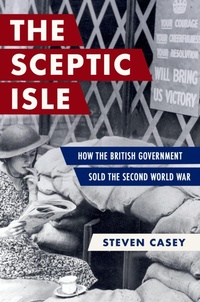
The Sceptic Isle
How the British Government Sold the Second World War
Will be published approx. on 27. August 2026
Book
Hardback
392 pages
978-0-19-778187-6 (ISBN)
Description
A major reassessment of the British government's communication of the goals of the Second World War and how its propaganda undermined the people's faith in the reliability of war news and the credibility of political leaders.
While waging war against enemies overseas, governments also need to win the hearts and minds of their own citizens. The media is critical to delivering the official message, raising public support for war, maintaining morale, spelling out what is to be achieved, downplaying setbacks, and presenting a bright vision of the postwar future. ln public memory, the British people were united in their support for the Second World War. Yet this popular image of the People's War neglects the fact that the war had to be sold.
In this work stretching from appeasement in 1938 through victory, award-winning historian Steven Casey examines how media, government, and armed forces worked to convince the British public to support the war, as well as the ways the British home front often questioned and challenged the official line. Using a vast array of primary sources, some of them previously untapped, he looks at the broad range of problems and policies that needed to be defended and explained, censored and concealed. The venues range widely from the battlefield to the football field, from the rubble-strewn cities of blitzed Britain to the faraway outposts of Empire. ln his chronological narrative of the war, Casey shines light on numerous high-profile episodes, including Munich and Dunkirk, the Battle of Britain and the Blitz, evacuation and rationing, and the campaigns in Africa, Asia, and Europe. Throughout, Casey stresses how the British military forged a relationship with reporters, how this relationship shaped news coverage of the fighting, and how this coverage in turn exerted a profound impact on every other dimension of the government's private and public actions. No one before has examined how all the branches of the armed services kept the home front informed about progress and especially setbacks. Officials, Casey argues, failed to communicate effectively with the British people, which undermined public trust and called the credibility of the political leadership into question. Remarkably, the BBC and Fleet Street sometimes relayed German communiques to the public because the British government failed to release timely reports of its own.
The Sceptic Isle provides a bold reassessment of how the British government sold the Second World War to the British public. It powerfully showcases how the attempt to mould and manipulate coverage of battles created a major credibility gap that cast a long shadow over the British government's efforts to sell the different dimensions of the Second World War to the home front.
While waging war against enemies overseas, governments also need to win the hearts and minds of their own citizens. The media is critical to delivering the official message, raising public support for war, maintaining morale, spelling out what is to be achieved, downplaying setbacks, and presenting a bright vision of the postwar future. ln public memory, the British people were united in their support for the Second World War. Yet this popular image of the People's War neglects the fact that the war had to be sold.
In this work stretching from appeasement in 1938 through victory, award-winning historian Steven Casey examines how media, government, and armed forces worked to convince the British public to support the war, as well as the ways the British home front often questioned and challenged the official line. Using a vast array of primary sources, some of them previously untapped, he looks at the broad range of problems and policies that needed to be defended and explained, censored and concealed. The venues range widely from the battlefield to the football field, from the rubble-strewn cities of blitzed Britain to the faraway outposts of Empire. ln his chronological narrative of the war, Casey shines light on numerous high-profile episodes, including Munich and Dunkirk, the Battle of Britain and the Blitz, evacuation and rationing, and the campaigns in Africa, Asia, and Europe. Throughout, Casey stresses how the British military forged a relationship with reporters, how this relationship shaped news coverage of the fighting, and how this coverage in turn exerted a profound impact on every other dimension of the government's private and public actions. No one before has examined how all the branches of the armed services kept the home front informed about progress and especially setbacks. Officials, Casey argues, failed to communicate effectively with the British people, which undermined public trust and called the credibility of the political leadership into question. Remarkably, the BBC and Fleet Street sometimes relayed German communiques to the public because the British government failed to release timely reports of its own.
The Sceptic Isle provides a bold reassessment of how the British government sold the Second World War to the British public. It powerfully showcases how the attempt to mould and manipulate coverage of battles created a major credibility gap that cast a long shadow over the British government's efforts to sell the different dimensions of the Second World War to the home front.
Reviews / Votes
Timely' is all too often applied to books by their publishers, but in an age where communication is all, this history more than merits it. * The Telegraph * A gripping account that punctures the myth of a 'People's War' and reveals the immense political effort spent managing fear, hope, and frustration. * FRANK TRENTMANN, author of Out of the Darkness: The Germans, 1942-2022 * From 1939 to 1945, the British people overwhelmingly supported the war effort while often distrusting the willingness of their government to tell them the plain facts about what was going on. Steven Casey's absorbing and richly researched history of the propaganda battle in the forties reminds us that public cynicism and suspicion in wartime are nothing new. * ALAN ALLPORT, author of Advance Britannia: How the Second World War Was Won, 1942-1945 * Drawing on Home Intelligence reports to good effect, Steven Casey tells the history of Britain's Second World War as seen through cracks in the facade of 'morale'. While providing a smoothly readable narrative of more or less familiar events, Casey puts a new spin on them by showing the British public and press to be attentive, probing, and yes, sceptical recipients of the messages disseminated by their government during the war. * ERIK LINSTRUM, author of Age of Emergency: Living with Violence at the End of the British Empire *More details
Language
English
Place of publication
New York
United States
Target group
Professional and scholarly
College/higher education
Illustrations
25 black and white halftones
Dimensions
Height: 235 mm
Width: 156 mm
Thickness: 31 mm
Weight
703 gr
ISBN-13
978-0-19-778187-6 (9780197781876)
Copyright in bibliographic data and cover images is held by Nielsen Book Services Limited or by the publishers or by their respective licensors: all rights reserved.
Schweitzer Classification
Person
Steven Casey is Professor of International History The London School of Economics and Political Science. He is the author of eleven multi-awarding-winning books, including Cautious Crusade: Franklin D. Roosevelt, American Public Opinion and Nazi Germany, 1941-45 (OUP, 2001); Selling the Korean War: Propaganda, Politics, and the Press in the United States, 1950-1953 (OUP, 2008); The War Beat, Europe: The American Media at War against Nazi Germany (OUP, 2017); and The War Beat, Pacific: The American Media at War against Japan (OUP, 2021). His articles appear in such outlets as Foreign Affairs, History Today, the Sydney Morning Herald, and The Spectator.
Content
Acknowledgments
Introduction 1. Appeasement 2. Adjustment 3. Disaster 4. Destruction 5. Fightback 6. Morale 7. Mobilization 8. Empire 9. Allies 10. Return 11. Visions 12. Victory Conclusion Notes
Bibliography
Index
Introduction 1. Appeasement 2. Adjustment 3. Disaster 4. Destruction 5. Fightback 6. Morale 7. Mobilization 8. Empire 9. Allies 10. Return 11. Visions 12. Victory Conclusion Notes
Bibliography
Index