

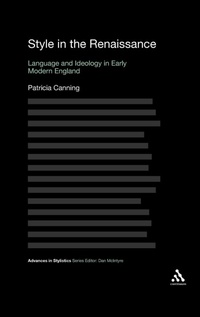
Style in the Renaissance
Language and Ideology in Early Modern England
Published on 26. July 2012
Book
Hardback
224 pages
978-1-4411-8552-5 (ISBN)
Description
Within the historical literary genre, stylistics is widely applicable but as yet under deployed. This book acts as a showcase for the range of analysis possible. Although the analytic focus within the genre has traditionally been on literary criticism, stylistics has much to offer. Bringing together text and context, Patricia Canning synthesizes stylistic models with literary theory and critical theory. The historical and contextual focus throughout the book is on religious, political and ideological issues that animated and defined Reformation England. Each chapter interrogates the dichotomous concept of 'word' and 'image' by considering the ways in which writers of this period deal with these contentious subjects in their dramatic and poetic works. 'Representation' is proposed not just as a matter of semiotics but of ideology.
Reviews / Votes
Patricia Canning's adventurous interdisciplinary study brings together in new and exciting ways the two fields of linguistics and literary criticism in her examination of selected texts by Shakespeare and his contemporaries. The range and detail of her analysis, evident especially in her microscopic examination of linguistic forms, cultural assumptions, and historical contexts in plays by Shakespeare and Middleton, and in the poetry of George Crashaw, is impressive. Here is a rare combination of strenuous scholarly rigour, and uncompromising analysis, replete with a full and clear awareness of what interdisciplinarity involves. A welcome new voice offering unique insights into texts that we thought we knew. -- Professor John Drakakis, University of Stirling, UK Canning's book opens new and exciting avenues for literary and stylistic investigation, while making an important contribution to the study of English Renaissance. Elegantly combining cognitive poetics focus with more traditional historically situated analysis yields a multi-faceted scholarly perspective from which scholars of many orientations can learn. The work is a model example of how the gap between linguistics and literature can be bridged for the benefit of both disciplines. -- Barbara Dancygier, University of British Columbia, Canada Patricia Canning provides a reading of Macbeth informed by contemporary stylistics in [the chapter entitled] "A Deed Without A Name" . . . Canning patiently explains her approach as it progresses, and her methodology will be of special interest to those working in stylistics. -- Johann Gregory * The Year's Work in English Studies *More details
Series
Language
English
Place of publication
New York
United States
Target group
College/higher education
Dimensions
Height: 240 mm
Width: 161 mm
Thickness: 17 mm
Weight
505 gr
ISBN-13
978-1-4411-8552-5 (9781441185525)
Copyright in bibliographic data and cover images is held by Nielsen Book Services Limited or by the publishers or by their respective licensors: all rights reserved.
Schweitzer Classification
Other editions
Additional editions
E-Book
05/2012
1st Edition
Bloomsbury Continuum
€42.99
Available for download
E-Book
05/2012
1st Edition
Continuum Publishing Corporation
€42.99
Available for download
Person
Patricia Canning is a Teaching Assistant at the School of English, Queen's University, Belfast, Northern Ireland.
Content
1. Introduction: 'In the beginning was the Word'; 2. Early Modern Understanding of the Monarch as a Double Body; 3. Constructing Plausible Stories: ideology, conceptual integration theory and the politics of representation; 4. Macbeth, Murder, and the Linguistics of Agency: "A deed without a name"; 5. Metonymy in Middleton's The Revenger's Tragedy and Webster's The White Devil: 'Bit Part' Actors; 6. Ekphrasis and The Word as Image in Early Modern Poetry: "Iconoclash". 7. Conclusion: the 'value' of the word; Bibliography; Index.