

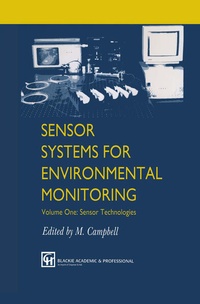
Sensor Systems for Environmental Monitoring
Volume One: Sensor Technologies
Published on 20. September 2011
Book
Paperback/Softback
XVIII, 310 pages
978-94-010-7202-1 (ISBN)
Description
1 Fibre optic sensors.- 1.1 Introduction to fibre optics.- 1.1.1 The need for environmental monitoring and new technology.- 1.1.2 Advantages and disadvantages of fibre optic sensors.- 1.2 Physical principles of fibre optic chemical sensors.- 1.2.1 Absorption sensors.- 1.2.2 Sensing through indicator dyes.- 1.2.3 Fluorescence sensors.- 1.2.4 Raman sensors.- 1.2.5 Refractive index and optical path length sensors.- 1.2.6 Evanescent field sensors.- 1.3 Sensor construction and basic types.- 1.3.1 Fibre optics with absorption cells.- 1.3.2 Fibre opt(r)odes.- 1.3.3 Evanescent field sensor types.- 1.3.4 Sol¿gel coatings.- 1.3.5 Other types of sensor construction.- 1.3.6 Source and detector considerations.- 1.4 Examples of fibre optic sensors for environmental applications.- 1.4.1 Air pollutants.- 1.4.2 Seawater monitoring.- 1.4.3 Ground and drinking water contamination.- 1.4.4 Soil contamination.- 1.5 Conclusion.- 1.5.1 Summary.- 1.5.2 Future trends.- References.- 2 Integrated optic sensors.- 2.1 Introduction to integrated optics.- 2.1.1 Waveguides.- 2.1.2 Waveguide couplers.- 2.1.3 Optical modulators and switches.- 2.1.4 Integrated optic light sources.- 2.1.5 Integrated optical detectors.- 2.2 Fabrication of integrated optic devices.- 2.2.1 Materials for integrated optic devices.- 2.2.2 Fabrication and modification of thin films.- 2.2.3 Patterning processes.- 2.3 Sensor techniques in integrated optics.- 2.3.1 Evanescent waves.- 2.3.2 Spectroscopy.- 2.3.3 Ellipsometry.- 2.3.4 Surface plasmon resonance.- 2.3.5 Light scattering.- 2.3.6 Optical biosensors.- 2.4 Applications of integrated optic devices for environmental sensing.- 2.4.1 An integrated optic biosensor.- 2.4.2 An integrated optic gas sensor.- 2.5 Conclusions.- References.- 3 Laser-based sensors.- 3.1 Introduction.- 3.2 Laser mass spectrometry.- 3.2.1 Resonance ionisation mass spectrometry.- 3.2.2 Factors determining the experimental arrangement.- 3.2.3 Ultra-trace detection of explosive molecules using REMPI.- 3.2.4 Trace detection of urban impurities.- 3.2.5 Trace detection of radiotoxic isotopes by RIMS.- 3.3 Laser remote sensing.- 3.3.1 LIDAR.- 3.3.2 DIAL.- 3.4 Applications of LIDAR.- 3.4.1 Mie scattering LIDAR.- 3.4.2 Raman LIDAR.- 3.4.3 Fluorescence LIDAR.- 3.5 DIAL.- 3.6 Laser absorption spectroscopy.- 3.6.1 Transmission methods.- 3.6.2 Direct laser absorption methods.- 3.6.3 Fixed frequency laser IR spectroscopy.- 3.6.4 Photoacoustic spectroscopy.- 3.6.5 Thermal lens spectroscopy (TLS).- References.- 4 Electrochemical sensors.- 4.1 Introduction.- 4.2 Voltammetric and potentiometrie techniques.- 4.2.1 Background.- 4.2.2 Applications.- 4.3 Microelectrode voltammetric sensors.- 4.3.1 The microelectrode sensor.- 4.3.2 Principle of operation.- 4.3.3 Fabrication techniques.- 4.3.4 Microelectrode measurement system considerations.- 4.3.5 Linear ramp cyclic voltammetric measurement systems.- 4.3.6 Anodic stripping analysis.- 4.3.7 Diagnostic techniques.- 4.4 Thick film sensors.- 4.4.1 Chemical environmental sensor arrays.- 4.4.2 Palintest disposable sensors.- 4.5 Ion-selective electrodes.- 4.5.1 Ion-sensitive field effect transistors.- 4.6 Summary.- References.- 5 Gas sensors and analysers.- 5.1 Gas sensors.- 5.1.1 Portable gas detectors.- 5.1.2 Portable continuous gas monitors.- 5.1.3 Fixed continuous gas measurement installations.- 5.2 Principles of gas detection.- 5.3 Catalytic oxidation gas sensors.- 5.3.1 Unembedded resistance filament sensors.- 5.3.2 Catalytic oxidation pellistors.- 5.4 Thermal conductivity pellistors.- 5.4.1 An inexpensive gas alarm for CO2 leakages.- 5.4.2 MSA model LV combustible gas indicator.- 5.5 Taguchi sintered semiconductor sensors.- 5.5.1 Principle of operation.- 5.5.2 Diffusion-reaction model.- 5.5.3 Thermal cycling of TGS heating filaments.- 5.6 Recent developments.- 5.6.1 Electronic noses.- 5.6.2 Metal oxide sensors.- 5.6.3 Single crystal thin film sensors.- 5.6.4 Thin film metal oxide sensors.- 5.6.5 Incorporation of catalysts.- 5.7 Zirconia devices.- 5.8 Organic conductors.- 5.8.1 Metal phthalocyanine sensors.- 5.8.2 Other materials.- 5.9 Conducting polymer sensors.- 5.10 Electrochemical cells for gas sensing.- 5.10.1 Clark cells.- 5.10.2 Metallised membrane cells.- 5.10.3 CiTiceLs for O2 measurements.- 5.10.4 Toxic gas cells.- 5.11 Gas analysers.- 5.11.1 Introduction.- 5.11.2 Principles of operation.- 5.11.3 Differential optical absorption spectroscopy.- 5.11.4 Fourier transform IR spectroscopy.- 5.11.5 Differential absorption LIDAR.- 5.11.6 Laser-induced fluorescence.- 5.11.7 Chemiluminescent techniques.- 5.11.8 Jamin type interferometer.- 5.12 Conclusions.- References.- 6 Piezoelectric sensors.- 6.1 Introduction.- 6.2 Piezoelectric crystal theory.- 6.3 Instrumentation.- 6.4 Gas analysis.- 6.5 Piezoelectric aerosol sensors.- 6.6 Piezoelectric crystal liquid sensors.- 6.7 PZ sensor coatings operating in liquids.- References.- 7 Biosensor devices.- 7.1 General introduction.- 7.2 The enzyme electrode.- 7.2.1 Enzyme kinetics.- 7.2.2 Inhibition of catalysis.- 7.2.3 Kinetic and mass transport considerations for an enzyme electrode.- 7.3 Preparation of the immobilised enzyme layer.- 7.3.1 Gel entrapment.- 7.3.2 Adsorption.- 7.3.3 Covalent immobilization.- 7.3.4 Immobilisation of enzymes to metal electrodes.- 7.3.5 Immobilisation of enzymes to carbon electrodes.- 7.3.6 Immobilisation in an electrochemically grown organic polymer.- 7.4 Theoretical considerations for amperometric enzyme electrodes.- 7.5 Enzyme electrodes for substances of environmental interest.- 7.5.1 Pesticides.- 7.5.2 Phenols.- 7.5.3 Heavy metals.- 7.5.4 Mass manufacture of enzyme electrodes.- 7.6 Whole cell sensors.- 7.6.1 Microbial biosensors.- 7.6.2 Theoretical considerations.- 7.6.3 Immobilisation of microbial whole cells.- 7.6.4 Methods of monitoring whole cells.- 7.6.5 Applications.- 7.7 Immunosensors.- 7.7.1 Kinetics of antigen¿antibody binding.- 7.7.2 Immobilisation of antibodies.- 7.8 Schemes for electrochemical/electrical immunosensors.- 7.8.1 Reagentless immunoprobes.- 7.8.2 Semiconductor systems.- 7.8.3 Piezoelectric systems.- 7.8.4 Voltammetric immunoassay schemes.- 7.9 Conclusions.- References.- 8 Automated measurement.- 8.1 Introduction.- 8.2 General principles.- 8.2.1 Sampling.- 8.2.2 Resolution.- 8.3 Analogue interfacing.- 8.3.1 Buffer amplifier.- 8.3.2 Voltage attenuator.- 8.3.3 Amplification.- 8.3.4 Current-to-voltage converters.- 8.3.5 Filters.- 8.3.6 Sample and hold circuits.- 8.4 Digital interfacing.- 8.4.1 Introduction.- 8.4.2 The general purpose interface bus: IEEE.488.2.- 8.4.3 Serial interface standards.- 8.4.4 VME/VXIbus.- 8.4.5 CAMAC.- 8.4.6 HART field communication protocol.- 8.4.7 Networks and fieldbus.- 8.5 Hardware aspects.- 8.5.1 Computers.- 8.5.2 Rack-based systems.- 8.5.3 Interface boards/modules.- 8.5.4 Data loggers.- 8.5.5 Portable data-acquisition systems.- 8.6 Software.- 8.7 Summary.- Further reading.
More details
Edition
Softcover reprint of the original 1st ed. 1997
Language
English
Place of publication
Dordrecht
Netherlands
Target group
Professional and scholarly
Research
Illustrations
XVIII, 310 p.
Dimensions
Height: 235 mm
Width: 155 mm
Thickness: 19 mm
Weight
505 gr
ISBN-13
978-94-010-7202-1 (9789401072021)
DOI
10.1007/978-94-009-1571-8
Schweitzer Classification
Other editions
Additional editions
Book
12/1996
Chapman and Hall
€213.99
Shipment within 15-20 days
Content
1 Fibre optic sensors.- 1.1 Introduction to fibre optics.- 1.2 Physical principles of fibre optic chemical sensors.- 1.3 Sensor construction and basic types.- 1.4 Examples of fibre optic sensors for environmental applications.- 1.5 Conclusion.- References.- 2 Integrated optic sensors.- 2.1 Introduction to integrated optics.- 2.2 Fabrication of integrated optic devices.- 2.3 Sensor techniques in integrated optics.- 2.4 Applications of integrated optic devices for environmental sensing.- 2.5 Conclusions.- References.- 3 Laser-based sensors.- 3.1 Introduction.- 3.2 Laser mass spectrometry.- 3.3 Laser remote sensing.- 3.4 Applications of LIDAR.- 3.5 DIAL.- 3.6 Laser absorption spectroscopy.- References.- 4 Electrochemical sensors.- 4.1 Introduction.- 4.2 Voltammetric and potentiometrie techniques.- 4.3 Microelectrode voltammetric sensors.- 4.4 Thick film sensors.- 4.5 Ion-selective electrodes.- 4.6 Summary.- References.- 5 Gas sensors and analysers.- 5.1 Gas sensors.- 5.2 Principles of gas detection.- 5.3 Catalytic oxidation gas sensors.- 5.4 Thermal conductivity pellistors.- 5.5 Taguchi sintered semiconductor sensors.- 5.6 Recent developments.- 5.7 Zirconia devices.- 5.8 Organic conductors.- 5.9 Conducting polymer sensors.- 5.10 Electrochemical cells for gas sensing.- 5.11 Gas analysers.- 5.12 Conclusions.- References.- 6 Piezoelectric sensors.- 6.1 Introduction.- 6.2 Piezoelectric crystal theory.- 6.3 Instrumentation.- 6.4 Gas analysis.- 6.5 Piezoelectric aerosol sensors.- 6.6 Piezoelectric crystal liquid sensors.- 6.7 PZ sensor coatings operating in liquids.- References.- 7 Biosensor devices.- 7.1 General introduction.- 7.2 The enzyme electrode.- 7.3 Preparation of the immobilised enzyme layer.- 7.4 Theoretical considerations for amperometric enzyme electrodes.- 7.5 Enzyme electrodes for substances of environmental interest.- 7.6 Whole cell sensors.- 7.7 Immunosensors.- 7.8 Schemes for electrochemical/electrical immunosensors.- 7.9 Conclusions.- References.- 8 Automated measurement.- 8.1 Introduction.- 8.2 General principles.- 8.3 Analogue interfacing.- 8.4 Digital interfacing.- 8.5 Hardware aspects.- 8.6 Software.- 8.7 Summary.- Further reading.