

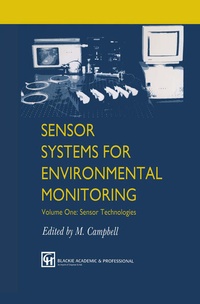
Sensor Systems for Environmental Monitoring
Volume One: Sensor Technologies
Published on 31. December 1996
Book
Hardback
XVIII, 310 pages
978-0-7514-0418-0 (ISBN)
Description
Stringent legislation is forcing manufacturing industry to be aware of the impact its operations have on the environment, in order to control and reduce the affect of those operations. Increasingly sophisticated equipment is required for this monitoring, and development of that equipment and strategies for its use is a multi-disciplinary field involving chemists, analytical scientists and engineers. This volume is divided into two parts, the first introducing the reader to the various sensor systems and illustrating the advantages and disadvantages those systems have for monitoring programmes, and the second introducing the problems associated with environmental monitoring, and showing how the sensors discussed in the first section can be applied to produce a thorough monitoring programme.
More details
Edition
1997 ed.
Language
English
Place of publication
Dordrecht
Netherlands
Target group
College/higher education
Professional and scholarly
Research
Product notice
sewn/stitched
Cloth over boards
Illustrations
XVIII, 310 p.
Dimensions
Height: 234 mm
Width: 156 mm
Thickness: 19 mm
Weight
640 gr
ISBN-13
978-0-7514-0418-0 (9780751404180)
DOI
10.1007/978-94-009-1571-8
Schweitzer Classification
Other editions
Additional editions
E-Book
12/2012
Springer
€213.99
Available for download
Book
09/2011
Springer
€213.99
Shipment within 15-20 days
Content
1 Fibre optic sensors.- 1.1 Introduction to fibre optics.- 1.2 Physical principles of fibre optic chemical sensors.- 1.3 Sensor construction and basic types.- 1.4 Examples of fibre optic sensors for environmental applications.- 1.5 Conclusion.- References.- 2 Integrated optic sensors.- 2.1 Introduction to integrated optics.- 2.2 Fabrication of integrated optic devices.- 2.3 Sensor techniques in integrated optics.- 2.4 Applications of integrated optic devices for environmental sensing.- 2.5 Conclusions.- References.- 3 Laser-based sensors.- 3.1 Introduction.- 3.2 Laser mass spectrometry.- 3.3 Laser remote sensing.- 3.4 Applications of LIDAR.- 3.5 DIAL.- 3.6 Laser absorption spectroscopy.- References.- 4 Electrochemical sensors.- 4.1 Introduction.- 4.2 Voltammetric and potentiometrie techniques.- 4.3 Microelectrode voltammetric sensors.- 4.4 Thick film sensors.- 4.5 Ion-selective electrodes.- 4.6 Summary.- References.- 5 Gas sensors and analysers.- 5.1 Gas sensors.- 5.2 Principles of gas detection.- 5.3 Catalytic oxidation gas sensors.- 5.4 Thermal conductivity pellistors.- 5.5 Taguchi sintered semiconductor sensors.- 5.6 Recent developments.- 5.7 Zirconia devices.- 5.8 Organic conductors.- 5.9 Conducting polymer sensors.- 5.10 Electrochemical cells for gas sensing.- 5.11 Gas analysers.- 5.12 Conclusions.- References.- 6 Piezoelectric sensors.- 6.1 Introduction.- 6.2 Piezoelectric crystal theory.- 6.3 Instrumentation.- 6.4 Gas analysis.- 6.5 Piezoelectric aerosol sensors.- 6.6 Piezoelectric crystal liquid sensors.- 6.7 PZ sensor coatings operating in liquids.- References.- 7 Biosensor devices.- 7.1 General introduction.- 7.2 The enzyme electrode.- 7.3 Preparation of the immobilised enzyme layer.- 7.4 Theoretical considerations for amperometric enzyme electrodes.- 7.5 Enzyme electrodes for substances of environmental interest.- 7.6 Whole cell sensors.- 7.7 Immunosensors.- 7.8 Schemes for electrochemical/electrical immunosensors.- 7.9 Conclusions.- References.- 8 Automated measurement.- 8.1 Introduction.- 8.2 General principles.- 8.3 Analogue interfacing.- 8.4 Digital interfacing.- 8.5 Hardware aspects.- 8.6 Software.- 8.7 Summary.- Further reading.