

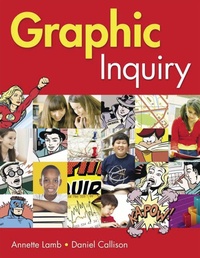
Graphic Inquiry
Published on 3. May 2012
Book
Paperback/Softback
280 pages
978-1-59158-745-3 (ISBN)
Description
This full-color book provides a practical approach to incorporating graphic inquiry across the curriculum for school library media specialists, technology coordinators, and classroom teachers.
It's new. It's graphic. And it is the first of its kind. Designed to bridge theory and actual practice, Graphic Inquiry contains applications for new and practicing educators and librarians that can truly bring classroom learning into the 21st century. This visually rich book provides numerous, standards-based inquiry activities and projects that incorporate traditional materials as well as emerging social and collaborative technologies.
This full-color book provides real-world strategies for integrating graphic inquiry across the curriculum and is specifically designed to help today's educators identify tools and techniques for using graphic inquiry with their students. Although research is cited and references are provided, lengthy text passages are avoided in favor of practical, visual examples rooted in best practice and presented in graphic format. Readers will view this book as a quick reference to timely, realistic activities and approaches as compared to a traditional textbook.
It's new. It's graphic. And it is the first of its kind. Designed to bridge theory and actual practice, Graphic Inquiry contains applications for new and practicing educators and librarians that can truly bring classroom learning into the 21st century. This visually rich book provides numerous, standards-based inquiry activities and projects that incorporate traditional materials as well as emerging social and collaborative technologies.
This full-color book provides real-world strategies for integrating graphic inquiry across the curriculum and is specifically designed to help today's educators identify tools and techniques for using graphic inquiry with their students. Although research is cited and references are provided, lengthy text passages are avoided in favor of practical, visual examples rooted in best practice and presented in graphic format. Readers will view this book as a quick reference to timely, realistic activities and approaches as compared to a traditional textbook.
Reviews / Votes
This book is full of information, tips, and ideas for using graphics (charts, graphic organizers, photos, diagrams, graphs) to teach and present. . . . This professional resource will prove to be helpful when collaborating with teachers and creating lessons that align with Common Core Standards. * Library Media Connection * Authored by two professors of education and library science and former library media specialists, this work is filled with examples and ideas to implement across the curriculum. Presented in a graphic manner, with colorful images and glossy paper, this book is an example of nontraditional presentation of materials, which is apropos to the content. . . . The content is very valuable, drawing on research and experience, tying the practical and the theoretical together seamlessly. * ARBA * The book is fun! You will absorb content quickly and find new ways to bring graphics into your teaching and student learning. * School Librarian's Workshop * This is an amazing book! These two scholars have built a fresh approach to the use of the graphic arts to teach an inquiry method of learning through pictorial representations. This book is an important contribution to what we would usually term as information literacy but in another dimension. . . . This is simply the best book on using visuals in education we have seen. Well-done, practical, useful, creative, thoughtful, and filled with possibility for great new advances in teaching and learning-those are just a few of the adjectives that come to mind. This is the best of the crop we have seen in a long time. Congratulations to the authors, and a well-deserved must-read, must-own, must-use recommendation from this reviewer. * David Loertscher, Teacher Librarian Magazine *More details
Language
English
Place of publication
United States
Publishing group
Bloomsbury Publishing Plc
Target group
Professional and scholarly
Dimensions
Height: 280 mm
Width: 216 mm
Thickness: 15 mm
Weight
717 gr
ISBN-13
978-1-59158-745-3 (9781591587453)
Copyright in bibliographic data and cover images is held by Nielsen Book Services Limited or by the publishers or by their respective licensors: all rights reserved.
Schweitzer Classification
Other editions
Additional editions
Daniel Callison | Annette Lamb
Graphic Inquiry
E-Book
05/2012
1st Edition
Libraries Unlimited Inc
€47.49
Available for download
Persons
Annette Lamb has been a school library media specialist, computer teacher, and professor of education and library science.
Daniel Callison is professor and dean of the School of Continuing Studies at Indiana University, Bloomington.
Daniel Callison is professor and dean of the School of Continuing Studies at Indiana University, Bloomington.
Content
Contents
Acknowledgments
Introduction
Section 1: Graphic Literacy, Fluency, Inquiry, and Life-long Learning
Graphic Literacy
Graphic Fluency
Graphic Inquiry
Graphic and Life-long Learning
Section 2: Types of Graphics
Charts and Graphs
Diagrams
Illustrations
Maps
Organizers
Images
Symbols
Section 3: SCORE IT! Standards and Deep Thinking
Storytelling
Communication
Organization
Representation
Evidence
Inference
Teaching
Section 4: Skills and Strategies
Reading and Comprehending Graphics
Analyzing and Interpreting Graphics
Using and Applying Graphics
Designing and Creating Graphics
Section 5: Interdisciplinary Approaches and Individual Differences
Primary Sources in Learning
Data Collection and Use in Learning
Photos in Learning
Maps in Learning
Info Graphics and Organizers in Learning
Comics in Learning
Literature and Visual Thinking
Section 6: Graphic Inquiry and the 21st Century Learner
Question
Explore
Assimilate
Infer
Reflect
Section 7: Learning through Graphic Inquiry
Graphics and Object-based Inquiry
Graphics and Place-based Learning
Community, Collaboration, and Authentic Learning
Inquiry, Innovation, and Illuminated Term Papers
Issues in Graphic Inquiry
Afterword
Bibliography
Image Credits
Index
Acknowledgments
Introduction
Section 1: Graphic Literacy, Fluency, Inquiry, and Life-long Learning
Graphic Literacy
Graphic Fluency
Graphic Inquiry
Graphic and Life-long Learning
Section 2: Types of Graphics
Charts and Graphs
Diagrams
Illustrations
Maps
Organizers
Images
Symbols
Section 3: SCORE IT! Standards and Deep Thinking
Storytelling
Communication
Organization
Representation
Evidence
Inference
Teaching
Section 4: Skills and Strategies
Reading and Comprehending Graphics
Analyzing and Interpreting Graphics
Using and Applying Graphics
Designing and Creating Graphics
Section 5: Interdisciplinary Approaches and Individual Differences
Primary Sources in Learning
Data Collection and Use in Learning
Photos in Learning
Maps in Learning
Info Graphics and Organizers in Learning
Comics in Learning
Literature and Visual Thinking
Section 6: Graphic Inquiry and the 21st Century Learner
Question
Explore
Assimilate
Infer
Reflect
Section 7: Learning through Graphic Inquiry
Graphics and Object-based Inquiry
Graphics and Place-based Learning
Community, Collaboration, and Authentic Learning
Inquiry, Innovation, and Illuminated Term Papers
Issues in Graphic Inquiry
Afterword
Bibliography
Image Credits
Index