

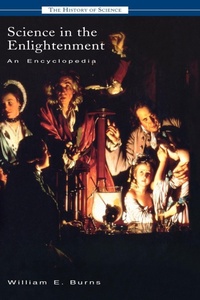
Science in the Enlightenment
An Encyclopedia
Published on 17. November 2003
Book
Hardback
384 pages
978-1-57607-886-0 (ISBN)
Description
The first introductory A-Z resource on the dynamic achievements in science from the late 1600s to 1820, including the great minds behind the developments and science's new cultural role.
Though the Enlightenment was a time of amazing scientific change, science is an often-neglected facet of that time. Now, Science in the Enlightenment redresses the balance by covering all the major scientific developments in the period between Newton's discoveries in the late 1600s to the early 1800s of Michael Faraday and Georges Cuvier.
Over 200 A-Z entries explore a range of disciplines, including astronomy and medicine, scientists such as Sir Humphry Davy and Benjamin Franklin, and instruments such as the telescope and calorimeter. Emphasis is placed on the role of women, and proper attention is given to the shifts in the worldview brought about by Newtonian physics, Antoine-Laurent Lavoisier's "chemical revolution," and universal systems of botanical and zoological classification. Moreover, the social impact of science is explored, as well as the ways in which the work of scientists influenced the thinking of philosophers such as Voltaire and Denis Diderot and the writers and artists of the romantic movement.
Though the Enlightenment was a time of amazing scientific change, science is an often-neglected facet of that time. Now, Science in the Enlightenment redresses the balance by covering all the major scientific developments in the period between Newton's discoveries in the late 1600s to the early 1800s of Michael Faraday and Georges Cuvier.
Over 200 A-Z entries explore a range of disciplines, including astronomy and medicine, scientists such as Sir Humphry Davy and Benjamin Franklin, and instruments such as the telescope and calorimeter. Emphasis is placed on the role of women, and proper attention is given to the shifts in the worldview brought about by Newtonian physics, Antoine-Laurent Lavoisier's "chemical revolution," and universal systems of botanical and zoological classification. Moreover, the social impact of science is explored, as well as the ways in which the work of scientists influenced the thinking of philosophers such as Voltaire and Denis Diderot and the writers and artists of the romantic movement.
Reviews / Votes
Intended for people in high school, college, and beyond . . . this volume fills a need, as there is little published that is devoted to this particular era of scientific discovery. This would be a useful resource for high school, college, and large public libraries. * Booklist * This book is a very useful addition to any collection with a need to cover the history of science during this formative age. * American Reference Books Annual * Most libraries will want the book in the reference collection. Recommended. All collections. * Choice *More details
Series
Language
English
Place of publication
United States
Publishing group
Bloomsbury Publishing Plc
Target group
College/higher education
Interest Age: From 7 to 17 years
Illustrations
46 bw illus
Dimensions
Height: 260 mm
Width: 183 mm
Thickness: 25 mm
Weight
915 gr
ISBN-13
978-1-57607-886-0 (9781576078860)
Copyright in bibliographic data and cover images is held by Nielsen Book Services Limited or by the publishers or by their respective licensors: all rights reserved.
Schweitzer Classification
Other editions
Additional editions
E-Book
11/2003
ABC-CLIO
€90.99
Available for download
Person
William Earl Burns is a professional historian living in Washington, D.C. He is the author of ABC-CLIO's The Scientific Revolution and has written articles for the ABC-CLIO World History website.