

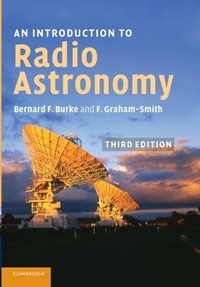
An Introduction to Radio Astronomy
3rd Edition
Published on 20. February 2014
Book
Paperback/Softback
458 pages
978-1-107-67260-4 (ISBN)
Description
Written by two prominent figures in radio astronomy, this well-established, graduate-level textbook is a thorough introduction to radio telescopes and techniques. It is an invaluable overview for students and researchers turning to radio astronomy for the first time. The first half of the book describes how radio telescopes work - from basic antennas and single aperture dishes through to full aperture-synthesis arrays. It includes reference material on the fundamentals of astrophysics and observing techniques. The second half of the book reviews radio observations of our galaxy, stars, pulsars, radio galaxies, quasars, and the cosmic microwave background. This third edition describes the applications of fundamental techniques to newly developing radio telescopes, including ATA, LOFAR, MWA, SKA, and ALMA, which all require an understanding of aspects specific to radio astronomy. Two entirely new chapters now cover cosmology, from the fundamental concepts to the most recent results of WMAP.
Reviews / Votes
From a previous edition: 'Written by two of the world's leading radio astronomers ... If you are looking for an up-to-date review of radio astronomy, from the telescopes and techniques to the fabulous wonders of the Universe they reveal, then this is the book for you.' Geoff Macdonald, Astronomy Now 'The authors are to be praised ... a comprehensive overview of the impact of radio astronomy on astrophysics.' Paul Hewett, Endeavour '... an excellent graduate-level text - the best available by far. It is also the best reference book for the practising astronomer who wants to do radio astronomy properly ...' Carl Heiles, Physics Today '... written by two of the world's leading radio astronomers, it provides a comprehensive review of the subject, both in terms of the instruments and techniques employed and the knowledge of the Universe that is revealed by them ... It must be stressed, however, that this is a graduate text book and thus employs a high level of mathematics throughout - perfect for its intended reader ... there is no doubt that a keen reader could ignore the mathematics and still get a very good feel of how our understanding of the Universe has been greatly enhanced by this exciting branch of astronomy.' Astronomy NowMore details
Edition
3rd Revised edition
Language
English
Place of publication
Cambridge
United Kingdom
Target group
Professional and scholarly
Edition type
Revised edition
Product notice
Paperback (trade)
Illustrations
Worked examples or Exercises; Printed music items
Dimensions
Height: 244 mm
Width: 170 mm
Thickness: 25 mm
Weight
784 gr
ISBN-13
978-1-107-67260-4 (9781107672604)
Copyright in bibliographic data and cover images is held by Nielsen Book Services Limited or by the publishers or by their respective licensors: all rights reserved.
Schweitzer Classification
Other editions
New editions
Bernard F. Burke | Francis Graham-Smith | Peter N. Wilkinson
An Introduction to Radio Astronomy
Book
08/2019
4th Edition
Cambridge University Press
€99.10
Shipment within 15-20 days
Persons
Bernard F. Burke is William A. M. Burden Professor of Astrophysics, Emeritus in the Department of Physics, Massachusetts Institute of Technology. He was the co-discoverer of radio noise from Jupiter, and he was later involved in the development of very-long-baseline interferometry. He has been a Visiting Professor at the University of Leiden and the University of Manchester, is a member of the National Academy of Science, and is on the governing board of the National Science Foundation. F. Graham-Smith is an Emeritus Professor at the Jodrell Bank Observatory, University of Manchester. He has been Director of the Royal Greenwich Observatory and President of the Royal Astronomical Society, and was the 13th Astronomer Royal. He is a Fellow of the Royal Society, and researches in many fields of radio astronomy, particularly pulsars.
Content
Preface; 1. Introduction; 2. The nature of the radio signal; 3. Signals, noise, radiometers and spectrometers; 4. Single-aperture radio telescopes; 5. The two-element interferometer; 6. Aperture synthesis; 7. Radiation, propagation and absorption of radio waves; 8. The local universe; 9. The interstellar medium; 10. Galactic dynamics; 11. Stars; 12. Pulsars; 13. Radio galaxies and quasars; 14. Cosmology fundamentals; 15. The angular structure of the CMB; 16. Cosmology: discrete radio sources and gravitational lensing; 17. The future of radio astronomy; Appendixes; References; Index.