

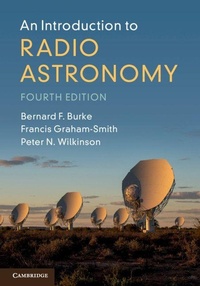
An Introduction to Radio Astronomy
4th Edition
Published on 22. August 2019
Book
Hardback
540 pages
978-1-107-18941-6 (ISBN)
Description
Radio astronomy is an active and rapidly expanding field due to advances in computing techniques, with several important new instruments on the horizon. This text provides a thorough introduction to radio astronomy and its contribution to our understanding of the universe, bridging the gap between basic introductions and research-level treatments. It begins by covering the fundamentals physics of radio techniques, before moving on to single-dish telescopes and aperture synthesis arrays. Fully updated and extensively rewritten, the fourth edition places greater emphasis on techniques, with detailed discussion of interferometry in particular, and comprehensive coverage of digital techniques in the appendices. The science sections are fully revised, with new author Peter N. Wilkinson bringing added expertise to the sections on pulsars, quasars and active galaxies. Spanning the entirety of radio astronomy, this is an engaging introduction for students and researchers approaching radio astronomy for the first time.
Reviews / Votes
'An engaging introduction for students and researchers approaching this observational field for the first time.' All About Space '... the book succeeds in its overall aims, and the fourth edition, with nearly a hundred pages of extra material and substantial additional on-line resources, is a useful upgrade from the third.' Martin Hardcastle, The Observatory 'An Introduction to Radio Astronomy is impressively comprehensive in addressing the basic theory, techniques, telescopes, and astrophysics in the radio regime ... The authors adopt a lecture-like writing style that is easy to read, and the text is interspersed with relatively clean, simple figures.' Matthew L. Lister, Physics Today '... the authors include comprehensive discussion of correlation, digitization, and modern techniques of image restoration. The book concludes with a masterful summary of the recent extraordinary advances in our knowledge of the universe and its constituents. Many of these have involved significant contributions at radio wavelengths.' D. E. Hogg, ChoiceMore details
Edition
4th Revised edition
Language
English
Place of publication
Cambridge
United Kingdom
Target group
College/higher education
Edition type
Revised edition
Illustrations
Worked examples or Exercises; 89 Halftones, black and white; 240 Line drawings, black and white
Dimensions
Height: 250 mm
Width: 175 mm
Thickness: 34 mm
Weight
1107 gr
ISBN-13
978-1-107-18941-6 (9781107189416)
Copyright in bibliographic data and cover images is held by Nielsen Book Services Limited or by the publishers or by their respective licensors: all rights reserved.
Schweitzer Classification
Other editions
Additional editions
Bernard F. Burke
Introduction to Radio Astronomy
E-Book
08/2019
Cambridge University Press
€58.99
Available for download
Bernard F. Burke | Francis Graham-Smith | Peter N. Wilkinson
An Introduction to Radio Astronomy
E-Book
07/2019
4th Edition
Cambridge University Press
€65.99
Available for download
Previous edition
Bernard F. Burke | Francis Graham-Smith
An Introduction to Radio Astronomy
Book
02/2014
3rd Edition
Cambridge University Press
€71.80
Article exhausted; check for reprint
Persons
Bernard F. Burke was William A. M. Burden Professor of Astrophysics, formerly of the Radio Astronomy Group of the Massachusetts Institute of Technology (MIT) Research Laboratory of Electronics, and principal investigator at the MIT Kavli Institute for Astrophysics and Space Research. He was elected a member of the United States National Academy of Sciences in 1970, and served as the American Astronomical Society (AAS) President from 1986 to 1988. He and Kenneth Franklin discovered Jupiter as a source of radio waves while working at the Carnegie Institution for Science; and he was part of the 6-member team credited with the 1988 discovery of the first Einstein ring.
Content
Preface; Acknowledgements; Part I. The Emission, Propagation, and Detection of Radio Waves: 1. The role of radio observations in astronomy; 2. Emission and general properties of radio waves; 3. Spectral lines; 4. Radio wave propagation; 5. The nature of the received radio signal; 6. Radiometers; 7. Spectrometers and polarimeters; Part II. Radio Telescopes and Aperture Synthesis: 8. Single-aperture radio telescopes; 9. The basics of interferometry; 10. Aperture synthesis; 11. Further interferometric techniques; Part III. The Radio Cosmos: 12. The Sun and the planets; 13. Stars and nebulae; 14. The Milky Way galaxy; 15. Pulsars; 16. Active galaxies; 17. The radio contributions to cosmology; Appendix 1. Fourier transforms; Appendix 2. Celestial coordinates and time; Appendix 3. Digitization; Appendix 4. Calibrating polarimeters; Appendix 5. Spherical harmonics; References; Index.