

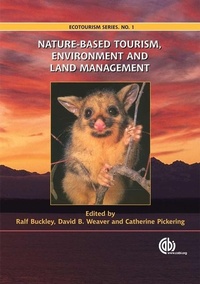
Nature-based Tourism, Environment and Land Management
Published on 4. August 2008
Book
Paperback/Softback
224 pages
978-1-84593-455-2 (ISBN)
Description
Tourism based on natural environments is a significant and growing international industry, and one that requires access to land with scenery, native plants and wildlife. In turn, land managers need money to maintain their land and its natural resources. This book looks at the economic, social and environmental consequences of nature-based tourism, and its effects on land managers. It discusses the importance of links and partnerships, as well as the conflicts between commercial tourism interests and land management agencies. Now in paperback, this book will be an essential resource for tourism students, as well as researchers and industry practitioners.
More details
Series
Language
English
Place of publication
Wallingford
United Kingdom
Target group
College/higher education
Professional and scholarly
Product notice
Paperback (trade)
Unsewn / adhesive bound
Dimensions
Height: 239 mm
Width: 170 mm
Thickness: 10 mm
Weight
476 gr
ISBN-13
978-1-84593-455-2 (9781845934552)
Copyright in bibliographic data and cover images is held by Nielsen Book Services Limited or by the publishers or by their respective licensors: all rights reserved.
Schweitzer Classification
Persons
received his PhD in Geography from the University of Western Ontario (Canada) in 1986. He is currently Professor of Tourism Research at Griffith University, Australia, and has published more than 120 journal articles, book chapters and books. He maintains an active research agenda in sustainable destination and protected area management, ecotourism, and resident perceptions of tourism. Current projects include investigating the willingness of protected area visitors to participate in site enhancement activities. Professor Weaver has published extensively in leading journals such as Annals of Tourism Research, Tourism Management, Journal of Travel Research and Journal of Sustainable Tourism. His widely adopted textbooks include Tourism Management (5th ed.) and Ecotourism (Wiley Australia), Encyclopedia of Ecotourism (CABI), and Sustainable Tourism: Theory and Practice (Taylor & Francis). He is a Fellow of the International Academy for the Study of Tourism and has delivered numerous invited international keynote addresses on innovative tourism management topics. He has worked with organisations such as UNWTO and PATA as an expert advisor.
Content
1: The practice and politics of tourism and land management,R Buckley 2: Nature-based tourism and sustainability: issues and approaches in nature tourism, C Pickering and D Weaver 3: Sustainable tourism: world trends and challenges ahead, E Yunis, Sustainable Development of Tourism, World Organization, Capitan Haya 41,28020 Madrid, Spain 4: Private reserves: the Conservation Corporation Africa model, L Carlisle, Conservation Corporation Africa, PO Box 966, White River, 1240 South Africa 5: Applying public purpose marketing in the US to protect relationships with public land, A Watson, Aldo Leopold Wilderness Research Institute, Montana, USA and W Borrie, University of Montana, USA 6: The financial liability of parks managers for visitor injuries, J McDonald, Griffith University, Australia 7: Visitor fees, tour permits, and asset and risk management by parks agencies: Australian case study, R Buckley et al 8: The net economic benefits of recreation and timber production in selected new south wales native forests, J Ward, Griffith University, Australia 9: Moving nearer to heaven: growth & change in the Greater Yellowstone Region, USA, J Johnson et al, Montana State University, USA 10: Visitor impact data in a land management context, R Buckley and N King, Griffith University, Australia 11: Small recreational and tourist vessels in inshore coastal areas: a characterisation of types of impacts, J Warnken and T Byrnes, Griffith University, Australia 12: Establishing best practice environmental management: lessons from the Australian tour boat industry, T Byrnes and J Warnken 13: Impacts of nature tourism on the Mt Kosciuszko Alpine Area, Australia, C Pickering et al 14: Ecological change as a result of winter tourism: snow manipulation in the Australian Alps, C Pickering and W Hill, Griffith University, Australia 15: A method to calculate environmental sensitivity to walker trampling in the Tasmanian Wilderness World Heritage Area, J Whinam et al, Department of Primary Industries, Water and Environment, Tasmania, Australia 16: Modelling potential for nature-based tourism, C Arrowsmith, RMIT University, Victoria, Australia 17: Contributions of non-consumptive wildlife tourism to conservation, K Higginbottom et al, Griffith University, Australia 18: Balancing conservation and visitation in protected areas, R Bushell, University of Western Sydney, Australia 19: Conclusions, R Buckley