

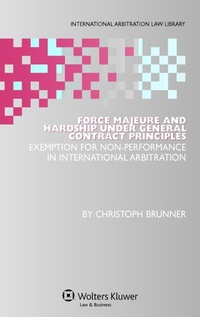
Force Majeure and Hardship under General Contract Principles
Description
More details
Other editions
Additional editions
Content
<b>Chapter 1. Introduction. § 1.</b> Force Majeure and Hardship in
International Commercial Transactions. <b>§ 2.</b> General Principles of
Commercial Contracts: Methodological Approach.
<b>Chapter 2. Scope of Application of
General Contract Principles. § 3.</b> General Remarks on the Governing
Law and the Application of General Contract Principles. <b>§ 4.</b>
Choice of Law Agreement Providing for the Application of a National Law. <b>§
5.</b> No Choice of Law Made by the Parties.
<b>
Chapter 3. The Concept of Non-performance. § 6.</b> The Concept of
Non-Performance under General Contract Principles. <b>Chapter 4.
Force Majeure Excuse.§ 7</b>.The Force Majeure Excuse as a General
Principle of Law. <b>§ 8.</b> Individual Requirements of the Force
Majeure Excuse under General Contract Principles. <b>§ 9.</b> Legal
Effects of the Force Majeure Excuse. <b>§ 10.</b> Interpretation and
Effects of Force Majeure Clauses.
<b>Chapter 5. Hardship (Change
of Circumstances): Fundamental Change of the Equilibrium of the Contract. §
11. </b>Hardship as a General Principle of Law.<b> § 12.</b> Individual
Requirements of the Hardship Defence. <b>§ 13.</b> Legal Effects of
Hardship.<b> § 14.</b> Interpretation and Legal Effects of Hardship
Clauses. <b>§ 15. </b>Hardship Distinguished from Other Remedies.
<b>Chapter 6.
Conclusion. </b>
<b>Bibliography,
Principles on Force Majeure in the
CISG, UPICC,PECL, the TLDB-Principles and ICC Force Majeure Clause 2003,
Principles on Hardship in the UPICC, PECL, the TLDB-Principles and ICC
Hardship Clause 2003, Index</b>