

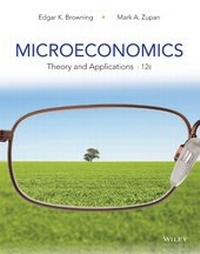
Microeconomics
Theory and Applications
12th Edition
Published on 29. September 2014
Book
Paperback/Softback
576 pages
978-1-118-75887-8 (ISBN)
Description
Microeconomics: Theory & Applications, 12th Edition provides students with the fundamental tools of analysis and shows how these tools can be used to explain and predict phenomena. Written for both economics and business students, Edgar Browning and Mark Zupan present basic microeconomic principles in a clear and thorough way, using numerous applications to illustrate the use of theory and reinforce students' understanding.
More details
Other editions
New editions
Book
11/2019
13th Edition
Wiley
€159.64
Article is exhausted; no reprint
Previous edition
Book
10/2011
11th Edition
Wiley
€319.00
Article exhausted; check for reprint
Persons
Professor Edgar Browning received his Ph.D. in 1971 from Princeton University. He joined the Department of Economics at Texas A&M University in 1984. His fields of interest are public finance, microeconomic theory, public choice, public policy analysis, applied microeconomics, labor economics.
Dean Zupan assumed his duties at the Simon School on a full-time basis on January 1, 2004. He is responsible for the administrative and academic functions of the Simon School, and serves as the leading advocate of the School's faculty, programs and students to the business community and other external constituencies. Zupan served as dean and professor of economics at the University of Arizona's Eller College of Management from 1997 to 2003. Among his accomplishments at Eller were highly successful fundraising efforts, a record of promoting scholarship, fostering innovation in academic programs and enhanced community outreach. Before his appointment at Arizona, Zupan taught at the University of Southern California's Marshall School of Business, where he also served as associate dean of master's programs. He was a teaching fellow in Harvard's Department of Economics while pursuing his doctoral studies at MIT, and he has been a visiting faculty member at the Amos Tuck School of Business Administration at Dartmouth College. Zupan earned a BA degree in economics from Harvard University and a PhD in economics from the Massachusetts Institute of Technology.
Dean Zupan assumed his duties at the Simon School on a full-time basis on January 1, 2004. He is responsible for the administrative and academic functions of the Simon School, and serves as the leading advocate of the School's faculty, programs and students to the business community and other external constituencies. Zupan served as dean and professor of economics at the University of Arizona's Eller College of Management from 1997 to 2003. Among his accomplishments at Eller were highly successful fundraising efforts, a record of promoting scholarship, fostering innovation in academic programs and enhanced community outreach. Before his appointment at Arizona, Zupan taught at the University of Southern California's Marshall School of Business, where he also served as associate dean of master's programs. He was a teaching fellow in Harvard's Department of Economics while pursuing his doctoral studies at MIT, and he has been a visiting faculty member at the Amos Tuck School of Business Administration at Dartmouth College. Zupan earned a BA degree in economics from Harvard University and a PhD in economics from the Massachusetts Institute of Technology.
Content
Chapter 1: An Introduction to Microeconomics
Chapter 2: Supply and Demand
Chapter 3: The Theory of Consumer Choice
Chapter 4: Individual and Market Demand
Chapter 5: Using Consumer Choice Theory
Chapter 6: Exchange, Efficiency, and Prices
Chapter 7: Production
Chapter 8: The Cost of Production
Chapter 9: Profit Maximization in Perfectly Competitive Markets
Chapter 10: Using the Competitive Model
Chapter 11: Monopoly
Chapter 12: Product Pricing with Monopoly Power
Chapter 13: Monopolistic Competition and Oligopoly
Chapter 14: Game Theory and the Economics of Information
Chapter 15: Using Noncompetitive Market Models
Chapter 16: Employment and Pricing of Inputs
Chapter 17: Wages, Rent, Interest, and Profit
Chapter 18: Using Input Market Analysis
Chapter 19: General Equilibrium Analysis and Economic Efficiency
Chapter 20: Public Goods and Externalities
Chapter 2: Supply and Demand
Chapter 3: The Theory of Consumer Choice
Chapter 4: Individual and Market Demand
Chapter 5: Using Consumer Choice Theory
Chapter 6: Exchange, Efficiency, and Prices
Chapter 7: Production
Chapter 8: The Cost of Production
Chapter 9: Profit Maximization in Perfectly Competitive Markets
Chapter 10: Using the Competitive Model
Chapter 11: Monopoly
Chapter 12: Product Pricing with Monopoly Power
Chapter 13: Monopolistic Competition and Oligopoly
Chapter 14: Game Theory and the Economics of Information
Chapter 15: Using Noncompetitive Market Models
Chapter 16: Employment and Pricing of Inputs
Chapter 17: Wages, Rent, Interest, and Profit
Chapter 18: Using Input Market Analysis
Chapter 19: General Equilibrium Analysis and Economic Efficiency
Chapter 20: Public Goods and Externalities