

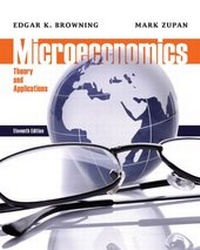
Microeconomic
Theory and Applications
11th Edition
Published on 4. October 2011
Book
Hardback
640 pages
978-1-118-06554-9 (ISBN)
Description
Browning and Zupan's Microeconomics: Theory & Applications, 11th Edition, provides students with the fundamental tools of analysis, and shows how the tools can be used to explain and predict phenomena.
The text presents basic microeconomic principles in a clear and thorough way, using numerous applications to illustrate the use of theory, and to reinforce students' understanding of it. Students are exposed to thorough coverage of fundamental microeconomics concepts, including behavioral economics, game theory, and price theory.
Written for both economics and business students, Browning and Zupan provide an essential foundation to any bachelor's or master's degree business student.
The text presents basic microeconomic principles in a clear and thorough way, using numerous applications to illustrate the use of theory, and to reinforce students' understanding of it. Students are exposed to thorough coverage of fundamental microeconomics concepts, including behavioral economics, game theory, and price theory.
Written for both economics and business students, Browning and Zupan provide an essential foundation to any bachelor's or master's degree business student.
More details
Edition
11. Auflage
Language
English
Place of publication
New York
United States
Target group
College/higher education
Edition type
Revised edition
Illustrations
Illustrations
Dimensions
Height: 26 cm
Width: 20.4 cm
Thickness: 2.7 cm
Weight
1250 gr
ISBN-13
978-1-118-06554-9 (9781118065549)
Schweitzer Classification
Other editions
New editions
Book
09/2014
12th Edition
Wiley
€235.00
Article exhausted; check for reprint
Previous edition
Book
09/2009
10th Edition
Wiley
€225.30
Article exhausted; check for reprint
Persons
Content
Chapter 1: An Introduction to Microeconomics 1
Chapter 2: Supply and Demand 15
Chapter 3: The Theory of Consumer Choice 48
Chapter 4: Individual and Market Demand 85
Chapter 5: Using Consumer Choice Theory 122
Chapter 6: Exchange, Efficiency, and Prices 158
Chapter 7: Production 180
Chapter 8: The Cost of Production 207
Chapter 9: Profit Maximization in Perfectly Competitive Markets 245
Chapter 10: Using the Competitive Model 280
Chapter 11: Monopoly 316
Chapter 12: Product Pricing with Monopoly Power 348
Chapter 13: Monopolistic Competition and Oligopoly 375
Chapter 14: Game Theory and the Economics of Information 405
Chapter 15: Using Noncompetitive Market Models 437
Chapter 16: Employment and Pricing of Inputs 456
Chapter 17: Wages, Rent, Interest, and Profit 482
Chapter 18: Using Input Market Analysis 513
Chapter 19: General Equilibrium Analysis and Economic Efficiency 545
Chapter 20: Public Goods and Externalities 571
Chapter 2: Supply and Demand 15
Chapter 3: The Theory of Consumer Choice 48
Chapter 4: Individual and Market Demand 85
Chapter 5: Using Consumer Choice Theory 122
Chapter 6: Exchange, Efficiency, and Prices 158
Chapter 7: Production 180
Chapter 8: The Cost of Production 207
Chapter 9: Profit Maximization in Perfectly Competitive Markets 245
Chapter 10: Using the Competitive Model 280
Chapter 11: Monopoly 316
Chapter 12: Product Pricing with Monopoly Power 348
Chapter 13: Monopolistic Competition and Oligopoly 375
Chapter 14: Game Theory and the Economics of Information 405
Chapter 15: Using Noncompetitive Market Models 437
Chapter 16: Employment and Pricing of Inputs 456
Chapter 17: Wages, Rent, Interest, and Profit 482
Chapter 18: Using Input Market Analysis 513
Chapter 19: General Equilibrium Analysis and Economic Efficiency 545
Chapter 20: Public Goods and Externalities 571