

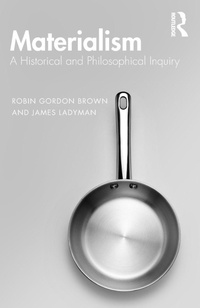
Materialism
A Historical and Philosophical Inquiry
1st Edition
Published on 13. May 2019
Book
Paperback/Softback
142 pages
978-0-367-20134-0 (ISBN)
Description
The doctrine of materialism is one of the most controversial in the history of ideas. For much of its history it has been aligned with toleration and enlightened thinking, but it has also aroused strong, often violent, passions amongst both its opponents and proponents. This book explores the development of materialism in an engaging and thought-provoking way and defends the form it takes in the twenty-first century.
Opening with an account of the ideas of some of the most important thinkers in the materialist tradition, including Epicurus, Lucretius, Hobbes, Hume, Darwin and Marx, the authors discuss materialism's origins, as an early form of naturalistic explanation and as an intellectual outlook about life and the world in general. They explain how materialism's beginnings as an imaginative vision of the true nature of things faced a major challenge from the physics it did so much to facilitate, which now portrays the microscopic world in a way incompatible with traditional materialism. Brown and Ladyman explain how out of this challenge materialism developed into the new doctrine of physicalism.
Drawing on a wide range of colourful examples, the authors argue that although materialism does not have all the answers, its humanism and commitment to naturalistic explanation and the scientific method is our best philosophical hope in the ideological maelstrom of the modern world.
Opening with an account of the ideas of some of the most important thinkers in the materialist tradition, including Epicurus, Lucretius, Hobbes, Hume, Darwin and Marx, the authors discuss materialism's origins, as an early form of naturalistic explanation and as an intellectual outlook about life and the world in general. They explain how materialism's beginnings as an imaginative vision of the true nature of things faced a major challenge from the physics it did so much to facilitate, which now portrays the microscopic world in a way incompatible with traditional materialism. Brown and Ladyman explain how out of this challenge materialism developed into the new doctrine of physicalism.
Drawing on a wide range of colourful examples, the authors argue that although materialism does not have all the answers, its humanism and commitment to naturalistic explanation and the scientific method is our best philosophical hope in the ideological maelstrom of the modern world.
Reviews / Votes
"Highly recommended for those interested in materialism as a perennial current in the history of philosophy and for those wondering how contemporary physicalism and naturalism connect with older materialist philosophies and politics." - William Lewis, Skidmore College, USA"Brown and Ladyman offer a clear exposition of philosophical materialism much needed in these muddle-headed times. Particularly refreshing is their stress on the essential incompleteness of the explanations it provides, which distinguish it as a scientific world-view from its more strictly 'philosophical' rivals." - Thomas Uebel, University of Manchester, UK "Highly recommended for those interested in materialism as a perennial current in the history of philosophy and for those wondering how contemporary physicalism and naturalism connect with older materialist philosophies and politics." - William Lewis, Skidmore College, USA
"Brown and Ladyman offer a clear exposition of philosophical materialism much needed in these muddle-headed times. Particularly refreshing is their stress on the essential incompleteness of the explanations it provides, which distinguish it as a scientific worldview from its more strictly 'philosophical' rivals." - Thomas Uebel, University of Manchester, UK
More details
Language
English
Place of publication
London
United Kingdom
Publishing group
Taylor & Francis Ltd
Target group
College/higher education
General, Postgraduate, and Undergraduate
Dimensions
Height: 198 mm
Width: 129 mm
Thickness: 9 mm
Weight
178 gr
ISBN-13
978-0-367-20134-0 (9780367201340)
Copyright in bibliographic data and cover images is held by Nielsen Book Services Limited or by the publishers or by their respective licensors: all rights reserved.
Schweitzer Classification
Other editions
Additional editions
Book
05/2019
1st Edition
Routledge
€173.32
Shipment within 15-20 days
E-Book
04/2019
Routledge
€31.49
Available for download
E-Book
04/2019
1st Edition
Routledge
€31.49
Available for download
Persons
Robin Gordon Brown is a Research Associate in the Department of Philosophy at the University of Bristol, UK.
James Ladyman is Professor of Philosophy at the University of Bristol, UK. He is the author of Understanding Philosophy of Science (2002) and editor (with Alexander Bird) of Arguing About Science (2012), both published by Routledge.
James Ladyman is Professor of Philosophy at the University of Bristol, UK. He is the author of Understanding Philosophy of Science (2002) and editor (with Alexander Bird) of Arguing About Science (2012), both published by Routledge.
Content
Preface A Preliminary Disambiguation Part 1: An Outline of the History of Materialism 1. The Heart of Materialism 2. Materialist Thought in the Ancient World 3. The Triumphs of Materialism: The Mechanical Philosophy, The Scientific Revolution and the Enlightenment 4. Materialism in the Nineteenth Century Part 2: The Evolution of Materialism into Physicalism 5. The Challenges to Materialism from post-Newtonian Physics 6. Physicalist Responses to the Problems of Materialism 7. The Heart of Physicalist Materialism 8. Physicalist Materialism in the Twenty-First Century. Bibliography Index