

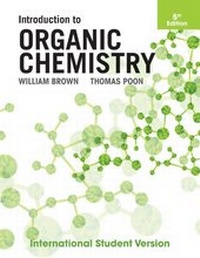
Introduction to Organic Chemistry
International Student Version
5th Edition
Published on 19. March 2013
Book
Paperback/Softback
792 pages
978-1-118-32176-8 (ISBN)
Unfortunately, price unknown
Article is exhausted; no reprint
Description
This text provides an introduction to organic chemistry for students who require the fundamentals of organic chemistry as a requirement for their major. It is most suited for a one semester organic chemistry course. In an attempt to highlight the relevance of the material to students, the authors place a strong emphasis on showing the interrelationship between organic chemistry and other areas of science, particularly the biological and health sciences. The text illustrates the use of organic chemistry as a tool in these sciences; it also stresses the organic compounds, both natural and synthetic, that surround us in everyday life: in pharmaceuticals, plastics, fibers, agrochemicals, surface coatings, toiletry preparations and cosmetics, food additives, adhesives, and elastomers.
More details
Other editions
Previous edition
Book
04/2010
4th Edition
Wiley
€235.00
Article exhausted; check for reprint
Persons
William H. Brown is Professor Emeritus at Beloit College, where he was twice named Teacher of the Year. He is also the author of two other college textbooks: Organic Chemistry 5/e, coauthored with Chris Foote, Brent Iverson, and Eric Anslyn, published in 2009, and General, Organic, and Biochemistry 9/e, coauthored with Fred Bettelheim, Mary Campbell, and Shawn Farrell, published in 2010. He received his Ph.D. from Columbia University under the direction of Gilbert Stork and did postdoctoral work at California Institute of Technology and the University of Arizona. Twice he was Director of a Beloit College World Affairs Center seminar at the University of Glasgow, Scotland. In 1999, he retired from Beloit College to devote more time to writing and development of educational materials. Although officially retired, he continues to teach Special Topics in Organic Synthesis on a yearly basis. Bill and his wife Carolyn enjoy hiking in the canyon country of the Southwest. In addition, they both enjoy quilting and quilts.
Thomas Poon is Associate Professor of Chemistry in the Joint Science Department of Claremont McKenna, Pitzer, and Scripps Colleges, three of the five undergraduate institutions that make up the Claremont Colleges in Claremont, California. He received his B.S. degree from Fairfield University (CT) and his Ph.D. from the University of California, Los Angeles under the direction of Christopher S. Foote. Poon was a Camille and Henry Dreyfus Postdoctoral Fellow under Bradford P. Mundy at Colby College (ME) before joining the faculty at Randolph-Macon College (VA) where he received the Thomas Branch Award for Excellence in Teaching in 1999. He was a visiting scholar at Columbia University (NY) in 2002 (and again in 2004) where he worked on projects in both research and education with his friend and mentor, Nicholas J. Turro. He has taught organic chemistry, forensic chemistry, upper-level courses in advanced laboratory techniques, and a first-year seminar class titled Science of Identity. His favorite activity is working alongside undergraduates in the laboratory on research problems involving the investigation of synthetic methodology in zeolites, zeolite photochemistry, natural products isolation, and reactions of singlet oxygen. When not in the lab, he likes to play guitar and sing funny chemistry songs to his daughter Sophie.
Content
01 Covalent Bonding and Shapes of Molecules 1
Summary of Key Questions 32
Quick Quiz 34
Problems 35
Looking Ahead 40
Group Learning Activities 40
CHEMICAL CONNECTIONS
1A Buckyball: A New Form of Carbon 17
02 Acids and Bases 41
03 Alkanes and Cycloalkanes 63
Summary of Key Questions 94
Quick Quiz 96
Key Reactions 97
Problems 97
Looking Ahead 102
Group Learning Activities 103
Putting It Together 104
CHEMICAL CONNECTIONS
3A The Poisonous Puffer Fish 84
3B Octane Rating: What Those Numbers at the Pump Mean 94
Summary of Key Questions 57
Quick Quiz 58
Key Reactions 59
Problems 59
Looking Ahead 62
Group Learning Activities 62
04 Alkenes and Alkynes 108
Summary of Key Questions 123
Quick Quiz 124
Problems 124
Looking Ahead 128
Group Learning Activities 128
CHEMICAL CONNECTIONS
4A Ethylene, a Plant Growth Regulator 109
4B Cis-Trans Isomerism in Vision 111
4C Why Plants Emit Isoprene 121
05 Reactions of Alkenes and Alkynes 129
5A Catalytic Cracking and the Importance of Alkenes 133
Summary of Key Questions 158
Quick Quiz 159
Key Reactions 160
Problems 161
Looking Ahead 165
Group Learning Activities 166
06 Chirality: The Handedness of Molecules 167
CHEMICAL CONNECTIONS
6A Chiral Drugs 187
Summary of Key Questions 189
Quick Quiz 190
Problems 191
Chemical Transformations 196
Looking Ahead 196
Group Learning Activities 197
Putting It Together 197
CHEMICAL CONNECTIONS
07 Haloalkanes 200
CHEMICAL CONNECTIONS
7A The Environmental Impact of Chlorofluorocarbons 204
7B The Effect of Chlorofluorocarbon Legislation on Asthma Sufferers 228
Summary of Key Questions 229
Quick Quiz 230
Key Reactions 231
Problems 231
Chemical Transformations 236
Looking Ahead 237
Group Learning Activities 238
CHEMICAL CONNECTIONS
8A Nitroglycerin: An Explosive and a Drug 243
8B Blood Alcohol Screening 260
8C Ethylene Oxide: A Chemical Sterilant 268
08 Alcohols, Ethers, and Thiols 239
Summary of Key Questions 272
Quick Quiz 274
Key Reactions 274
Problems 275
Chemical Transformations 279
Looking Ahead 280
Group Learning Activities 281
09 Benzene and Its Derivatives 282
Summary of Key Questions 321
Quick Quiz 322
Key Reactions 322
Problems 324
Chemical Transformations 329
Looking Ahead 330
Group Learning Activities 330
CHEMICAL CONNECTIONS
9A Carcinogenic Polynuclear Aromatics and Cancer 293
9B Capsaicin, for Those Who Like It Hot 318
10 Amines 331
Summary of Key Questions 349
Quick Quiz 350
Key Reactions 350
Problems 351
Chemical Transformations 356
Looking Ahead 356
Group Learning Activities 357
Putting It Together 357
CHEMICAL CONNECTIONS
10A Morphine as a Clue in the Design and Discovery of Drugs 332
10B The Poison Dart Frogs of South America: Lethal Amines 338
11 Spectroscopy 361
11A Infrared Spectroscopy: A Window on Brain Activity 368
11B Magnetic Resonance Imaging 391
Summary of Key Questions 398
Quick Quiz 400
Problems 401
Looking Ahead 414
Group Learning Activities 415
CHEMICAL CONNECTIONS
12 Aldehydes and Ketones 416
12A A Green Synthesis of Adipic Acid 442
Summary of Key Questions 445
CHEMICAL CONNECTIONS
Quick Quiz 447
Key Reactions 447
Problems 448
Chemical Transformations 454
Spectroscopy 455
Looking Ahead 456
Group Learning Activities 456
CHEMICAL CONNECTIONS
13 Carboxylic Acids 457
13A From Willow Bark to Aspirin and Beyond 466
13B Esters as Flavoring Agents 472
13C Ketone Bodies and Diabetes 476
Summary of Key Questions 479
Quick Quiz 480
Key Reactions 480
Problems 481
Chemical Transformations 486
Looking Ahead 487
Group Learning Activities 487
14 Functional Derivatives of Carboxylic Acids 488
CHEMICAL CONNECTIONS
14A Ultraviolet Sunscreens and Sunblocks 490
14B From Moldy Clover to a Blood Thinner 491
14C The Penicillins and Cephalosporins: b-Lactam Antibiotics 492
14D The Pyrethrins: Natural Insecticides of Plant Origin 503
14E Systematic Acquired Resistance in Plants 506
Summary of Key Questions 513
Quick Quiz 514
Key Reactions 515
Problems 516
Chemical Transformations 522
Looking Ahead 523
Group Learning Activities 523
Putting It Together 523
15 Enolate Anions 526
Summary of Key Questions 554
Quick Quiz 554
Key Reactions 555
Problems 556
Chemical Transformations 561
Looking Ahead 562
Group Learning Activities 563
CHEMICAL CONNECTIONS
15A Drugs That Lower Plasma Levels of Cholesterol 546
15B Antitumor Compounds: The Michael Reaction in Nature 553
16 Organic Polymer Chemistry 564
Summary of Key Questions 580
Quick Quiz 581
Key Reactions 582
Problems 582
Looking Ahead 584
Group Learning Activities 585
CHEMICAL CONNECTIONS
16A Stitches That Dissolve 573
16B Paper or Plastic? 575
17 Carbohydrates 586
Summary of Key Questions 606
Quick Quiz 608
Key Reactions 608
Problems 609
Looking Ahead 614
Group Learning Activities 614
Putting It Together 615
CHEMICAL CONNECTIONS
17A Relative Sweetness of Carbohydrate and Artificial Sweeteners 602
17B A, B, AB, and O Blood-Group Substances 603
18 Amino Acids and Proteins 619
Summary of Key Questions 642
Quick Quiz 643
Key Reactions 644
Problems 645
Looking Ahead 648
Group Learning Activities 648
CHEMICAL CONNECTo IONS
18A Spider Silk: A Chemical and Engineering Wonder of Nature 640
19 Lipids 649
Summary of Key Questions 668
Quick Quiz 669
Problems 669
Looking Ahead 672
Group Learning Activities 673
CHEMICAL CONNECTIONS
19A Snake Venom Phospholipases 657
19B Nonsteroidal Estrogen Antagonists 661
20 Nucleic Acids (Online Chapter) 674
Summary of Key Questions 694
Quick Quiz 696
Problems 696
Group Learning Activities 699
CHEMICAL CONNECTIONS
20A The Search for Antiviral Drugs 677
20B DNA Fingerprinting 694
Summary of Key Questions 720
Quick Quiz 721
Key Reactions 722
Problems 722
Group Learning Activities 724
Appendix 1 Acid Ionization Constants for the Major Classes of Organic Acids A.1
Appendix 2 Characteristic 1H-NMR Chemical Shifts A.2
Appendix 3 Characteristic 13C-NMR Chemical Shifts A.3
Appendix 4 Characteristic Infrared Absorption Frequencies A.4
Glossary G.1
Answers Section Ans.1
Index I.1
21 The Organic Chemistry of Metabolism (Online Chapter) 700