

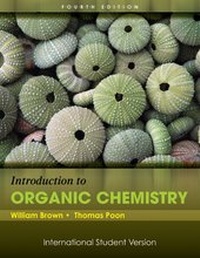
Introduction to Organic Chemistry
International Student Version
4th Edition
Published on 28. April 2010
Book
Paperback/Softback
856 pages
978-0-470-38467-1 (ISBN)
Description
This text provides an introduction to organic chemistry for students who require the fundamentals of organic chemistry as a requirement for their major. It is most suited for a one semester organic chemistry course. In an attempt to highlight the relevance of the material to students, the authors place a strong emphasis on showing the interrelationship between organic chemistry and other areas of science, particularly the biological and health sciences. The text illustrates the use of organic chemistry as a tool in these sciences; it also stresses the organic compounds, both natural and synthetic, that surround us in everyday life: in pharmaceuticals, plastics, fibers, agrochemicals, surface coatings, toiletry preparations and cosmetics, food additives, adhesives, and elastomers.
More details
Other editions
New editions
Book
03/2013
5th Edition
Wiley
Unfortunately, price unknown
Article is exhausted; no reprint
Persons
William H. Brown is Professor Emeritus at Beloit College, where he was twice named Teacher of the Year. He is also the author of two other college textbooks: Organic Chemistry 5/e, coauthored with Chris Foote, Brent Iverson, and Eric Anslyn, published in 2009, and General, Organic, and Biochemistry 9/e, coauthored with Fred Bettelheim, Mary Campbell, and Shawn Farrell, published in 2010. He received his Ph.D. from Columbia University under the direction of Gilbert Stork and did postdoctoral work at California Institute of Technology and the University of Arizona. Twice he was Director of a Beloit College World Affairs Center seminar at the University of Glasgow, Scotland. In 1999, he retired from Beloit College to devote more time to writing and development of educational materials. Although officially retired, he continues to teach Special Topics in Organic Synthesis on a yearly basis. Bill and his wife Carolyn enjoy hiking in the canyon country of the Southwest. In addition, they both enjoy quilting and quilts.
Thomas Poon is Associate Professor of Chemistry in the Joint Science Department of Claremont McKenna, Pitzer, and Scripps Colleges, three of the five undergraduate institutions that make up the Claremont Colleges in Claremont, California. He received his B.S. degree from Fairfield University (CT) and his Ph.D. from the University of California, Los Angeles under the direction of Christopher S. Foote. Poon was a Camille and Henry Dreyfus Postdoctoral Fellow under Bradford P. Mundy at Colby College (ME) before joining the faculty at Randolph-Macon College (VA) where he received the Thomas Branch Award for Excellence in Teaching in 1999. He was a visiting scholar at Columbia University (NY) in 2002 (and again in 2004) where he worked on projects in both research and education with his friend and mentor, Nicholas J. Turro. He has taught organic chemistry, forensic chemistry, upper-level courses in advanced laboratory techniques, and a first-year seminar class titled Science of Identity. His favorite activity is working alongside undergraduates in the laboratory on research problems involving the investigation of synthetic methodology in zeolites, zeolite photochemistry, natural products isolation, and reactions of singlet oxygen. When not in the lab, he likes to play guitar and sing funny chemistry songs to his daughter Sophie.
Thomas Poon is Associate Professor of Chemistry in the Joint Science Department of Claremont McKenna, Pitzer, and Scripps Colleges, three of the five undergraduate institutions that make up the Claremont Colleges in Claremont, California. He received his B.S. degree from Fairfield University (CT) and his Ph.D. from the University of California, Los Angeles under the direction of Christopher S. Foote. Poon was a Camille and Henry Dreyfus Postdoctoral Fellow under Bradford P. Mundy at Colby College (ME) before joining the faculty at Randolph-Macon College (VA) where he received the Thomas Branch Award for Excellence in Teaching in 1999. He was a visiting scholar at Columbia University (NY) in 2002 (and again in 2004) where he worked on projects in both research and education with his friend and mentor, Nicholas J. Turro. He has taught organic chemistry, forensic chemistry, upper-level courses in advanced laboratory techniques, and a first-year seminar class titled Science of Identity. His favorite activity is working alongside undergraduates in the laboratory on research problems involving the investigation of synthetic methodology in zeolites, zeolite photochemistry, natural products isolation, and reactions of singlet oxygen. When not in the lab, he likes to play guitar and sing funny chemistry songs to his daughter Sophie.
Content
Chapter One: Covalent Bonding and Shapes of Molecules.
Chapter Two: Acids and Bases.
Chapter Three: Alkanes and Cycloalkanes.
Chapter Four: Alkenes and Alkynes.
Chapter Five: Reactions of Alkanes and Alkynes.
Chapter Six: Chirality: The Handedness of Molecules.
Chapter Seven: Haloalkanes.
Chapter Eight: Alcohols, Ethers, and Thiols.
Chapter Nine: Benzene and its Derivatives.
Chapter Ten: Amines.
Chapter Eleven: Infrared Spectroscopy.
Chapter Twelve: Nuclear Magnetic Resonance Spectroscopy.
Chapter Thirteen: Aldehydes and Ketones.
Chapter Fourteen: Carboxylic Acids.
Chapter Fifteen: Functional Derivatives of Carboxylic Acids.
Chapter Sixteen: Enolate Anions.
Chapter Seventeen: Organic Polymer Chemistry.
Chapter Eighteen: Carbohydrates.
Chapter Nineteen: Amino Acids and Proteins.
Chapter Twenty: Nucleic Acids.
Chapter Twenty-One: Lipids.
Chapter Twenty-Two: Organic Chemistry of Metabolism.
Chapter Two: Acids and Bases.
Chapter Three: Alkanes and Cycloalkanes.
Chapter Four: Alkenes and Alkynes.
Chapter Five: Reactions of Alkanes and Alkynes.
Chapter Six: Chirality: The Handedness of Molecules.
Chapter Seven: Haloalkanes.
Chapter Eight: Alcohols, Ethers, and Thiols.
Chapter Nine: Benzene and its Derivatives.
Chapter Ten: Amines.
Chapter Eleven: Infrared Spectroscopy.
Chapter Twelve: Nuclear Magnetic Resonance Spectroscopy.
Chapter Thirteen: Aldehydes and Ketones.
Chapter Fourteen: Carboxylic Acids.
Chapter Fifteen: Functional Derivatives of Carboxylic Acids.
Chapter Sixteen: Enolate Anions.
Chapter Seventeen: Organic Polymer Chemistry.
Chapter Eighteen: Carbohydrates.
Chapter Nineteen: Amino Acids and Proteins.
Chapter Twenty: Nucleic Acids.
Chapter Twenty-One: Lipids.
Chapter Twenty-Two: Organic Chemistry of Metabolism.