

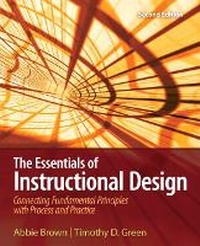
The Essentials of Instructional Design
Connecting Fundamental Principles with Process and Practice
2nd Edition
Published on 13. December 2010
Book
Paperback/Softback
240 pages
978-0-13-508422-9 (ISBN)
Description
This book is designed to introduce you to the foundational elements of instructional design - the fundamental principles, processes, and practices that currently shape and define the field. By not subscribing to any single ID model or approach, the authors are able to clearly articulate the principles of design (e.g. task analysis), and then they describe, compare, and contrast the processes of applying each principle as established by leaders in the field. Practical examples and application questions are woven throughout each chapter and present opportunities for you to check your understanding and apply what you've learned.
New to this edition:
Chapter 12 Visual Design for Instructional Media covers the essential concepts of visual design for ID students. Many instructional designers have to design and produce instructional media themselves and most instructional designers will approve designs and work closely with commercial artists. This chapter provides the principles of visual design to support instructional design students' media design and production efforts, and provides them with an understanding of the concepts of visual design they will need to work effectively with commercial artists.
Chapter 2: How People Think and Learn is reorganized and rewritten in response to reader feedback. This chapter covers foundational concepts of thinking and learning and describes learning theories. New to this chapter is a discussion of brain research. The chapter provides instructional designers with an overview of major concepts to consider as they design instruction.
Chapter opening and closing vignettes are added to Chapters 3 through 10. These scenarios serve as examples throughout the chapters and provide a wide range of applications across educational settings. Vignettes help readers understand the practical application of each step in the instructional design process.
End-of-chapter assignments that connect chapter concepts to ID project development. In addition, the end of each chapter has a new section that explains how the process described in the chapter relates to the ID process generally.
More details
Edition
2nd edition
Language
English
Place of publication
United States
Publishing group
Pearson Education (US)
Target group
Professional and scholarly
Dimensions
Height: 195 mm
Width: 233 mm
Thickness: 11 mm
Weight
346 gr
ISBN-13
978-0-13-508422-9 (9780135084229)
Copyright in bibliographic data and cover images is held by Nielsen Book Services Limited or by the publishers or by their respective licensors: all rights reserved.
Schweitzer Classification
Other editions
Previous edition
Abbie H. Brown | Tim D. Green
The Essentials of Instructional Design
Connecting Fundamental Principles with Process and Practice
Book
01/2006
Pearson
€39.60
Article exhausted; check for reprint
Persons
Abbie Brown, Ph.D. is an Associate Professor in the Department of Mathematics Science and Instructional Technology Education at East Carolina University. He is co-author of books including, Making the Most of the Web in Your Classroom (Corwin Press), and Teaching Strategies: A Guide to Effective Instruction (Wadsworth). He is also the editor-in-chief of the journal, TechTrends.
Timothy D. Green, a former elementary and middle school teacher, is currently an associate professor of Educational Technology at California State University, Fullerton. He received his Ph.D. in Instructional Systems Technology from Indiana University. He was formerly the director of distance education for California State University, Fullerton. Green conducts research on online teaching and learning, one-to-one computing, and integrating technology into teaching and learning processes. He has authored numerous articles and books on these topics.
Timothy D. Green, a former elementary and middle school teacher, is currently an associate professor of Educational Technology at California State University, Fullerton. He received his Ph.D. in Instructional Systems Technology from Indiana University. He was formerly the director of distance education for California State University, Fullerton. Green conducts research on online teaching and learning, one-to-one computing, and integrating technology into teaching and learning processes. He has authored numerous articles and books on these topics.
Content
Part 1: Before You Begin Designing Instruction
Chapter 1: The Discipline of Instructional Design
Chapter 2: Understanding How People Think and Learn
Part 2: Examining the Situation - Needs, Task, and Learner Analysis
Chapter 3: Needs Analysis
Chapter 4: Task Analysis
Chapter 5: Analyzing Learners
Part 3: Creating Instruction - Planning, Designing, and Implementing the Intervention
Chapter 6: Instructional Goals and Objectives
Chapter 7: Organizing Instruction
Chapter 8: Learning Environments and Instructional Activities
Part 4: Evaluation - Determining the Effect of the Intervention
Chapter 9: Evaluating Learner Achievement
Chapter 10: Determining the Success of the Instructional Design Product and Process
Part 5: Media Production - Managing the Media Development Process
Chapter 11: Instructional Media Production Management
Chapter 12: Visual Design for Instructional Media
Chapter 1: The Discipline of Instructional Design
Chapter 2: Understanding How People Think and Learn
Part 2: Examining the Situation - Needs, Task, and Learner Analysis
Chapter 3: Needs Analysis
Chapter 4: Task Analysis
Chapter 5: Analyzing Learners
Part 3: Creating Instruction - Planning, Designing, and Implementing the Intervention
Chapter 6: Instructional Goals and Objectives
Chapter 7: Organizing Instruction
Chapter 8: Learning Environments and Instructional Activities
Part 4: Evaluation - Determining the Effect of the Intervention
Chapter 9: Evaluating Learner Achievement
Chapter 10: Determining the Success of the Instructional Design Product and Process
Part 5: Media Production - Managing the Media Development Process
Chapter 11: Instructional Media Production Management
Chapter 12: Visual Design for Instructional Media