

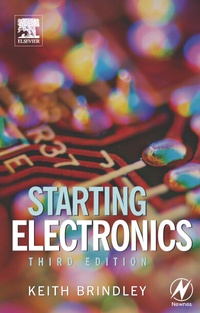
Starting Electronics
3rd Edition
Published on 18. September 2004
Book
Paperback/Softback
288 pages
978-0-7506-6386-1 (ISBN)
Description
Starting Electronics is unrivalled as a highly practical introduction for hobbyists, students and technicians. Keith Brindley introduces readers to the functions of the main component types, their uses, and the basic principles of building and designing electronic circuits. Breadboard layouts make this very much a ready-to-run book for the experimenter; and the use of multimeter, but not oscilloscopes, puts this practical exploration of electronics within reach of every home enthusiast's pocket. The third edition has kept the simplicity and clarity of the original. New material includes sections on transducers and more practical examples of digital ICs.
More details
Edition
3rd edition
Language
English
Place of publication
Oxford
United Kingdom
Publishing group
Elsevier Science & Technology
Target group
Professional and scholarly
Beginners, mostly hobbyists and vocational students, Technician engineers, and secondary/high school teachers / classes, especially Technology
Edition type
New edition
Illustrations
Approx. 100 illustrations
Dimensions
Height: 216 mm
Width: 138 mm
Weight
372 gr
ISBN-13
978-0-7506-6386-1 (9780750663861)
Copyright in bibliographic data and cover images is held by Nielsen Book Services Limited or by the publishers or by their respective licensors: all rights reserved.
Schweitzer Classification
Other editions
New editions
Previous edition

Keith Brindley
Starting Electronics
Book
06/1999
2nd Edition
Newnes
€12.37
Article exhausted; check for reprint
Person
Keith is a freelance journalist whose whole life (well, apart from the wife, the kids, the music and the mountain bike) is computers. He's been writing about them (computers, that is) for over 18 years, in the meantime working as a teacher, lecturer, engineer, journalist and finally (for the last 12 years) freelance in the computing field. He fondly remembers his first contacts with the Commodore Pet, the various Sinclair oddities, the BBC, PC-DOS, MS-DOS, the Mac, and the various incarnations of Windows. He dreams of new software and hardware, he realises that writing about computers makes little compared to making computers or writing the software for them, he is fully committed to passing his experience along to and making computer-life easier for his readers, yet still enjoys what he's doing. Which can't be all bad!
Content
Preface; The very first steps; On the boards; Measuring current and voltage; Capacitors; ICs, oscillators and filters; Diodes I; Diodes II; Transistors; Analogue integrated circuits; Digital integrated circuits I; Digital integrated circuits II; Glossary; Answers; Index