

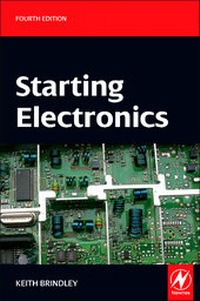
Starting Electronics
4th Edition
Published on 2. August 2011
Book
Paperback/Softback
296 pages
978-0-08-096992-3 (ISBN)
Description
Starting Electronics is unrivalled as a highly practical introduction for technicians, non-electronic engineers, software engineers, students, and hobbyists. Keith Brindley introduces readers to the functions of the main component types, their uses, and the basic principles of building and designing electronic circuits. Breadboard layouts make this very much a ready-to-run book for the experimenter, and the use of readily available, inexpensive components makes this practical exploration of electronics easily accessible to all levels of engineer and hobbyist.
Other books tell readers what to do, but sometimes fail to explain why - Brindley gives readers hands-on confidence in addition to real scientific knowledge, and insight into the principles as well as the practice. All written explanations and steps are supplemented with numerous photos, charts, tables and graphs. Concepts and practical aspects are explained thoroughly with mathematical formulae and technical schematic drawings.
Each chapter introduces a concept or tool, explains the basic theory, and provides clear instructions for a simple experiment to apply the concept or tool, with quiz sections and answers, at the end of each chapter. New chapters on multimeters and soldering will be added, covering the fundamentals and experiments, with a basic parts list and an expanded and updated buyer's guide.
Other books tell readers what to do, but sometimes fail to explain why - Brindley gives readers hands-on confidence in addition to real scientific knowledge, and insight into the principles as well as the practice. All written explanations and steps are supplemented with numerous photos, charts, tables and graphs. Concepts and practical aspects are explained thoroughly with mathematical formulae and technical schematic drawings.
Each chapter introduces a concept or tool, explains the basic theory, and provides clear instructions for a simple experiment to apply the concept or tool, with quiz sections and answers, at the end of each chapter. New chapters on multimeters and soldering will be added, covering the fundamentals and experiments, with a basic parts list and an expanded and updated buyer's guide.
Reviews / Votes
Amazon reviews - selected quotes: "I am ever so grateful to have found this amazing little book. I am a completely devoted fan of this book. I give this book ALL the credit for helping me pass my college course! This book gave me the skills and the confidence to figure out how to put together very simple robots and circuit boards. This book starts with the very, very basics, but it gives you the fundamentals very well so that you can tackle things on your own." - Kelly Jones "Outstanding book... plain and simple. If this book cost twice the amount it does, you would still be getting a deal." - Howard R. Lee "This is a great book. To admit one thing, I knew NOTHING about electronics. Coming from a software development background I wanted to see how the other side worked, and this book did an amazing job at explaining. Nothing could be done to make this book better, it's perfect!" - Kyle Goslin "This is great and has finally made the subject accessible to me. it's the way you wish your teacher had done things. I've picked things up in minutes from this book that I've seen other books spend hours talking about." - G. GrahamMore details
Edition
4th edition
Language
English
Place of publication
Oxford
United Kingdom
Publishing group
Elsevier Science & Technology
Target group
Professional and scholarly
Technicians, non-electronic engineers, software engineers, first year undergraduate students, vocational students, secondary/high school teachers and students, hobbyists. Anyone requiring a basic introduction to electronics theory and practice.
Illustrations
Approx. 100 illustrations
Dimensions
Height: 229 mm
Width: 152 mm
Weight
480 gr
ISBN-13
978-0-08-096992-3 (9780080969923)
Copyright in bibliographic data and cover images is held by Nielsen Book Services Limited or by the publishers or by their respective licensors: all rights reserved.
Schweitzer Classification
Other editions
Previous edition
Keith Brindley
Starting Electronics
Book
09/2004
3rd Edition
Newnes
€22.27
Article exhausted; check for reprint
Person
Keith is a freelance journalist whose whole life (well, apart from the wife, the kids, the music and the mountain bike) is computers. He's been writing about them (computers, that is) for over 18 years, in the meantime working as a teacher, lecturer, engineer, journalist and finally (for the last 12 years) freelance in the computing field. He fondly remembers his first contacts with the Commodore Pet, the various Sinclair oddities, the BBC, PC-DOS, MS-DOS, the Mac, and the various incarnations of Windows. He dreams of new software and hardware, he realises that writing about computers makes little compared to making computers or writing the software for them, he is fully committed to passing his experience along to and making computer-life easier for his readers, yet still enjoys what he's doing. Which can't be all bad!
Content
1. The very first steps2. On the boards3. Measuring current and voltage4. Capacitors5. ICs, oscillators and filters6. Diodes I7. Diodes II8. Transistors9. Analogue integrated circuits10. Digital integrated circuits I11. Digital integrated circuits II12. Soldering