

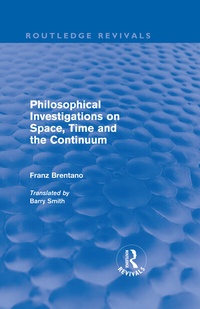
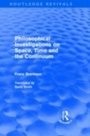
Philosophical Investigations on Time, Space and the Continuum (Routledge Revivals)
1st Edition
Published on 23. October 2009
Book
Hardback
232 pages
978-0-415-56378-9 (ISBN)
Description
Franz Brentano is recognised as one of the most important philosophers of the late nineteenth and early twentieth centuries. This work, first published in English in 1988, besides being an important contribution to metaphysics in its own right, has considerable historical importance through its influence on Husserl's views on internal time consciousness. The work is preceded by a long introduction by Stephan Koerner in collaboration with Brentano's literary executor.
More details
Series
Language
English
Place of publication
London
United Kingdom
Publishing group
Taylor & Francis Ltd
Target group
College/higher education
Product notice
Paper over boards
Dimensions
Height: 216 mm
Width: 138 mm
Weight
590 gr
ISBN-13
978-0-415-56378-9 (9780415563789)
Copyright in bibliographic data and cover images is held by Nielsen Book Services Limited or by the publishers or by their respective licensors: all rights reserved.
Schweitzer Classification
Other editions
Additional editions
Ben Vitiello | Gabriele Masi | Donatella Marazziti
Philosophical Investigations on Time, Space and the Continuum (Routledge Revivals)
Book
12/2009
1st Edition
Routledge
€83.10
Shipment within 15-20 days
Ben Vitiello | Gabriele Masi | Donatella Marazziti
Philosophical Investigations on Time, Space and the Continuum (Routledge Revivals)
E-Book
10/2009
Routledge
€77.99
Available for download
Ben Vitiello | Gabriele Masi | Donatella Marazziti
Philosophical Investigations on Time, Space and the Continuum (Routledge Revivals)
E-Book
10/2009
Routledge
€77.99
Available for download
E-Book
10/2009
1st Edition
Routledge
€110.69
Available for download
Persons
Content
Part 1: The Continuum 1. On What is Continuous 2. On the Measure of What is Continuous Part 2: Time and Time Consciousness 3. What the Philosophers have Taught about time 4. On Memory 5. Our intuition of Time as a Continuum of Modi of Presentation and Acceptance 6. Unacceptability of the Assumption of a Single Preterite Mode 7. To be Real is to be Temporarily Continuous. There is no Internal Proteraesthesis 8. If There no Longer Existed any Things or Only a Timeless God, Then Nothing Would Ever Have Been 9. Material and Modal Differences in What is Temporal 10. The Temporal as Relative 11. On Understanding the Aristotelian Doctrine of Time Part 3: Space and Time 12. Nativistic, Empiricist and Anoetic Theories of our Presentation of Spac e 13. The Impenetrability of Bodies in Space Rests on the Fact that Spatial Determinations are Substantial and Individuating 14. What is to be Learned About Space and Time from the Conflicting Errors of the Philosophers