

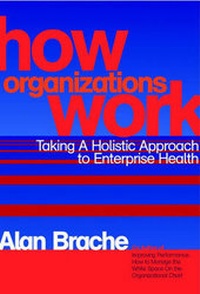
How Organizations Work
Taking a Holistic Approach to Enterprise Health
Published on 4. January 2002
Book
Hardback
240 pages
978-0-471-20033-8 (ISBN)
Description
A groundbreaking approach to successful performance improvement Almost every executive in business today is faced with the challenge of improving performance, from incremental improvements to wholesale organizational change. Here, a world-renowned expert in organizational improvement asserts that most hard-won changes don't last for long, however, because of the inability to identify the root causes of the problem. How Organizations Work offers a clear, integrated solution to performance improvement via a new "Enterprise Model"-which takes into account all variables that influence performance. Alan Brache provides a comprehensive "physical exam" for checking an organization's vital signs and a 360-degree picture of how organizational dynamics can be harnessed to effect permanent improvements in performance.
More details
Language
English
Place of publication
New York
United States
Target group
College/higher education
Professional and scholarly
Dimensions
Height: 234 mm
Width: 162 mm
Thickness: 22 mm
Weight
426 gr
ISBN-13
978-0-471-20033-8 (9780471200338)
Copyright in bibliographic data and cover images is held by Nielsen Book Services Limited or by the publishers or by their respective licensors: all rights reserved.
Schweitzer Classification
Other editions
Additional editions
E-Book
07/2002
Wiley
€21.99
Available for download
Person
Alan Brache, Chief Technology Officer at Kepner-Tregoe, is responsible for creating product strategies, developing and upgrading consulting applications and skill development programs, ensuring delivery quality, writing on topical business is-sues, and developing internal consulting capability. He is one of the seven members of Kepner-Tregoe's Strategic Leadership Committee.
From 1978 to 1986 Mr. Brache served in a number of positions with Kepner-Tregoe, including Product Manager, Technical Director of the Strategy Group, and Vice President of Product Development. He rejoined the company in 1997. During his ten-year absence from Kepner-Tregoe, Mr. Brache co-founded and was a part-ner in The Rummler-Brache Group, a consulting and training company that spe-cializes in helping companies implement their strategies through the design and management of business processes, organization structures, measurement systems, and human performance environments.
Alan co-authored Improving Performance: How to Manage the White Space on the Organization Chart, the book that launched the process improvement revolution and introduced the first set of tools for comprehensively managing an organization as an integrated system. He has published articles in 25 business magazines.
From 1978 to 1986 Mr. Brache served in a number of positions with Kepner-Tregoe, including Product Manager, Technical Director of the Strategy Group, and Vice President of Product Development. He rejoined the company in 1997. During his ten-year absence from Kepner-Tregoe, Mr. Brache co-founded and was a part-ner in The Rummler-Brache Group, a consulting and training company that spe-cializes in helping companies implement their strategies through the design and management of business processes, organization structures, measurement systems, and human performance environments.
Alan co-authored Improving Performance: How to Manage the White Space on the Organization Chart, the book that launched the process improvement revolution and introduced the first set of tools for comprehensively managing an organization as an integrated system. He has published articles in 25 business magazines.
Content
Foreword. Acknowledgments. Chapter 1: Exploring the New Enterprise Model. Chapter 2: Understanding the External Business Environment. Chapter 3: Leading the Enterprise. Chapter 4: Creating Strategic Alignment. Chapter 5: Rethinking Business Processes. Chapter 6: Setting Goals and Measuring Progress. Chapter 7: Reframing Culture. Chapter 8: Managing Human Capabilities. Chapter 9: Leveraging Information and Knowledge. Chapter 10: Putting Organization Structure in Its Place. Chapter 11: Resolving Business Issues. Chapter 12: Putting It All Together. Index.