

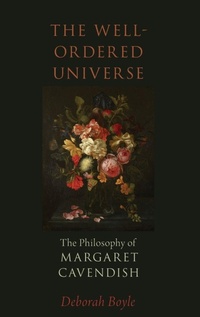
The Well-Ordered Universe
The Philosophy of Margaret Cavendish
Published on 28. December 2017
Book
Hardback
286 pages
978-0-19-023480-5 (ISBN)
Description
The prolific Margaret Cavendish (1623-1673) published books on natural philosophy as well as stories, plays, poems, orations, allegories, and letters. Her mature philosophical system offered a unique panpsychist theory of Nature as composed of a continuous, non-atomistic, perceiving, knowing matter. In contrast to the dominant philosophical thinking of her day, Cavendish argued that all matter has free will and can choose whether or not to follow Nature's rules. The Well-Ordered Universe explores the development of Cavendish's natural philosophy from the atomism of her 1653 poems to the panpsychist materialism of her 1668 Grounds of Natural Philosophy.
Deborah Boyle argues that her natural philosophy, her medical theories, and her social and political philosophy are all informed by an underlying concern with order, regularity, and rule-following. This focus on order reveals interesting connections among apparently disparate elements of Cavendish's philosophical program, including her views on gender, on animals and the environment, and on sickness and health. Focusing on the role of order in Cavendish's philosophy also helps reveal key differences between her natural philosophy and her more conservative social and political philosophy. Cavendish believed that humans' special desire for public recognition often leads to an unruly ambition, causing humans to disrupt society in ways not seen in the rest of Nature. Thus, The Well-Ordered Universe defends Cavendish as a royalist who endorsed absolute monarchy and a rigid social hierarchy for maintaining order in human society.
Deborah Boyle argues that her natural philosophy, her medical theories, and her social and political philosophy are all informed by an underlying concern with order, regularity, and rule-following. This focus on order reveals interesting connections among apparently disparate elements of Cavendish's philosophical program, including her views on gender, on animals and the environment, and on sickness and health. Focusing on the role of order in Cavendish's philosophy also helps reveal key differences between her natural philosophy and her more conservative social and political philosophy. Cavendish believed that humans' special desire for public recognition often leads to an unruly ambition, causing humans to disrupt society in ways not seen in the rest of Nature. Thus, The Well-Ordered Universe defends Cavendish as a royalist who endorsed absolute monarchy and a rigid social hierarchy for maintaining order in human society.
Reviews / Votes
The Well-Ordered Universe is a welcome spark to further discussion, and scholars will enjoy engaging with Boyle on a variety of philosophical questions. * Brandie R. Siegfried, Early Modern Women * The Well Ordered Universe by Deborah Boyle is a critical element in the now constantly expanding discussion of the philosophical views and arguments of Margaret Cavendish * David Cunning, Locke Studies * Boyle's elegant and careful book, informed by a deep knowledge of the primary texts and a secondary literature spanning multiple disciplinary boundaries, goes a long way toward discerning the order in Cavendish's texts, and to illuminating the systematic philosophy they contain. This book should be required reading for everybody interested in Cavendish, and in the history of early modern philosophy more generally. * Colin Chamberlain, Hypatia * Boyle's thorough and carefully argued volume, with its excellent and up-to-date bibliography and index, is a helpful introduction to Margaret Cavendish's philosophy and to the recent literature about it. * Edith Dudley Sylla, Isis * If you want to get an overall grasp on what's going on in Cavendish's philosophy, this book is an excellent guide. While it engages throughout with existing literature, it also gives a comprehensive and clear overview, and finds in the notions of order and regularity a plausible framework within which to organize Cavendish's many and diverse views. * Stewart Duncan, Journal of the History of Philosophy *More details
Language
English
Place of publication
New York
United States
Target group
Professional and scholarly
Dimensions
Height: 240 mm
Width: 161 mm
Thickness: 20 mm
Weight
596 gr
ISBN-13
978-0-19-023480-5 (9780190234805)
Copyright in bibliographic data and cover images is held by Nielsen Book Services Limited or by the publishers or by their respective licensors: all rights reserved.
Schweitzer Classification
Other editions
Additional editions
E-Book
11/2017
OUP eBook
€56.99
Available for download
Person
Deborah Boyle is Professor of Philosophy at the College of Charleston and the author of Descartes on Innate Ideas (2009).
Content
Introduction
Chapter 1: Order and Regularities
Chapter 2: Cavendish's Atomism
Chapter 3: Vitalist Materialism and Infinite Nature
Chapter 4: Creatures
Chapter 5: Human Nature and the Desire for Fame
Chapter 6: Peace and Order in Human Societies
Chapter 7: Gender Roles and the Role of Nature
Chapter 8: Humans and the Natural World
Chapter 9: Health and Order in the Human Body
Conclusion
Bibliography
Chapter 1: Order and Regularities
Chapter 2: Cavendish's Atomism
Chapter 3: Vitalist Materialism and Infinite Nature
Chapter 4: Creatures
Chapter 5: Human Nature and the Desire for Fame
Chapter 6: Peace and Order in Human Societies
Chapter 7: Gender Roles and the Role of Nature
Chapter 8: Humans and the Natural World
Chapter 9: Health and Order in the Human Body
Conclusion
Bibliography