

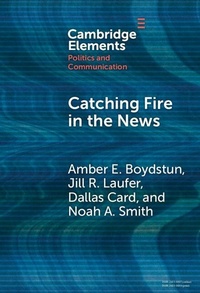
Catching Fire in the News
The Necessary Conditions for Media Storms
Will be published approx. on 28. February 2026
Book
Hardback
75 pages
978-1-009-49841-8 (ISBN)
Description
Why do some events catch fire in the news, producing a media storm, while many similar events go unnoticed? This Element uses a fire triangle analogy to explain the necessary conditions of media storms. The 'heat' is the spark: a dramatic event or discovery. The 'fuel' is the political and cultural landscape, including similar items in recent news, as well as current debates that allow the event to be framed in a resonant way. The 'oxygen' is the available news agenda space, plus attention the event receives beyond the news (by activists, politicians, people on social media, etc.). Media storms are not easily predictable; it takes the right event, at the right time, with the right momentum of attention. But when the political stars align and a media storm erupts, it can be a window of opportunity for change. This title is also available as Open Access on Cambridge Core.
More details
Series
Language
English
Place of publication
Cambridge
United Kingdom
Illustrations
Worked examples or Exercises
Dimensions
Height: 235 mm
Width: 157 mm
Thickness: 10 mm
Weight
308 gr
ISBN-13
978-1-009-49841-8 (9781009498418)
Copyright in bibliographic data and cover images is held by Nielsen Book Services Limited or by the publishers or by their respective licensors: all rights reserved.
Schweitzer Classification
Other editions
Additional editions
Amber E. Boydstun | Jill R. Laufer | Dallas Card
Catching Fire in the News
The Necessary Conditions for Media Storms
Book
approx. 02/2026
Cambridge University Press
€27.00
Not yet published
Amber E. Boydstun | Jill R. Laufer | Dallas Card
Catching Fire in the News
The Necessary Conditions for Media Storms
E-Book
02/2026
Cambridge University Press
€21.99
Available for download
Persons
Content
1. Introduction; 2. What we know about media storms; 3. Methodology: identifying the correlates of media storms; 4. The fire triangle model of media storms; 5. The role of political actors in the fire triangle model; 6. Necessary elements of media storms: heat, fuel, and oxygen; 7. Effects of media storms; References.