

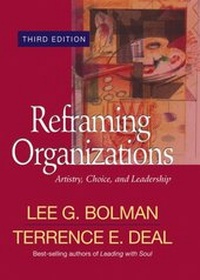
Reframing Organizations
Artistry, Choice and Leadership
3rd Edition
Published on 11. August 2003
Book
Hardback
512 pages
978-0-7879-6426-9 (ISBN)
Description
From the authors of the best-selling book Leading with Soul (0-7879-5547-7) comes the third edition of their classic book Reframing Organizations. Authors Lee Bolman and Terrence Deal explain how to use the powerful tool of "reframing" deliberately looking at situations from more than one vantage point to bring order out of confusion and to build high-performing, responsive organizations. In this edition, the authors maintain their lively style and solid structure while revising and updating both case examples and trends in the literature.
More details
Edition
3., Aufl.
Language
English
Place of publication
New York
United States
Publishing group
John Wiley & Sons Inc
Target group
Professional and scholarly
Edition type
Revised edition
Dimensions
Height: 24.3 cm
Width: 18.2 cm
Thickness: 32 mm
Weight
936 gr
ISBN-13
978-0-7879-6426-9 (9780787964269)
Schweitzer Classification
Other editions
New editions
Book
08/2008
4th Edition
Jossey-Bass
€55.90
Article exhausted; check different version
Additional editions
E-Book
10/2003
3rd Edition
Jossey-Bass
€30.99
Available for download
Persons
Lee G. Bolman and Terrence E. Deal are the best-selling authors of Leading with Soul. Bolman holds the Marion Bloch Chair in Leadership at the Bloch School of Business, University of Missouri--Kansas City. He consults worldwide to corporations, public agencies, universities, and schools.
Deal is the Irving R. Melbo Professor of Education at the Rossier School, University of Southern California, and aninternational consultant to business, health care, military, educational, and religious organizations.
Deal is the Irving R. Melbo Professor of Education at the Rossier School, University of Southern California, and aninternational consultant to business, health care, military, educational, and religious organizations.
Content
PREFACE.THE AUTHORS.PART ONE: MAKING SENSE OF ORGANIZATIONS.CHAPTER 1. INTRODUCTION: THE POWER OF REFRAMING.Virtues and Drawbacks of Organized Activity.The Curse of Cluelessness.Strategies for Improving Organizations: The Track Record.Theory Base.Frames and Reframing.Conclusion.CHAPTER 2. SIMPLE IDEAS, COMPLEX ORGANIZATIONS.Properties of Organizations.Organizational Learning.Coping with Ambiguity and Complexity.Common Fallacies in Organizational Diagnosis.Conclusion.PART TWO: THE STRUCTURAL FRAME.CHAPTER 3. GETTING ORGANIZED.Structural Assumptions.Origins of the Structural Perspective.Structural Forms and Functions.Basic Structural Tensions.Vertical Coordination.Lateral Coordination.McDonald's and Harvard: A Structural Odd Couple.Structural Imperatives.Conclusion.CHAPTER 4. STRUCTURE AND RESTRUCTURING.Structural Dilemmas.Structural Configurations.Generic Issues in Restructuring.Why Restructure?Making Restructuring Work: Three Case Examples.Conclusion.CHAPTER 5. ORGANIZING GROUPS AND TEAMS.Tasks and Linkages in Small Groups.Teamwork and Interdependence.Team Structure and Top Performance.Saturn: The Story Behind the Story.Conclusion.PART THREE: THE HUMAN RESOURCE FRAME.CHAPTER 6. PEOPLE AND ORGANIZATIONS.Human Resource Assumptions.Human Needs.What Needs Do People Have?Theory X and Theory Y.Personality and Organization.Human Capacity and the New Employment Contract.Lean and Mean: More Benefits Than Costs?Investing in People.Conclusion.CHAPTER 7. IMPROVING HUMAN RESOURCE MANAGEMENT.Build and Implement an HR Philosophy.Hire the Right People: Know What You Want and Be Selective.Keep Employees.Invest in Employees.Empower Employees.Promote Diversity.Putting It All Together: TQM and NUMMI.Getting There: Training and Organization Development.Conclusion.CHAPTER 8. INTERPERSONAL AND GROUP DYNAMICS.Interpersonal Dynamics.Management Styles.Groups and Teams in Organizations.Conclusion.PART FOUR: THE POLITICAL FRAME.CHAPTER 9. POWER, CONFLICT, AND COALITION.Political Assumptions.Organizations as Coalitions.Power and Decision Making.Conflict in Organizations.Moral Mazes: The Politics of Getting Ahead.Conclusion.CHAPTER 10. THE MANAGER AS POLITICIAN.Political Skills.Morality and Politics.Conclusion.CHAPTER 11.ORGANIZATIONS AS POLITICAL ARENAS AND POLITICAL AGENTS.Organizations as Arenas.Organizations as Political Agents.Conclusion.PART FIVE: THE SYMBOLIC FRAME.CHAPTER 12. ORGANIZATIONAL CULTURE AND SYMBOLS.Symbolic Assumptions.Organizations as Cultures.Organizational Symbols.Conclusion.CHAPTER 13. ORGANIZATION AS THEATER.Institutional Theory.Organizational Structure as Theater.Organizational Process as Theater.Conclusion.CHAPTER 14. ORGANIZATIONAL CULTURE IN ACTION.The Eagle Group's Sources of Success.Leading Principles.Conclusion.PART SIX: IMPROVING LEADERSHIP PRACTICE.CHAPTER 15. INTEGRATING FRAMES FOR EFFECTIVE PRACTICE.Life as Managers Know It.Across Frames: Organizations as Multiple Realities.Matching Frames to Situations.Effective Managers and Organizations.Conclusion.CHAPTER 16. REFRAMING IN ACTION: OPPORTUNITIES AND PERILS.Structural Frame.Human Resource Frame.Political Frame.Symbolic Frame.Benefits and Risks of Reframing.Reframing for Newcomers and Outsiders.Conclusion.CHAPTER 17. REFRAMING LEADERSHIP.The Idea of Leadership.The Context of Leadership.What Do We Know About Good Leadership?Gender and Leadership.Reframing Leadership.Conclusion.CHAPTER 18. REFRAMING CHANGE: TRAINING, REALIGNING, NEGOTIATING, GRIEVING, AND MOVING ON.A Common Change Scenario.Change and Training.Change and Realignment.Change and Conflict.Change and Loss.Change Strategy.Team Zebra: The Rest of the Story.Conclusion.CHAPTER 19. REFRAMING ETHICS AND SPIRIT.Soul and Spirit in Organizations.The Factory: Excellence and Authorship.The Family: Caring and Love.The Jungle: Justice and Power.The Temple: Faith and Significance.Conclusion.CHAPTER 20. BRINGING IT ALL TOGETHER: CHANGE AND LEADERSHIP IN ACTION.Structural Issues and Options.Human Resource Issues and Options.Political Issues and Options.Symbolic Issues and Options.Conclusion: The Reframing Process.CHAPTER 21. EPILOGUE.Commitment to Core Beliefs.Multiframe Thinking.APPENDIX. THE BEST OF ORGANIZATIONAL STUDIES: SCHOLARS' HITS AND POPULAR BEST-SELLERS.REFERENCES.NAME INDEX.SUBJECT INDEX.