

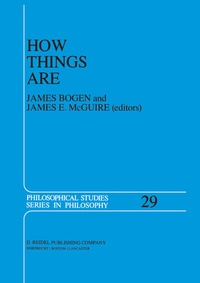
How Things Are
Studies in Predication and the History of Philosophy and Science
Published on 31. December 1984
Book
Hardback
X, 345 pages
978-90-277-1583-8 (ISBN)
Description
One of the earliest and most influential treatises on the subject of this volume is Aristotle's Categories. Aristotle's title is a form of the Greek verb for speaking against or submitting an accusation in a legal proceeding. By the time of Aristotle, it also meant: to signify or to predicate. Surprisingly, the "predicates" Aristotle talks about include not only bits of language, but also such nonlinguistic items as the color white in a body and the knowledge of grammar in a man's soul. (Categories I/ii) Equally surprising are such details as Aristotle's use of the terms 'homonymy' and 'synonymy' in connection with things talked about rather than words used to talk about them. Judging from the evidence in the Organon, the Metaphysics, and elsewhere, Aristotle was both aware of and able to mark the distinction between using and men tioning words; and so we must conclude that in the Categories, he was not greatly concerned with it. For our purposes, however, it is best to treat the term 'predication' as if it were ambiguous and introduce some jargon to disambiguate it. Code, Modrak, and other authors of the essays which follow use the terms 'linguistic predication' and 'metaphysical predication' for this.
More details
Series
Edition
1985 ed.
Language
English
Place of publication
Dordrecht
Netherlands
Publishing group
Springer
Target group
Professional and scholarly
Research
Product notice
sewn/stitched
Cloth over boards
Illustrations
X, 345 p.
Dimensions
Height: 241 mm
Width: 160 mm
Thickness: 24 mm
Weight
705 gr
ISBN-13
978-90-277-1583-8 (9789027715838)
DOI
10.1007/978-94-009-5199-0
Schweitzer Classification
Other editions
Additional editions
J. Bogen | J.E. McGuire
How Things Are
Studies in Predication and the History of Philosophy and Science
Book
11/2011
Springer
€160.49
Shipment within 15-20 days
Content
Zeno's Stricture and Predication in Plato, Aristotle, and Plotinus.- Form and Predication in Aristotle's Metaphysics.- Forms and Compounds.- On the Origins of Some Aristotelian Theses About Predication.- Plato's Third Man Argument and the 'Platonism' of Aristotle.- Things versus 'Hows', or Ockham on Predication and Ontology.- Buridan's Ontology.- Phenomenalism, Relations, and Monadic Representation: Leibniz on Predicate Levels.- Predication, Truth, and Transworld Identity in Leibniz.- Towards a Theory of Predication.- On the Origins of Some Aristotelian Theses About Predication: Appendix on The Third Man Argument'.- Alan Code.- Notes on the Contributors.- Index of Labeled Expressions.- Name Index.