

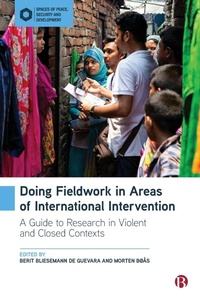
Doing Fieldwork in Areas of International Intervention
A Guide to Research in Violent and Closed Contexts
1st Edition
Published on 1. June 2020
Book
Paperback/Softback
288 pages
978-1-5292-0689-0 (ISBN)
Description
Using rich insights from those with first-hand experience of conducting research in areas of international intervention, this much-needed book provides essential practical guidance and key reflections for researchers and students embarking on fieldwork in violent, repressive and closed contexts. Contributors provide explicit discussion of their mistakes and hard-learned lessons, raising important questions that intervention researchers need to consider before, during and after their research.
More details
Series
Edition
First Edition
Language
English
Place of publication
Bristol
United Kingdom
Target group
Professional and scholarly
Illustrations
1 s/w Abbildung
Dimensions
Height: 234 mm
Width: 156 mm
Thickness: 17 mm
Weight
471 gr
ISBN-13
978-1-5292-0689-0 (9781529206890)
Copyright in bibliographic data and cover images is held by Nielsen Book Services Limited or by the publishers or by their respective licensors: all rights reserved.
Schweitzer Classification
Other editions
Additional editions
Berit Bliesemann de Guevara | Morten Bøås
Doing Fieldwork in Areas of International Intervention
A Guide to Research in Violent and Closed Contexts
E-Book
06/2020
1st Edition
Bristol University Press
€45.49
Available for download
Morten Boas | Berit Bliesemann de Guevara
Doing Fieldwork in Areas of International Intervention
A Guide to Research in Violent and Closed Contexts
Book
06/2020
1st Edition
Bristol University Press
€105.20
Shipment within 3-4 weeks
Persons
Berit Bliesemann de Guevara is a Reader in Peacebuilding at the Department of International Politics at Aberystwyth University, UK.
Morten Boas is a Research Professor at the Norwegian Institute of International Affairs (NUPI), Norway.
Morten Boas is a Research Professor at the Norwegian Institute of International Affairs (NUPI), Norway.
Content
PART 1: CONTROL AND CONFUSION;
The interview as a cultural performance and the value of surrendering control ~ Markus Goeransson;
Interpretivist methods and military intervention research: using interview research to de-centre the 'intervener' ~ Casey McNeill;
Shifting identities, policy networks, and the ethical and practical challenges of gaining access to the field in interventions ~ Roland Kosti?;
Being watched and being handled ~ Jesse Driscoll;
Unequal research relationships in highly insecure places: of fear, funds and friendship ~ Morten Boas;
PART 2: SECURITY AND RISK;
The politics of safe research in violent and illiberal contexts ~ Francesco Strazzari and Alessandra Russo;
Challenges of research in an active conflict environment ~ Boukary Sangare and Jamie Bleck;
The politics and ethics of fieldwork in post-conflict environments: the dilemmas of a vocational approach ~ John Heathershaw and Parviz Mullojonov;
On assessing risk assessments and situating security advice: the unsettling quest for 'security expertise' ~ Judith Verweijen;
PART 3: DISTANCE AND CLOSENESS;
Positioning in an insecure field: reflections on negotiating identity ~ Maria-Louise Clausen;
A different form of intervention? Revisiting the role of researchers in post-war contexts ~ Daniela Lai;
The road to Darfur: Ethical and practical challenges of embedded research in areas of open conflict ~ Mateja Peter;
Interpretation by proxy? Interpretive fieldwork with local associates in areas of restricted research access ~ Katarina Kusi?;
PART 4: SEX AND SENSITIVITY;
Sex workers and sugar babies: empathetic engagement with vulnerable sources ~ Kathleen Jennings;
Lifting the burden? The ethical implications of studying exemplary, not pathological, wartime sexual conduct ~ Angela Muvumba Sellstroem;
Unexpected grey areas, innuendo and webs of complicity: experiences of researching sexual exploitation in UN peacekeeping missions ~ Henri Myrtinnen;
Sexual exploitation, rape and abuse as a narrative and a strategy ~ Ingunn Bjorkhaug;
CONCLUSIONS;
Lessons for intervention fieldwork in violent and closed contacts ~ Berit Bliesemann de Guevara and Morten Boas.
The interview as a cultural performance and the value of surrendering control ~ Markus Goeransson;
Interpretivist methods and military intervention research: using interview research to de-centre the 'intervener' ~ Casey McNeill;
Shifting identities, policy networks, and the ethical and practical challenges of gaining access to the field in interventions ~ Roland Kosti?;
Being watched and being handled ~ Jesse Driscoll;
Unequal research relationships in highly insecure places: of fear, funds and friendship ~ Morten Boas;
PART 2: SECURITY AND RISK;
The politics of safe research in violent and illiberal contexts ~ Francesco Strazzari and Alessandra Russo;
Challenges of research in an active conflict environment ~ Boukary Sangare and Jamie Bleck;
The politics and ethics of fieldwork in post-conflict environments: the dilemmas of a vocational approach ~ John Heathershaw and Parviz Mullojonov;
On assessing risk assessments and situating security advice: the unsettling quest for 'security expertise' ~ Judith Verweijen;
PART 3: DISTANCE AND CLOSENESS;
Positioning in an insecure field: reflections on negotiating identity ~ Maria-Louise Clausen;
A different form of intervention? Revisiting the role of researchers in post-war contexts ~ Daniela Lai;
The road to Darfur: Ethical and practical challenges of embedded research in areas of open conflict ~ Mateja Peter;
Interpretation by proxy? Interpretive fieldwork with local associates in areas of restricted research access ~ Katarina Kusi?;
PART 4: SEX AND SENSITIVITY;
Sex workers and sugar babies: empathetic engagement with vulnerable sources ~ Kathleen Jennings;
Lifting the burden? The ethical implications of studying exemplary, not pathological, wartime sexual conduct ~ Angela Muvumba Sellstroem;
Unexpected grey areas, innuendo and webs of complicity: experiences of researching sexual exploitation in UN peacekeeping missions ~ Henri Myrtinnen;
Sexual exploitation, rape and abuse as a narrative and a strategy ~ Ingunn Bjorkhaug;
CONCLUSIONS;
Lessons for intervention fieldwork in violent and closed contacts ~ Berit Bliesemann de Guevara and Morten Boas.