

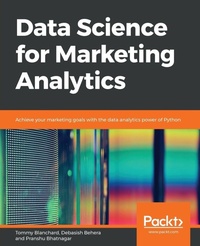
Data Science for Marketing Analytics
Achieve your marketing goals with the data analytics power of Python
Published on 30. March 2019
Book
Paperback/Softback
420 pages
978-1-78995-941-3 (ISBN)
Description
Explore new and more sophisticated tools that reduce your marketing analytics efforts and give you precise results
Key Features
Study new techniques for marketing analytics
Explore uses of machine learning to power your marketing analyses
Work through each stage of data analytics with the help of multiple examples and exercises
Book DescriptionData Science for Marketing Analytics covers every stage of data analytics, from working with a raw dataset to segmenting a population and modeling different parts of the population based on the segments.
The book starts by teaching you how to use Python libraries, such as pandas and Matplotlib, to read data from Python, manipulate it, and create plots, using both categorical and continuous variables. Then, you'll learn how to segment a population into groups and use different clustering techniques to evaluate customer segmentation. As you make your way through the chapters, you'll explore ways to evaluate and select the best segmentation approach, and go on to create a linear regression model on customer value data to predict lifetime value. In the concluding chapters, you'll gain an understanding of regression techniques and tools for evaluating regression models, and explore ways to predict customer choice using classification algorithms. Finally, you'll apply these techniques to create a churn model for modeling customer product choices.
By the end of this book, you will be able to build your own marketing reporting and interactive dashboard solutions.
What you will learn
Analyze and visualize data in Python using pandas and Matplotlib
Study clustering techniques, such as hierarchical and k-means clustering
Create customer segments based on manipulated data
Predict customer lifetime value using linear regression
Use classification algorithms to understand customer choice
Optimize classification algorithms to extract maximal information
Who this book is forData Science for Marketing Analytics is designed for developers and marketing analysts looking to use new, more sophisticated tools in their marketing analytics efforts. It'll help if you have prior experience of coding in Python and knowledge of high school level mathematics. Some experience with databases, Excel, statistics, or Tableau is useful but not necessary.
Key Features
Study new techniques for marketing analytics
Explore uses of machine learning to power your marketing analyses
Work through each stage of data analytics with the help of multiple examples and exercises
Book DescriptionData Science for Marketing Analytics covers every stage of data analytics, from working with a raw dataset to segmenting a population and modeling different parts of the population based on the segments.
The book starts by teaching you how to use Python libraries, such as pandas and Matplotlib, to read data from Python, manipulate it, and create plots, using both categorical and continuous variables. Then, you'll learn how to segment a population into groups and use different clustering techniques to evaluate customer segmentation. As you make your way through the chapters, you'll explore ways to evaluate and select the best segmentation approach, and go on to create a linear regression model on customer value data to predict lifetime value. In the concluding chapters, you'll gain an understanding of regression techniques and tools for evaluating regression models, and explore ways to predict customer choice using classification algorithms. Finally, you'll apply these techniques to create a churn model for modeling customer product choices.
By the end of this book, you will be able to build your own marketing reporting and interactive dashboard solutions.
What you will learn
Analyze and visualize data in Python using pandas and Matplotlib
Study clustering techniques, such as hierarchical and k-means clustering
Create customer segments based on manipulated data
Predict customer lifetime value using linear regression
Use classification algorithms to understand customer choice
Optimize classification algorithms to extract maximal information
Who this book is forData Science for Marketing Analytics is designed for developers and marketing analysts looking to use new, more sophisticated tools in their marketing analytics efforts. It'll help if you have prior experience of coding in Python and knowledge of high school level mathematics. Some experience with databases, Excel, statistics, or Tableau is useful but not necessary.
More details
Language
English
Place of publication
Birmingham
United Kingdom
Target group
Professional and scholarly
US School Grade: College Graduate Student
Dimensions
Height: 235 mm
Width: 191 mm
Thickness: 23 mm
Weight
780 gr
ISBN-13
978-1-78995-941-3 (9781789959413)
Copyright in bibliographic data and cover images is held by Nielsen Book Services Limited or by the publishers or by their respective licensors: all rights reserved.
Schweitzer Classification
Other editions
Additional editions
Tommy Blanchard | Debasish Behera | Pranshu Bhatnagar
Data Science for Marketing Analytics
Achieve your marketing goals with the data analytics power of Python
E-Book
09/2024
Packt Publishing
from
€46.39
Available for download
Persons
Tommy Blanchard earned his PhD from the University of Rochester and did his postdoctoral training at Harvard. Now, he leads the data science team at Fresenius Medical Care North America. His team performs advanced analytics and creates predictive models to solve a wide variety of problems across the company. Debasish Behera works as a data scientist for a large Japanese corporate bank, where he applies machine learning/AI to solve complex problems. He has worked on multiple use cases involving AML, predictive analytics, customer segmentation, chat bots, and natural language processing. He currently lives in Singapore and holds a Master's in Business Analytics (MITB) from the Singapore Management University. Pranshu Bhatnagar works as a data scientist in the telematics, insurance, and mobile software space. He has previously worked as a quantitative analyst in the FinTech industry and often writes about algorithms, time series analysis in Python, and similar topics. He graduated with honors from the Chennai Mathematical Institute with a degree in Mathematics and Computer Science and has completed certification courses in Machine Learning and Artificial Intelligence from the International Institute of Information Technology, Hyderabad. He is based in Bangalore, India.
Content
Table of Contents