

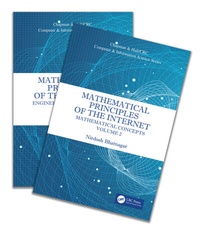
Mathematical Principles of the Internet, Two Volume Set
1st Edition
Published on 30. September 2020
Book
1768 pages
978-0-367-65582-2 (ISBN)
Description
This two-volume set on Mathematical Principles of the Internet provides a comprehensive overview of the mathematical principles of Internet engineering. The books do not aim to provide all of the mathematical foundations upon which the Internet is based. Instead, these cover only a partial panorama and the key principles.
Volume 1 explores Internet engineering, while the supporting mathematics is covered in Volume 2. The chapters on mathematics complement those on the engineering episodes, and an effort has been made to make this work succinct, yet self-contained. Elements of information theory, algebraic coding theory, cryptography, Internet traffic, dynamics and control of Internet congestion, and queueing theory are discussed. In addition, stochastic networks, graph-theoretic algorithms, application of game theory to the Internet, Internet economics, data mining and knowledge discovery, and quantum computation, communication, and cryptography are also discussed.
In order to study the structure and function of the Internet, only a basic knowledge of number theory, abstract algebra, matrices and determinants, graph theory, geometry, analysis, optimization theory, probability theory, and stochastic processes, is required. These mathematical disciplines are defined and developed in the books to the extent that is needed to develop and justify their application to Internet engineering.
Volume 1 explores Internet engineering, while the supporting mathematics is covered in Volume 2. The chapters on mathematics complement those on the engineering episodes, and an effort has been made to make this work succinct, yet self-contained. Elements of information theory, algebraic coding theory, cryptography, Internet traffic, dynamics and control of Internet congestion, and queueing theory are discussed. In addition, stochastic networks, graph-theoretic algorithms, application of game theory to the Internet, Internet economics, data mining and knowledge discovery, and quantum computation, communication, and cryptography are also discussed.
In order to study the structure and function of the Internet, only a basic knowledge of number theory, abstract algebra, matrices and determinants, graph theory, geometry, analysis, optimization theory, probability theory, and stochastic processes, is required. These mathematical disciplines are defined and developed in the books to the extent that is needed to develop and justify their application to Internet engineering.
More details
Series
Language
English
Place of publication
United Kingdom
Publishing group
Taylor & Francis Ltd
Target group
College/higher education
Dimensions
Height: 254 mm
Width: 178 mm
Weight
453 gr
ISBN-13
978-0-367-65582-2 (9780367655822)
Copyright in bibliographic data and cover images is held by Nielsen Book Services Limited or by the publishers or by their respective licensors: all rights reserved.
Schweitzer Classification
Other editions
Additional editions
Nirdosh Bhatnagar
Mathematical Principles of the Internet, Two Volume Set
E-Book
03/2019
1st Edition
Chapman & Hall/CRC
€118.99
Available for download

Nirdosh Bhatnagar
Mathematical Principles of the Internet, Two Volume Set
Book
12/2018
1st Edition
CRC Press
€698.22
Shipment within 10-20 days
Person
Nirdosh Bhatnagar works, both in the academia and industry in Silicon Valley, California, USA. He is the author of several papers and reports. Nirdosh earned an MS in operations research, and MS and PhD in electrical engineering, all from Stanford University, Stanford, California.
Content
Information Theory. Algebraic Coding Theory. Cryptography. Internet Traffic. Dynamics, Control, and Management of Internet Congestion. Queueing Theory. Stochastic Structure of the Internet and World Wide Web. Graph-Theoretic Algorithms. Game Theory and the Internet. Internet Economics. Data Mining and Knowledge Discovery. Quantum Computation, Communication, and Cryptography. Number Theory. Abstract Algebra. Matrices and determinants. Graph Theory. Geometry. Applied Analysis. Optimization, stability, and chaos theory. Probability theory. Stochastic processes.