

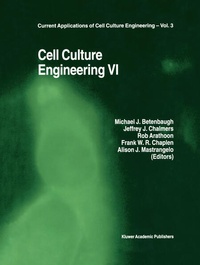
Cell Culture Engineering VI
Published on 11. October 2012
Book
Paperback/Softback
VI, 235 pages
978-94-010-6011-0 (ISBN)
Description
The latest edition in this continuing series includes the newest advances in the rapidly evolving field of animal cell culture, genetic manipulations for heterologous gene expression, cell line enhancements, improved bioreactor designs and separations, gene therapy manufacturing, tissue engineering, anti-apoptosis strategies and cell cycle research. The contents include new research articles as well as critical reviews on emerging topics such as viral and viral-like agent contamination of animal cell culture components. These papers were carefully selected from contributions by leading academic and industrial experts in the biotechnology community at the recent Cell Culture Engineering VI Meeting in San Diego, USA, 1998. However, the book is not merely a proceedings.
Audience: Biochemical engineers, cell biologists, biochemists, molecular biologists, immunologists and other disciplines related to cell culture engineering, working in the academic environment and the biotechnology or pharmaceutical industry.
Audience: Biochemical engineers, cell biologists, biochemists, molecular biologists, immunologists and other disciplines related to cell culture engineering, working in the academic environment and the biotechnology or pharmaceutical industry.
More details
Series
Edition
Softcover reprint of the original 1st ed. 1998
Language
English
Place of publication
Dordrecht
Netherlands
Target group
Professional and scholarly
Research
Illustrations
VI, 235 p.
Dimensions
Height: 260 mm
Width: 195 mm
Thickness: 14 mm
Weight
524 gr
ISBN-13
978-94-010-6011-0 (9789401060110)
DOI
10.1007/978-94-011-4786-6
Schweitzer Classification
Other editions
Additional editions
Michael J. Betenbaugh | Jeffrey J. Chalmers | Rob Arathoon
Cell Culture Engineering VI
E-Book
12/2012
Springer
€149.79
Available for download
Michael J. Betenbaugh | Jeffrey J. Chalmers | Rob Arathoon
Cell Culture Engineering VI
Book
04/1999
Kluwer Academic Publishers
€160.49
Shipment within 15-20 days
Content
Cell therapy in kidney failure.- Improved bicistronic mammalian expression vectors using expression augmenting sequence element (EASE).- Effects on growth behavior in continuous hybridoma cell cultures: The role of viral contamination.- Isolation, characterization and recombinant protein expression in Veggie-CHO: A serum-free CHO host cell line.- Collective experiences of adventitious viruses of animal-derived raw materials and what can be done about them.- An overview of viral and viral-like agents in cell culture systems.- New adenovirus vectors for protein production and gene transfer.- Modulation of cell cycle progression and of antibody production in mouse hybridomas by a nucleotide analogue.- Engineering Chinese hamster ovary (CHO) cells to achieve an inverse growth - associated production of a foreign protein, ?-galactosidase.- A high-yielding serum-free, suspension cell culture process to manufacture recombinant adenoviral vectors for gene therapy.- Recombinant insulin-like growth factor-I (IGF-I) production in Super-CHO results in the expression of IGF-I receptor and IGF binding protein 3.- Attachment and growth of anchorage-dependent cells on a novel, charged-surface microcarrier under serum-free conditions.- Regulated multicistronic expression technology for mammalian metabolic engineering.- Design, characterization and application of a minibioreactor for the culture of human hematopoietic cells under controlled conditions.- Historical reflections on cell culture engineering.- Optimization of transient gene expression in mammalian cells and potential for scale-up using flow electroporation.- Population balance model of in vivo neutrophil formation following bone marrow rescue therapy.- Mammalian cell retention devides for stirred perfusion bioreactors.-Variable functions of bcl-2 in mediating bioreactor stress-induced apoptosis in hybridoma cells.- Apoptosis-resistant NS/0 E1B-19K myelomas exhibit increased viability and chimeric antibody productivity under cell cycle modulating conditions.- Effects of temperature on recombinant protein expression in Semliki Forest virus infected mammalian cell lines growing in serum-free suspension cultures.- Effects of CO2 and osmolality on hybridoma cells: growth, metabolism and monoclonal antibody production.- pQuattro vectors allow one-step multigene metabolic engineering and auto-selection of quattrocistronic artificial mammalian operons.