

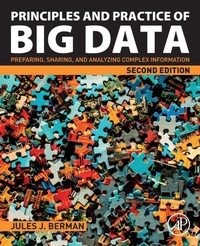
Principles and Practice of Big Data
Preparing, Sharing, and Analyzing Complex Information
2nd Edition
Published on 25. July 2018
Book
Paperback/Softback
480 pages
978-0-12-815609-4 (ISBN)
Description
Principles and Practice of Big Data: Preparing, Sharing, and Analyzing Complex Information, Second Edition updates and expands on the first edition, bringing a set of techniques and algorithms that are tailored to Big Data projects. The book stresses the point that most data analyses conducted on large, complex data sets can be achieved without the use of specialized suites of software (e.g., Hadoop), and without expensive hardware (e.g., supercomputers). The core of every algorithm described in the book can be implemented in a few lines of code using just about any popular programming language (Python snippets are provided).
Through the use of new multiple examples, this edition demonstrates that if we understand our data, and if we know how to ask the right questions, we can learn a great deal from large and complex data collections. The book will assist students and professionals from all scientific backgrounds who are interested in stepping outside the traditional boundaries of their chosen academic disciplines.
Through the use of new multiple examples, this edition demonstrates that if we understand our data, and if we know how to ask the right questions, we can learn a great deal from large and complex data collections. The book will assist students and professionals from all scientific backgrounds who are interested in stepping outside the traditional boundaries of their chosen academic disciplines.
More details
Edition
2nd edition
Language
English
Place of publication
San Diego
United States
Publishing group
Elsevier Science Publishing Co Inc
Target group
Professional and scholarly
Dimensions
Height: 233 mm
Width: 189 mm
Thickness: 30 mm
Weight
1009 gr
ISBN-13
978-0-12-815609-4 (9780128156094)
Copyright in bibliographic data and cover images is held by Nielsen Book Services Limited or by the publishers or by their respective licensors: all rights reserved.
Schweitzer Classification
Other editions
Additional editions
Jules J. Berman
Principles and Practice of Big Data
Preparing, Sharing, and Analyzing Complex Information
E-Book
07/2018
2nd Edition
Morgan Kaufmann
€69.95
Available for download
Previous edition
Book
07/2013
Morgan Kaufmann
€55.70
Shipment within 15-20 days
Person
Jules Berman holds two Bachelor of Science degrees from MIT (in Mathematics and in Earth and Planetary Sciences), a PhD from Temple University, and an MD from the University of Miami. He was a graduate researcher at the Fels Cancer Research Institute (Temple University) and at the American Health Foundation in Valhalla, New York. He completed his postdoctoral studies at the US National Institutes of Health, and his residency at the George Washington University Medical Center in Washington, DC. Dr. Berman served as Chief of anatomic pathology, surgical pathology, and cytopathology at the Veterans Administration Medical Center in Baltimore, Maryland, where he held joint appointments at the University of Maryland Medical Center and at the Johns Hopkins Medical Institutions. In 1998, he transferred to the US National Institutes of Health as a Medical Officer and as the Program Director for Pathology Informatics in the Cancer Diagnosis Program at the National Cancer Institute. Dr. Berman is a past President of the Association for Pathology Informatics and is the 2011 recipient of the Association's Lifetime Achievement Award. He is a listed author of more than 200 scientific publications and has written more than a dozen books in his three areas of expertise: informatics, computer programming, and pathology. Dr. Berman is currently a freelance writer.
Content
1. Introduction2. Providing Structure to Unstructured Data3. Identification, Deidentification, and Reidentification4. Metadata, Semantics, and Triples5. Classifications and Ontologies6. Introspection7. Data Integration and Software Interoperability8. Immutability and Immortality9. Assessing the Adequacy of a Big Data Resource10. Measurement11. Indispensable Tips for Fast and Simple Big Data Analysis12. Finding the Clues in Large Collections of Data13. Using Random Numbers to Bring Your Big Data Analytic Problems Down to Size14. Special Considerations in Big Data Analysis15. Big Data Failures and How to Avoid (Some of) Them16. Legalities17. Data Sharing18. Data Reanalysis: Much More Important than Analysis19. Repurposing Big Data