

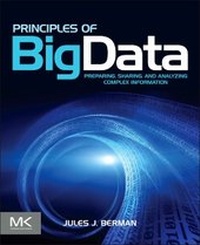
Principles of Big Data
Preparing, Sharing, and Analyzing Complex Information
Published on 4. July 2013
Book
Paperback/Softback
288 pages
978-0-12-404576-7 (ISBN)
Description
Principles of Big Data helps readers avoid the common mistakes that endanger all Big Data projects. By stressing simple, fundamental concepts, this book teaches readers how to organize large volumes of complex data, and how to achieve data permanence when the content of the data is constantly changing. General methods for data verification and validation, as specifically applied to Big Data resources, are stressed throughout the book. The book demonstrates how adept analysts can find relationships among data objects held in disparate Big Data resources, when the data objects are endowed with semantic support (i.e., organized in classes of uniquely identified data objects). Readers will learn how their data can be integrated with data from other resources, and how the data extracted from Big Data resources can be used for purposes beyond those imagined by the data creators.
Reviews / Votes
"By stressing simple, fundamental concepts, this book teaches readers how to organize large volumes of complex data, and how to achieve data permanence when the content of the data is constantly changing. General methods for data verification and validation, as specifically applied to Big Data resources, are stressed throughout the book." --ODBMS.org, March 2014"The book is written in a colloquial style and is full of anecdotes, quotations from famous people, and personal opinions." --ComputingReviews.com, February 2014
"The author has produced a sober, serious treatment of this emerging phenomenon, avoiding hype and gee-whiz cases in favor of concepts and mature advice. For example, the author offers ten distinctions between big data and small data, including such factors as goals, location, data structure, preparation, and longevity. This characterization provides much greater insight into the phenomenon than the standard 3V treatment (volume, velocity, and variety)." --ComputingReviews.com, October 2013
More details
Language
English
Place of publication
San Francisco
United States
Publishing group
Elsevier Science & Technology
Target group
Professional and scholarly
data managers, data analysts, statisticians
Dimensions
Height: 235 mm
Width: 191 mm
Weight
580 gr
ISBN-13
978-0-12-404576-7 (9780124045767)
Copyright in bibliographic data and cover images is held by Nielsen Book Services Limited or by the publishers or by their respective licensors: all rights reserved.
Schweitzer Classification
Other editions
New editions
Jules J. Berman
Principles and Practice of Big Data
Preparing, Sharing, and Analyzing Complex Information
Book
07/2018
2nd Edition
Academic Press
€78.50
Shipment within 15-20 days
Additional editions
E-Book
05/2013
Morgan Kaufmann
€49.95
Available for download
Person
Jules Berman holds two Bachelor of Science degrees from MIT (in Mathematics and in Earth and Planetary Sciences), a PhD from Temple University, and an MD from the University of Miami. He was a graduate researcher at the Fels Cancer Research Institute (Temple University) and at the American Health Foundation in Valhalla, New York. He completed his postdoctoral studies at the US National Institutes of Health, and his residency at the George Washington University Medical Center in Washington, DC. Dr. Berman served as Chief of anatomic pathology, surgical pathology, and cytopathology at the Veterans Administration Medical Center in Baltimore, Maryland, where he held joint appointments at the University of Maryland Medical Center and at the Johns Hopkins Medical Institutions. In 1998, he transferred to the US National Institutes of Health as a Medical Officer and as the Program Director for Pathology Informatics in the Cancer Diagnosis Program at the National Cancer Institute. Dr. Berman is a past President of the Association for Pathology Informatics and is the 2011 recipient of the Association's Lifetime Achievement Award. He is a listed author of more than 200 scientific publications and has written more than a dozen books in his three areas of expertise: informatics, computer programming, and pathology. Dr. Berman is currently a freelance writer.
Content
1. Big Data Moves to the Center of the Universe
2. Measurement
3. Annotation
4. Identification, De-identification, and Re-identification
5. Ontologies and Semantics: How information is endowed with meaning
6. Standards and their Versions
7. Legacy Data
8. Hypothesis Testing
9. Prediction
10. Software
11. Complexity
12. Vulnerabilities
13. Legalities
14. Social and Ethical Issues
2. Measurement
3. Annotation
4. Identification, De-identification, and Re-identification
5. Ontologies and Semantics: How information is endowed with meaning
6. Standards and their Versions
7. Legacy Data
8. Hypothesis Testing
9. Prediction
10. Software
11. Complexity
12. Vulnerabilities
13. Legalities
14. Social and Ethical Issues