

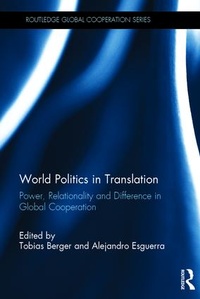
World Politics in Translation
Power, Relationality and Difference in Global Cooperation
1st Edition
Published on 21. September 2017
Book
Hardback
236 pages
978-1-138-63057-4 (ISBN)
Description
Virtually all pertinent issues that the world faces today - such as nuclear proliferation, climate change, the spread of infectious disease and economic globalization - imply objects that move. However, surprisingly little is known about how the actual objects of world politics are constituted, how they move and how they change while moving. This book addresses these questions through the concept of 'translation' - the simultaneous processes of object constitution, transportation and transformation. Translations occur when specific forms of knowledge about the environment, international human rights norms or water policies consolidate, travel and change.
World Politics in Translation conceptualizes 'translation' for International Relations by drawing on theoretical insights from Literary Studies, Postcolonial Scholarship and Science and Technology Studies. The individual chapters explore how the concept of translation opens new perspectives on development cooperation, the diffusion of norms and organizational templates, the performance in and of international organizations or the politics of international security governance.
This book constitutes an excellent resource for students and scholars in the fields of Politics, International Relations, Social Anthropology, Development Studies and Sociology. Combining empirically grounded case studies with methodological reflection and theoretical innovation, the book provides a powerful and productive introduction to world politics in translation.
The Open Access version of this book, available at http://www.taylorfrancis.com, has been made available under a Creative Commons Attribution-No Derivatives (CC-BY-ND) 4.0 license.
World Politics in Translation conceptualizes 'translation' for International Relations by drawing on theoretical insights from Literary Studies, Postcolonial Scholarship and Science and Technology Studies. The individual chapters explore how the concept of translation opens new perspectives on development cooperation, the diffusion of norms and organizational templates, the performance in and of international organizations or the politics of international security governance.
This book constitutes an excellent resource for students and scholars in the fields of Politics, International Relations, Social Anthropology, Development Studies and Sociology. Combining empirically grounded case studies with methodological reflection and theoretical innovation, the book provides a powerful and productive introduction to world politics in translation.
The Open Access version of this book, available at http://www.taylorfrancis.com, has been made available under a Creative Commons Attribution-No Derivatives (CC-BY-ND) 4.0 license.
Reviews / Votes
"Examining the potent role of seemingly mundane objects, instruments, and facts in global politics, this volume makes a key contribution to our understanding of power, expertise and practice in the contemporary world. In these pages, it becomes clear just how powerful the concept of translation can be - enabling the contributors to both map the various ways in which people, objects and ideas can move from one space into another, and to recognize the slippages and tensions that can result." - Jacqueline Best, Professor, School of Political Studies, University of Ottawa, CanadaMore details
Series
Language
English
Place of publication
London
United Kingdom
Publishing group
Taylor & Francis Ltd
Target group
College/higher education
Illustrations
4 s/w Abbildungen, 4 s/w Zeichnungen
4 Line drawings, black and white; 4 Illustrations, black and white
Dimensions
Height: 234 mm
Width: 156 mm
Weight
528 gr
ISBN-13
978-1-138-63057-4 (9781138630574)
Copyright in bibliographic data and cover images is held by Nielsen Book Services Limited or by the publishers or by their respective licensors: all rights reserved.
Schweitzer Classification
Other editions
Additional editions
Tobias Berger | Alejandro Esguerra
World Politics in Translation
Power, Relationality and Difference in Global Cooperation
Book
06/2019
1st Edition
Routledge
€64.36
Shipment within 15-20 days
Alejandro Esguerra
Translation in World Politics
Book
09/2017
Routledge
€126.28
Article exhausted; check different version
Tobias Berger | Alejandro Esguerra
World Politics in Translation
Power, Relationality and Difference in Global Cooperation
E-Book
09/2017
Routledge
€65.99
Available for download
Tobias Berger | Alejandro Esguerra
World Politics in Translation
Power, Relationality and Difference in Global Cooperation
E-Book
09/2017
Routledge
€65.99
Available for download
Persons
Tobias Berger is Assistant Professor of Transnational Politics of the Global South at the Freie Universitaet Berlin, Germany.
Alejandro Esguerra is a post-doctoral researcher at the University of Potsdam, Germany.
Alejandro Esguerra is a post-doctoral researcher at the University of Potsdam, Germany.
Content
Introduction: The Objects of Translation
Part I: Concepts
Good treason. Following actor-network theory to the realm of drug policy
The travelling concept of organized crime and the stabilization of securitized international cooperation: a translational reading
Part II: Instruments
Translating the glucometer - from "Western" markets to Uganda: of glucometer graveyards, missing testing strips and the difficulties of patient care
Rule of Law promotion in translation: Technologies of normative knowledge transfer in South Sudan's constitution making
Part III: Facts
What is wrong with the United Nations? Cynicism and the problem of translating the facts
Reflexivity, positionality and normativity in the ethnography of policy translation
Part IV: Projects
Europe in translation: Governance, integration, and the project
Translation and the challenges of supranational integration: the common grammar and its dissent
Part V: Expertise
Faithful translation? Shifting the boundaries of the religious and the secular in the global climate change debate
Translating for politico-epistemic authority. Comparing food safety agencies in Germany and in the UK
Conclusion: Power, Relationality, and Difference
Part I: Concepts
Good treason. Following actor-network theory to the realm of drug policy
The travelling concept of organized crime and the stabilization of securitized international cooperation: a translational reading
Part II: Instruments
Translating the glucometer - from "Western" markets to Uganda: of glucometer graveyards, missing testing strips and the difficulties of patient care
Rule of Law promotion in translation: Technologies of normative knowledge transfer in South Sudan's constitution making
Part III: Facts
What is wrong with the United Nations? Cynicism and the problem of translating the facts
Reflexivity, positionality and normativity in the ethnography of policy translation
Part IV: Projects
Europe in translation: Governance, integration, and the project
Translation and the challenges of supranational integration: the common grammar and its dissent
Part V: Expertise
Faithful translation? Shifting the boundaries of the religious and the secular in the global climate change debate
Translating for politico-epistemic authority. Comparing food safety agencies in Germany and in the UK
Conclusion: Power, Relationality, and Difference